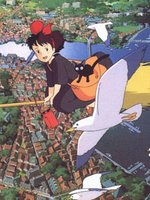
I’ve had occasion to watch three
Hayao Miyazaki films in the last week. I went to see
Howl’s Moving Castle at the cinema, and then I stumbled across the end of one of those festivals that
SBS often has where they showcase a film maker’s works over a few weeks. It truly was the end of the run, I only managed to see the last two films that were broadcast,
Kiki’s Delivery Service and
Spirited Away.
One of the things that struck me in Miyazaki’s films is the way his heroines laugh. It’s an open-mouth laugh, expressed without any self-consciousness. It has the high, thin timbre of a young girl’s voice and its duration extends just beyond what is comfortable. It is at once unsettling, belonging only to the animated form, and liberating, in its unabashed joy.
The laughter of Miyazaki’s heroines is the best way I can describe my reaction to the following observations:
It’s not my Baghdad.
I’m not sure if people in other Australian states have a similar version of the anti-terrorism advertisements that we’re getting in Queensland. After the London bombings the Queensland Transport Authority has placed stickers and posters on buses and trains, as well as on bus shelters and in train stations. The general thrust of the campaign is to recruit the public into surveillance mode, with an emphasis on identifying abandoned luggage, suggesting that a bag by itself makes no sense. In the context of Brisbane, this is not quite true; we don’t have the incidence of bag snatching that other places have, so it’s not that abnormal to leave your luggage in sight while you wander off to a vending machine.
The
print campaign is being complemented by television advertising and the observation that provoked me to laugh like a Miyazaki heroine was about one of these ads. A father and son are standing on a platform at Central Station in Brisbane when the train arrives. As they are getting on the train, the father points to an abandoned sports bag and says to the son, ‘Don’t forget your bag’. The son replies, ‘It’s not my bag, Dad’. Then the father casts a search glance around the platform before the voice over warns of the dangers of things that don’t make sense.
It’s all a little too Cold War and subliminal for me. After the initial, ‘What!’ and the ensuing Miyazaki heroine laughter, I thought, ‘Sheesh! What doesn’t make sense is that the father can’t identify his son’s luggage!’ But then, perhaps the kid is visiting his father for the weekend as dictated in the post-divorce custody settlement. I’m not suggesting that public awareness campaigns aren’t a good idea, but leave the sly aspersions against whole populaces out of it.
Even while I can critique these advertisements, I became aware the other day that they have been successful in evoking my fears about terrorism. I was going into a supermarket in the city and the turnstile at the entrance was blocked by four or five Asian people. They were quite absorbed in what appeared to be a debate about what to do with a large calico bag they had. In the end they left it at the side of the turnstile and went into the supermarket. My first thought was, why would you leave your bag there? Just take it in. Then a glimmer of the terrorism advertisements entered my consciousness. I thought about telling the group not to abandon their bag because someone might think they were planting a bomb. At that point, it occurred to me that the bag became a problem at the intersection of two discourses. (Yes, I do go around thinking this way.) Clearly, the group, whether tourists or international students, were law abiding. Entering the supermarket with a bag of groceries from another shop presented a problem for them: how would they be able to leave the shop without being accused of shop-lifting? Now, if they were belligerent anti-bag-checking shoppers like me, they would point to the brand and quality of their groceries and demand to know how anyone could mistake such a healthy bunch of coriander for the over-priced, slimy, emaciated stalks sold in supermarket chains everywhere. (May I say, I only arrived at this defensive position towards bag checking after a security guard made me the object of public humiliation as she individually passed my library books through the security scanners in order to determine which one had set off the alarm. Perhaps there was a tin of tomatoes sequestered in the pages?) But, no, they were respectful of the store’s security measures and duly disciplined into avoiding any possibility of accusation. And they had enough faith that their bag would be there when they returned. What they didn’t count on was that what was appropriate behaviour through the lens of supermarket security was potentially a cause for imprisonment—no questions asked—through the discourse of anti-terrorist measures.
Well, now I’ve strayed far away from anything resembling laughter, so I will move on...
The Future is Now
I went into the ANZ Bank in the Queen Street Mall in Brisbane on Friday. I am not a customer of the ANZ, but I thought it was about time I made a payment on the outstanding student loan that I’ve been avoiding. This time when the University sent me a quarterly statement, someone had taken the trouble to highlight in green the direction to make regular payments in order to avoid breaching my contract. Green highlighter means business, so I responded accordingly and went to make a direct debit into the account nominated by the University.
I’ve seen all the ANZ advertising, where the bank brags about its 5 consecutive titles as the Bank of the Year and extols the virtues of having solved the problem of customers waiting in queues, but I hadn’t experienced this banking utopia for myself. I walked into a hive of activity, first past rows of automatic tellers flanking both sides of the entrance hall, then past similar rows of desks behind which employees of the bank were very busy meeting with customers. I searched for the usual benches with their wads of withdrawal and deposit slips arranged to fill out with chained, rarely-working pens and only sighted one stand alone pedestal table. I made my way over to the table and began to fill out the deposit form. As I stood there, I became aware of several things. First, there was no place to put my loan reference number on the deposit slip, which would make my payment difficult to trace; then I noticed that several other people were straining to use the pedestal and serious infringements of my personal space were ensuing. Next, I noticed the bank’s solution to the queue dilemma was a ticketing system and the provision of chairs, creating the effect of an airport waiting lounge. (This airport aesthetic has taken over the world. Multiplex cinemas resemble the narrow interior of aeroplanes. Public spaces discourage loitering and encourage only movement from one purchase to the next. The shoppingtown was an early example of this architectural aesthetic, effectively eliminating the free public square, creating runways of consumerism. One of the University’s libraries is designed so that one keeps moving past the reference books of old to look for less grounded material in the atmosphere of cyberspace. And now the airport is at a bank near you.) At this point I think the designers of banks should revisit Sesame Street; remember how Ernie showed us that no matter how you arrange six cookies, it is still six cookies?
The Miyazaki heroine moment occurred at the next level of awareness, when I began to focus on the dulcet tones announcing which ticket holders should now approach the counter for service. Perhaps my reaction was influenced by the fact that I had just been to see
Serenity, but upon hearing that ingratiating, mellifluous and repetitive female voice I truly felt that I had entered onto the set of a science-fiction film and it was no utopia. I was reminded of the depiction of dystopias in every film from
Alphaville to
Blade Runner, right up to
Serenity, where screens beam advertising and propaganda to susceptible masses and expressionless, mechanised voices guide the population’s every move. Aaaagh!
Suffice to say, I didn’t make a loan repayment because I had to leave in order to preserve my individual autonomy. I’d prefer to queue at the University Cashier.
Johnny’s My Idol
The final Miyazaki heroine moment is in several parts, but the common element is the program
Inside Idol. That I watch this program, in addition to the performance and elimination shows, should convince you once and for all what an
Australian Idol devotee I am. This week
Inside Idol had breaking news on a couple of fronts. The first of these was
Marcia Hines’s admission to
Kyle Sandilands that she was unaware of the concept of unsightly tan lines or that anyone could or would apply fake tan to themselves. I loved this moment: strange, freakish white people! Has there ever been a show as popular in Australian history that decentres—however slightly—the norm of whiteness?
The second revelation was from
Mark Holden about the days he worked with David Hasselhoff. Mark recalled the time Johnny Depp and Kate Moss waited back stage at one of Hasselhoff’s concert with one of his CDs for an autograph.
*Laughing like a Miyazaki heroine*
What does this revelation of a somewhat dubious taste in music do for Johnny Depp’s credibility? I immediately sent a text message to Dr. H_____, the biggest Depp fan I know. Her response was, ‘See, Russell Crowe wouldn’t do that’. I’m not sure that’s anything against Russell. Actually her point was a reference to a previous conversation we’d had in which she said that Crowe took himself far too seriously. She can’t bear to watch anything with him in it, not even when I recommend it. (I told her he made me cry in
Cinderella Man and she scoffed, ‘Oh, he did not!’ He makes her cry as well, just not for the same reasons.) I have to agree though, that anyone who won’t appear on
Parkinson in accordance with the usual proceedings, demanding that he appear on stage by himself, does need to relax a little. Perhaps he needs an experience equivalent to that which Hasselhoff had this past week at the ARIAs. If ever a stunt was effective in popping a celebrity’s over-inflated ego, it was the actions of those young rapscallions
Ben Lee and
Missy Higgins when they accepted their
ARIA awards. After the embarrassment of
Gretel Killeen fawning all over Hasselhoff and telling him how handsome he looked in person—we’ll have to take your word for it Gretel—then, as Ben and Missy jumped on him (Ben going so far as to plant one on Hasselhoff’s lips), they effectively demonstrated the
respect that is due to the executive producer of
Bay Watch.
A Final ObservationI first wrote this in Word and it’s worth mentioning that when I first typed ‘Miyazaki’ no wriggly red spell-check line appeared beneath his name. Why is ‘Miyazaki’ in the Word dictionary, which can’t even cope with the addition of an ‘s’ on many words? I can only speculate that the programmers were either Miyazaki fans or they entered their own surnames into the dictionary. Hmmm.

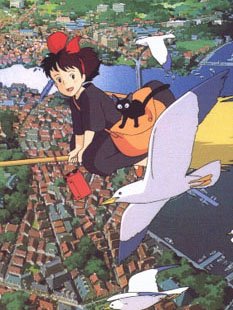 I’ve had occasion to watch three Hayao Miyazaki films in the last week. I went to see Howl’s Moving Castle at the cinema, and then I stumbled across the end of one of those festivals that SBS often has where they showcase a film maker’s works over a few weeks. It truly was the end of the run, I only managed to see the last two films that were broadcast, Kiki’s Delivery Service and Spirited Away.
 I found another place with regally cushioned booths and the requisite polished wood that had all the details of the high tea worked out for the plebeian class who were unsure of the minutiae of the ritual. We parted with enough money for the set fare and were served with a glass of champagne to settle in with, a necessity to toast the achievements of Dr H_____. Then the waiter arrived with the tiered stand that stretched so high we could only catch a glimpse of the delicacies on the top level. Dr H_____ eyed the uppermost tier and asked whether it was compulsory to start at the bottom level, which held asparagus and smoked salmon wrapped in soft brown bread and secured with toothpicks. While it’s true that part of the attraction of the high tea was its sanctioning of the consumption of multiple desserts, I thought that champagne would go better with asparagus and we should at least attempt to exercise some restraint. On the next level there were chicken mayonnaise ribbon sandwiches and individual quiches, which also go very nicely with wine of the sparkling variety. Did I mention that it was already 11.30 and neither of us had eaten breakfast in anticipation of this event? In such circumstances, champagne only travels in one direction, and that is straight to a teetotaller’s head. I still had a third of a glass of wine after I’d eaten my share of the savoury items and since I wanted to drink tea with the sweets that I couldn’t wait to eat, I swiftly drank the remainder of the glass. I wasn’t so bad, just a touch light-headed.
