Tuesday, April 24, 2007

Water

You have to imagine the title of this post being wailed in the plaintive tones of one Ms Polly Jean Harvey as she sings a song of the same name.

It isn't that the song has anything to do with Brisbane's water crisis but the level of desperation expressed is not dissimilar:


Now that's the kind of toilet humour I like. If you can read the fine print, you'll see that this is the cover of the first edition of a student journalists' magazine. With their careers ahead of them, surely the only way is up?

Sunday, April 15, 2007

Duck Soup

Last night I went to dinner at a posh restaurant. A friend, E., who started her Master’s when I did, organises to go out to dinner every time another friend of her’s returns to visit Brisbane from Sydney, where he now works. For three or four years now, once or twice a year, I find myself sitting at a table with a group of wonderfully witty and interesting people, ordering exquisite food, and relaxing into a really enjoyable evening.

On a couple of occasions we’ve visited a restaurant at West End called Mondo Organics. We returned there last night and we noted quite a few changes since our last visit. Aside from a bit of remodelling, it seems to have become a fully-fledged fine dining restaurant. Just before I stopped buying Gourmet Traveller regularly, I noticed that Mondo had begun to garner a few favourable mentions in various brief notes throughout the magazine, and once, if I recall correctly, there was even a full feature article about the restaurant and the vision of its owners. This was remarkable because it always seemed to me that, outside of an ongoing reverence for Philip Johnson’s E'cco Bistro* and the very occasional mention of Pier Nine or Cha Cha Char, Brisbane was a bit neglected by GT.

Mondo was always a very good restaurant to dine at because of their commitment to organic ingredients and the range of choices they offered vegans, vegetarians and allergy sufferers. It will be disappointing for some, if not surprising, to learn that with the change towards more traditional dining standards the attention afforded to those with specific dietary requirements has waned. While I have much sympathy for those who are no longer catered for by Mondo, I, personally, cannot say I was unhappy with the changes.

On some level I enjoyed being surprised by dining on food, the price of which would normally serve as a deterrent to entering an establishment in the first place. But there I was, my vegetarianism a distant memory, finally in receipt of my first payment for tutoring—it’s only 6 weeks into the semester!—embroiled in various debates about the relative merits or lack thereof of Pan’s Labyrinth, Pink, and the end of irony**—not necessarily in that order—and I decided I would have bread, dessert and wine, in addition to a main, and, for a change, not worry about anything.

The ciabatta style bread was accompanied by a fruity olive oil that was apparently a hundred years old. I wasn’t sure if that was the age of the trees the olives came from or the oil itself. Whatever, I could have sipped it like wine, it was so delicious. It made me wonder about the age of the sticky black balsamic vinegar that had some roasted garlic cloves marinating in it. One of my dining companions declared that she thought it must have been at least two hundred years old to even grace the same table as the aforementioned olive oil.


For my main, I chose the duck, the name of which I wish I could remember. It was effectively two cuts of duck cooked and presented in different ways on a rectangular plate. The first portion was a breast of duck sitting atop a fig concoction with some wilted spinach greens. The second portion was a leg of duck, this time perched on a small bed of parsnip mash. There were a couple of slivers of carrot that formed a visual bridge between the two preparations. In the spirit of not worrying, I agreed to the suggested wine accompaniment of a pinot noir. I made everybody sniff the wine because it just smelled so good in the enormous glass it was served in; but I gave no one a chance to get close to the duck.

The dessert was a revelation. Served on another rectangular plate, at one end was a mould of vanilla pannacotta , next a scoop of rose sorbet, topped with a shortbread like biscuit, and finally a small bunch of muscatels drenched in a syrup that partly reconstituted the dried fruit. I relented and offered tastes of this delectable combination to everyone, but I had to decline their offers of chocolate and other sorbet desserts because I just couldn’t bear to sully the subtlety of the pannacotta.

I finished the meal with an espresso, which I never drink, but it just seemed right at the time, even if I had to drink three more glasses of the never-ending supply of water the attentive waiting staff kept pouring, so I could cope with its strength.

After we got around to paying the bill there was still plenty of conversation to be had, so we adjourned to the sidewalk outside the restaurant where we chatted and laughed for another half an hour. Our party finally broke up for the evening after we had promised one another that we’d next meet at E'cco, or perhaps another fine dining establishment. I guess I’ll have to revisit Gourmet Traveller—just to see if they’ve been to Brisbane lately.


* Was it a coincidence that the year that E'cco Bistro won The Best Restaurant of the Year, an overseas-based judge, Rick Stein, who had little inkling of the hierarchy of Australian cities, made the final decision?

* *To say nothing of the intrigue aroused by the revelation of one of my dinner companions, who is soon getting married, that she has created a spreadsheet on which she has calculated the probability of attendance for every one of the guests she has invited to her wedding. Did I mention that at least half of the table was comprised of maths nerds?

Thursday, April 12, 2007

The Four Minute Shower

At the beginning of this week South East Queensland began Level 5 water restrictions in an effort to mete out the ever dwindling water supply. The water needs to last either until we receive a substantial amount of rain, which isn’t looking likely any time soon, or until the water recycling works project is completed, hopefully ahead of schedule. As even the most irreligious amongst us pray for one or both of these eventualities, we are, as a population, collectively coming to terms with the novelty of these most recent water saving measures. I say ‘novelty’ because apparently they had to make the restrictions up; no government in the history of the area has ever had to cope with this combination of long term drought and population growth before.

Since I’m not a gardener, or a car or pet owner, I’ll admit to not really absorbing the details of the restrictions that apply to the water usage associated with those lifestyle accoutrements. (Something about only being allowed to water or wash with teaspoon measures of grey water). While washers of dishes, of which I am one, seem not to have received any particular directive, those who partake of regular showers, of which I am also one, have been appealed to on a nostalgic level: ‘Bring back the 4 minute shower’ is the new catch phrase. I am clearly far too young to have ever heard of ‘the four minute shower’—was it part of the home front effort for the Second World War? Viet Nam?


Nevertheless, I have found myself in a surprising state of readiness to take up this challenge from the SEQ Water Commission. Ever since I became enamoured of the star-shaped shower timers for sale at an eco shop up the road from me, I have been in training for the eventuality of ‘the [mandatory] four minute shower’. I have been flexing my four minute shower taking muscles and I’m working towards becoming a gold medal contender in the four minute shower taking stakes.

At present I am being hindered in attaining my goal due to difficulties encountered in the first stretch of the four minute shower. This is the time during the four minute shower that the water from the hot water tap takes to become hot. I have calculated that at least 20-30 valuable seconds worth of precious water is lost, for no exchange value in terms of cleaning myself, while I make the necessary adjustments to the temperature of the four minute shower.

If I was a gardener I would harness the water lost during this period of the four minute shower into a bucket for irrigating the garden. I do recall there was an invention on The New Inventors that solved the problem of this wasted water, but since I’m in rental accommodation I don’t like my chances of getting the lessor to install any water saving devices. (At this point I should probably not mention my terribly unsound shower head). I am working on solutions that might mitigate this loss of water. Perhaps if I purchase a clean bucket, especially for this purpose, I can tip it into my water filter? I’d have to be careful not to pollute the bucket with soap, lest my pasta begin to taste of suds.

Another hurdle to the timely four minute shower is the need to wash my hair. On the occasions when I have to wash my hair—every two days, since there’s masses of it—I have generally found that I have to reset the four minute shower timer, and I often take another minute or so. I am slowly getting better at this, but meanwhile, I have worked out a kind of exchange system whereby when I have a regular shower I try to be finished before the sand in the timer runs out. In this way, I can accrue shower time to use on those days when, for whatever reason, I exceed the four minute mark.

The four minute shower has been quite a challenge for me. Previously, I have liked to daydream in the shower, or just stand there for what must have been five minutes at a time with the water massaging my scalp and shoulders. But there is no time for dreaming of massages in the four minute shower. None at all. It’s all business. From the moment the water temperature is right, it’s a sprint to the end:

Shower gel. Check. Loofah. Check. Hands. Arms. Underarms. Feet. Calves. Thighs. Torso. Front. Back. Quick. Scrub away dead old skin cells and sweat. Face wash. Check. Forehead. Neck. Décolletage. Plunge my head under the stream of water. It can’t matter if it’s too hot for your face. Must get rid of the soap. Quickly. Taps off! Phew.

Aargh! Still only a silver medal performance.

Monday, April 09, 2007

What Einstein Told the Easter Bunny

When I was in year 12, I wanted to be a food technologist. I even got as far as nominating a degree on my university application forms that would have secured the first step in my pursuit of that profession. Then the forms came back, asking for confirmation of my choice, and I changed my mind. At the time I was unsure about my ability to do four years of chemistry.

Recently, I have come to recognise that during my high school years I drew the meagre sense of self-esteem I had from my teachers and any praise they meted out. While not wanting to blame my chemistry teacher for my lack of application in her subject, I do recall how devastated I was the day, early in our acquaintance, when she laughed off her mispronunciation of my name, with ‘You don’t mind, do you?’ Rightly or not, something within me was permanently altered from that moment on, and I never fully engaged with chemistry again.

In contrast, I had known my English teacher since my first year of high school. She had been my form teacher and my maths teacher in year 8. In year 9 a new school opened up closer to my home, so I went there, but in year 10, Ms W. transferred to the new school and she taught me English for the next three years.

It was she who first told me I was intelligent—in class, in front of everybody. From her I learned that my eyes were blue. In the middle of a maths lesson, where eye colour was being put to use in the service of a maths problem, she said ‘Kirsty, your eyes are blue, aren’t they?’ It might sound strange, since I now know that my eyes are especially blue, but until that point, it was something that I hadn’t known. I had been convinced by a comment from my mother that they weren’t any particular colour; that they were sort of non-descript.

I joined the debating team, solely because Ms W. was the co-ordinator. The team used to go over to her place, where her husband, who was my biology teacher, would serve us cordial and biscuits. After watching Kramer vs. Kramer in English, when it was apparent that everyone else in the class was convinced that the Dustin Hoffman and Meryl Streep characters would reunite, Ms W. asked what I thought. She knew that I would have a different perspective.

So, when it came to making, what seemed then to be an irreversible and permanently life-altering decision about what to do for a living, I decided to pursue a course in an area where I had received the most encouragement, and therefore had been the most successful. I left any thought of pursuing my interest in science behind.

It’s really only recently, via my interest in food and cooking—I also did home economics to senior level—that I find my interest in the science of food once again piqued.

For Christmas I received a voucher from Borders and I was able to get a book that I’d been looking at longingly for at least three years. What Einstein Told His Cook, by Robert L. Wolke promises ‘Kitchen Science Explained’. And so it does. When Morgan Spurlock asked people on the street what a calorie was for his documentary Supersize Me that was screened on Channel Ten a couple of weeks ago, I knew the answer, courtesy of Einstein’s mutterings. When I caught a repeat of Mythbusters on SBS over the weekend that sought to demystify the many urban myths around microwaves, I had already read with much interest Wolke’s chapter, dedicated to ‘Those Mysterious Microwaves’. I read the book too late to answer Laura’s question about sulphured molasses, but I’ve found it a wonderful complement to another repeated SBS programme that I missed the first time around, Sweet Paradise.

Sweet Paradise is a Canadian-produced documentary series about the history of sweets. Because of its Canadian origins, there’s a focus in the series on maple sugar that isn’t proportionate to its broader use in the history of sweets on a global scale, but still the sections on maple are interesting because of its novelty as a sugar and for its unique production process. Maple sugar aside, the history of other sugars and chocolate have been a bit of an eye opener. I don’t know why I hadn’t reflected on it before, but of course both the cultivation of sugar cane and the cacao bean have been an integral part of colonialism with slaves being coerced into the production of the sugar and chocolate destined for the exclusive tables of the European courts.

The series details various shifts in the history of sweets, from their initial ceremonial and medicinal uses to the royal edicts that transformed them into a source of inexpensive pleasure for everyone. Learning of the struggles between confectionary empires—Nestle, Lindt, Hershey, Mars, Cadbury—has also been fascinating. Why do we associate chocolate most readily with Switzerland when Spain was the first European country to know about chocolate? It was the Swiss who first thought to add milk to chocolate. Genius.

The connection between Sweet Paradise and What Einstein Told His Cook is most evident in the exploration of the various kinds of sugar, and the multiple products sourced from cocoa, including their discovery and development.

The murky origins of the jellybean have me intrigued, but so too does the apparent skill required to produce this common sweet just so. Of all the innovations in sweet making, I keep thinking that they are likely attributable to a food technologist, or a precursor of that profession.
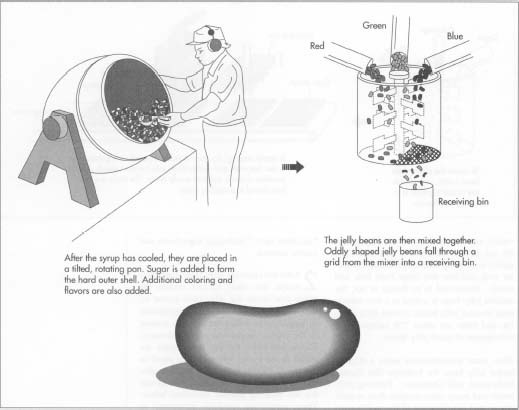


Have I missed my calling, I wonder? I don’t know. Although, I did find out years later that on the strength of my teenage career musings, a school friend, who moved away in my senior year, did go on to become a food technologist. Sweet.

Happy Easter!

Thursday, April 05, 2007

Alarmed

So, I finally presented the real estate agent with three Form 11s, also known as a Notice to Remedy Breach, because, really, how long is one expected to go without a properly functioning stove, a key to the laundry door, and a recycling bin?

I asked them nicely about the first for a year and the second two for a couple of months. I telephoned. I sent them emails. I said I was going to send them a Form 11.

In response to the Form 11 threat they sent a fellow around early last week to assess the stove. First I got a call from an electrician. I left it to him to tell the agent I had a gas stove.

The gas man confirmed exactly what the last fellow they sent around a year ago told me, that the grill needs replacing as does the ignition switch for the oven. He said he was off to get parts and would be back as soon as possible. Four hours later, I had to go and teach, and now, ten days later, despite repeated requests to the agent to find out what is happening, none of my phone calls have been returned and I still have no clue as to whether the stove will be fixed.


Let’s hope it doesn’t burst into a ball of fire before they get around to putting in the compulsory smoke alarms.