Showing posts with label Books. Show all posts

Wednesday, March 31, 2010

Hello

Hey. It's been a slow old start to this blog this year hasn't it? Although I'm not sure I can lay claim to starting anything quite yet...

I've been meaning to drop in for a while, but yeah, things were a bit much at the end of last year and I really did take January and much of February to just get back on an even keel.
Extra medication helped. Sitting my friend's cat while she's overseas has helped. The start of the semester and gainful employment and an income has made things better too.

I won't attempt to fill you in on everything that's happened since I last posted--if you're really interested, I continued to capture the incessant minutiae of my existence on Twitter. I was just reminded tonight, when I attended a new book club that I've joined, that I never really intended to stop blogging.

At the book group we discussed Julie & Julia, the book, but also, inevitably, the film, and then we talked about bone marrow and artichokes and aspic and the apparent pleasures of vivisecting, if not killing lobsters and then, eventually, blogging.

So here I am, reminded of my blog. Hello.

Sunday, August 09, 2009

I Don't Know


What's philosophy for do you reckon?

I'm asking this because it's about an hour and a half before I go off to my book group where we're reading Alain de Botton's The Consolations of Philosophy. And a little while ago, when I was looking for a link to information about the book for the 'Book Clubs' column in the margins of this blog, I came across its Wikipedia entry, which is little more than a collection of bad reviews that effectively declare that Botton's work is not philosophy.

Panel from Cham, J. 'Nature vs. Science, pt. 4' PhD Comics 5/8/2009

The criticism quoted seems to rely entirely on the usual boring old prejudices that because something is popular, or aimed at a popular audience, then it is somehow devoid of any value. There's an extract from one Mary Margaret McCabe that I take particular exception to:
the latest attempt to popularize philosophy [De Botton's The Consolations of Philosophy] - that is to say, to make philosophy into televisual fodder - does so precisely on the basis that philosophers can provide us with useful tips...
Ah, yes, how intellectually rigourous: something appears on television ergo it is debased. Still, I doubt Socrates would sanction this line of reasoning.

Before I continue let me just say that I have some sympathy with Messrs McCabe et al. It can be incredibly frustrating, if you spend your days revelling in the wonder of a subject you love, appreciating all of its joys, its contradictions and complexities, to then witness its apparent evisceration at the hands of someone who doesn't seem to have taken the time to understand those joys, contradictions and complexities, let alone communicate them as they purport to do.

Again to be fair to Messrs McCabe et al. perhaps they did say something more in their reviews of Consolations other than 'It's not philosophy'. I wish I had more time right now to find that out. I hope that in their reviews they would give me more of an idea of their understanding of what philosophy is and how that is different to Botton's. And yes, however Utilitarian, I also want to know 'What is philosophy for'?

I think, despite my years of study, I probably have a fairly lay conception of philosophy as a field of inquiry. I've used the writings of theorists (are they philosophers?), who are concerned with how we live, in my academic degrees. So this is my understanding of philosophy: that it is concerned with the matter of how we live and all the questions that are associated with that. As to what it is for, then I think it's for figuring out how to live.

What do you think? Or perhaps you know?

Wednesday, July 15, 2009

Three True Things I Have Recently Read

1. "Have you noticed how people talk about 'people', people do this, people do that,'without seeming to realise that they are a person too?" Emily Perkins, Novel About My Wife, p 208

2. "Her disapproval about such things, about the lifeline I found for myself, hurts me. But it's her ignorance that's making me angry. ... 'How dare you judge me? You're just like everyone else, disapproving of the fact that I'm obsessive then disapproving of the way I tried to pull myself out of it. Everyone's a fucking expert. ... Sometimes there's nothing else you can do. Those drugs don't make you well--Jesus, they don't even make you feel better--but they turn off the static. The noise,the interference, the shit in your head that keeps you from understanding you are destroying yourself.'
'You're smart,' Ruby says, looking at me anxiously because she knows I'm upset but she wants to stand her ground. 'You would have figured things out.'
'If we are going to be friends I need you tounderstand this. I'm smart but I could not figure things out. Could not." Sophie Cunningham, Geography, p200

3. "'You have no idea how tedious and unremarkable madness can be.'" Sophie Cunningham, Geography, p201

Saturday, January 31, 2009

Neverwhere

I've just finished reading Neverwhere by Neil Gaiman. I don't know if I've mentioned before that I'm not especially into fantasy as a novel genre, so this is the first of his work that I've read.

I do know a few people who like Neil Gaiman, so I had heard of him before in a favourable way. It's because of these recommendations that I was glad of the opportunity to read his work when it was proposed by one of the people in the book club; I probably wouldn't have sought it out otherwise.

Anyway, I'm not really going to say much about it here except that I liked it. I'll save my discussion for book club or in the comments below (especially if you have some insights that I can use at the book club).

I really just wanted to link to the television adaptation of Neverwhere that someone has stuck up on YouTube. I've just watched the first installment and again I'm reminded that while I'm not especially keen on fantasy in novel form, I rather like it on television.


I suppose this means that, for me, fantasy is more suited to the televisual form. It must be all those special fx that I like.

Wednesday, December 17, 2008

The Other Red Meat

While I was in Melbourne I went to a bookshop I had only previously read about: Books for Cooks. Ever since I first read about this shop on Gertrude Street, Fitzroy, I have known that I could while away an entire day there, perhaps a week if I had nothing else to do. I didn't spend quite that long there, but I did fulfill the other expectations I had for my behaviour: I ran from bookshelf to bookshelf, picking up one book, followed by another, and another, before finally having to sit down, wipe the drool from my chin, and have a deep think about the merits of the books I wanted relative to my budget.

I'll talk about the whole heady experience in more depth when I finally get around to completing the promised Melbourne posts, but for now let me tell you what I'm cooking for dinner tonight. Seasoned Chopped Beef (Picadillo) is a recipe from one of the books I bought at Books for Cooks, The New Complete Book of Mexican Cooking by Elisabeth Lambert Ortiz. It's the filling for Minced Beef Tacos (Taco de Picadillo) I'll be eating.

Ortiz instructs you to use half of the following recipe for Picadillo:

Brown 900g of minced lean beef in a large frying pan. I used that other red meat, kangaroo, because I can't really bring myself to buy beef at the supermarket anymore. I'll eat beef when I'm out, but between what I have access to and what I can afford, kangaroo is a more ethical, environmental, and cost-effective choice for me. Add 2 finely chopped onions and 1 clove of garlic, also chopped. When these are cooked add the following: 2 green cooking apples, peeled, cored and chopped; 450g tomatoes, peeled, seeded and chopped--I made half the recipe and just added a drained tin of tomatoes here; 3 tinned or fresh jalapeno chillies, seeded and chopped--again I went for the tinned; 1/2 cup of seedless raisins; 12 pimiento-stuffed olives, halved--I only had jalapeno stuffed olives, but I figured they weren't out of place in this recipe; 1/4 tsp each of ground cinnamon and cloves--I just threw in a whole clove that I accidentally crunched on later; and finally, salt and pepper to taste.


Simmer over a low heat for 20mins. When this is done you can sprinkle it with 1/4 cup of slivered almonds that you've fried in a bit of oil--I missed this touch since I didn't have any slivered almonds and didn't feel like the trouble of blanching, chopping and frying regular almonds. I'd bother if someone other than me was eating this.

So that's the filling for the tacos.

The Tacos de Picadillo are just a matter of assembly. I used some small, soft tortillas and filled them with the Picadillo, added some Salsa Verde Mexicana Picante, and some shredded ice-berg lettuce that came in this week's organic fruit and vege box. Ortiz recommends guacamole as well, but as I didn't have any avocado, I substituted with some Greek yoghurt--I didn't have any sour cream either.


I should mention that while the recipe book has recipes for both tortillas and the salsa verde I went for the pre-made and tinned varieties. I don't think I'll be too hard on myself for not making tortillas from scratch. As for the salsa verde, it's a case of lack of availability of the key ingredient, tomatillo, the green tomatoes that seem to be used extensively in Mexican cooking. The closest I could find to this ingredient in my, admittedly, rather short search was an enormous tin of them, as big as those Golden Circle juice tins. On that shopping expedition, I went for the much smaller tin of ready made salsa. It seems to be quite simple, consisting of the tomatilloes, serrano chillies, onions, and coriander, to comprise a rather refreshing sauce.

Overall, I found this to be a really tasty meal. I hope I haven't come across as too flaky in my lack of purity about all the substitutions. I used to be really up tight about such things, but ever since the woman at the Indian Grocers advised me that 'you cook with what you have', I've felt a whole lot freer about making substitutions. Maybe what's worrying me is that I used tinned things instead of fresh, but again, needs must.

When I first flicked through the book in Books for Cooks, I thought that the ingredients would be a bit more accessible than they've proved to be so far. Much of my decision to get the book was based upon the use of pineapple and banana and other sub-tropical ingredients readily available in South East Queensland. I was intrigued by the use of fruit throughout--and perhaps it's no surprise that I've since learnt that the used of fruit derives from the Spanish influence on Mexican cuisine via the Moorish influence on Spanish cuisine. Here I like to think that my use of kangaroo adds an Australian influence to Mexican cuisine.

Another reason I bought the book was because there's a fellow post-graduate at uni who is Mexican, and on the subject of Mexican food in Brisbane, Australia even, she is dismissive. 'Tex-Mex' she sniffs when people ask her about Mexican food in restaurants. Her response has long piqued my curiosity because it made me aware that of course all I know of Mexican food is Tex-Mex, exemplified by the 'Mexican' section in the supermarket that consists entirely of Old El Paso products.

I guess at the moment I'm sort of stuck between wanting to know more about Mexican food and being faced with the trouble of getting the ingredients. I don't think I'm ready to give up just yet, because clearly there's a whole lot more to know--about all the varieties of chilli alone. First, I'll be a bit more concerted in my efforts to find suppliers in Brisbane or who deliver to Brisbane.

Tuesday, July 15, 2008

Recent Shocking Deaths

Warning. Spoilers ahead for Suite Francaise by Irene Nemirovsky and the first season of the BBC/HBO series Rome.

The book club I'm in discussed Suite Francaise by Irene Nemirovsky at the last meeting. I was still reading, so hadn't yet happened upon this scene towards the end of the first part 'Storm in June'.

Father Phillipe Pericand is a young Catholic Priest charged with escorting a group of orphans out of Paris to the countryside on the eve of the German occupation of France in WWII. They have stopped for the night to camp in a field. Nearby is a grand looking house, about which some of the older boys avaricely express some curiosity. Phillipe tries to dissuade them from breaking in, but during the night they take matters into their own hands.

The moon lit up the front of the house. One of the boys was pushing the shutter, forcing it open. Before Philippe could shout at them to stop, a stone shattered inside the window and there was a rain of glass. The boys as lithe as cats, leapt inside.

...

'What are you doing here?' said the priest.
He heard a noise behind him and turned round; another boy was in the room, standing right behind him; he too was about seventeen or eighteen. He had thin, contemptuous lips and his yellowish face looked wild, as if he were possessed.

...

Philippe would have proven the stronger in spite of everything but they hit him on the head with a pedestal table with bronze legs; he fell down and as he fell he heard one of the boys run to the window and whistle. He saw nothing else: not the twenty-eight teenagers suddenly waking up, running across the lawn, climbing through the window; not the rush towards the delicate furniture that was being ripped apart and thrown out on to the grass.

...

They felt a terrifying kind of joy. Dragging Philippe by the feet, they threw him out of the window, so he fell heavily onto the lawn. At the edge of the lake, they swung him like a bundle.

...

Finally he raised both arms, put them in front of his face, and the boys saw him sink straight down, in his black cassock. He hadn't drowned: he'd got trapped in the mud. And that was how he died, in water up to his waist, head thrown back, one eye gouged out by a stone.

It's probably not too much of a spoiler to report on the death of Julius Caesar in Rome:


What distinguishes this particular depiction of Julius Caesar's murder by the senate, however is the way that in the BBC/HBO production it's intercut with the death of a Roman woman, Niobe. Niobe is the wife of Vorenus, formerly a soldier in Caesar's army and whom Caesar has since appointed a senator.

The importance of this distinction is commented upon in another YouTube video that takes issue with the editing of the above scene of Caesar's murder:


Watching these scenes as they were originally juxtaposed, I thought about some comments made in a paper delivered by Georgina Born in response to Frederic Jameson's charge that historical dramas were little more than an exercise in nostalgia. Born countered that in fact contemporary interpretations of historical texts offer insights into contemporary issues and values. I forget which particular BBC adaptation Born referred to, but I do recall she showed a particularly dark scene of what was effectively domestic violence. It may well not have been construed in those terms when the original novel was published, however, it is that interpretation which was invited by the BBC adaptation.

In Rome then, the witnessing of Caesar's death alongside that of Niobe, is a contemporary questioning of the prominence that has been historically afforded the lives and deaths of Great Men to the detriment of those of women in the same societies. I think it's important too that Vorenus is a character whom we are invited to admire: we think of him as an extraordinarily ethical man, who has struggled with his conscience on many occasions as he has risen through the ranks of society. On this occasion, Niobe's death is a tragedy much greater than Caesar's because it is an indirect and unintended consequence of a questionable war.

Contemporary resonances indeed.

Saturday, April 26, 2008

Book Club

Book club met today. We went to a cafe for breakfast and to discuss The Road by Cormac McCarthy. I was the only one who had read it, but that's okay, I didn't read the book for our last meeting, or the one before that, and maybe even the one before that.

We still managed to talk about the general themes. I might have dominated the conversation. Someone else had seen the Coen brothers' adaptation of No Country for Old Men, so we discussed that too.

I watched Oprah's interview with McCarthy on YouTube when I had not long finished reading The Road.


I was impressed by his quiet presence. I liked the way he held himself: laconic, refusing to be 'passionate', content to just like doing what he does.

There's not much that I can add to the plethora of reviews out there. Yes, it's harrowing.

Next, I planned to read something a bit less so. Shop Girl, maybe. I picked it up at a 2nd hand book store. And I watched the film on TV last night. But I've found myself picking up William Faulkner's Absalom, Absalom! I got that in the same haul at the 2nd hand bookshop.

I laughed when I read the first sentence. If McCarthy's prose is taciturn, then Faulkner's is not.

In the middle of reading The Road I stumbled into an arcade in the Valley and came across a photography exhibition by Simon Obarzanek, 80 Faces. I learned that he's a Melbourne-based photographer, but, still mired in the damaged vision of America, I imagined that these might be the faces that haunted McCarthy's wasted landscape.


The next book for this book club is Georges Perec's Life: A User's Manual. It's a book I've started before and not finished.

I'm meeting up with some other friends and we're going to have a Gothic-themed book club. The Monk by Mathew Lewis will be our first read. I've started that too.

80 Faces reminded me that I've wanted to write something about the art of portraiture for some time now. It was an impulse first prompted by seeing Zidane: A 21st Century Portrait.


And I was reminded of it when Brisbane was treated to the recent Andy Warhol exhibition.


But I'm yet to get over my own navel-gazing inertia.

Saturday, December 08, 2007

Coincidence?

Is Borders stalking me? In view of my last two posts, what do you think?

Thursday, December 06, 2007

Post-Holiday Blogging: Book Meme

I'm back in Brisbane after my two week holiday in Melbourne. I thought I'd get a chance to do a bit more blogging during the second week and so make 'Holiday Blogging' a two-part post, but things didn't conspire that way--there were too many cakes to be eaten and too many art galleries to visit--so I've had to resort to 'Post-Holiday Blogging' for the remainder of the book meme.

A point of interest you might like to note is that between this post and the previous one, I've had the pleasure of meeting Oanh, who tagged me with this meme, IRL . There was a small window of opportunity for us to get together after I returned from Melbourne and before Oanh left Brisbane, went to the Gold Coast and returned to the UK. We arranged our meeting via the chat function on Scrabulous--as all the cool kids are doing these days--and miraculously we managed to find one another, in spite of my suggestion to meet at a cafe that was closed on Mondays. Luckily Oanh knows West End a lot better than I do, so we easily found another place to sit and acquaint ourselves.

We talked of many things, and of course, one of those was our respective reading groups. I think book clubs all around the world are a front for various other activities--not quite in the subversive tradition of the quilting circle--but still it functions as a reminder to get together with friends and talk outside of the rush of everyday activities.

In a roundabout way that brings me back to the remainder of the book meme:

4.The author (alive or deceased) I would love to have lunch with would be…

Oh, so difficult. Jeanette Winterson would be good to have lunch with because the food would be good and organic, and while I haven't read much of her in recent years, I would swat up before we met purely on the basis of her first 4 or 5 novels.

If the food at the lunch was the primary purpose for meeting at that time of day--and clearly for me it is--I rather think I'd like to sit down with Maggie Beer to drink champagne and eat quinces, artichokes and kangaroo, all the while talking about cooking and eating.

I'd rather like to meet the television writer Tom Fontana. He's responsible for Homicide, Life on the Streets and Oz. Homicide is one of my all time favourite television programmes.

5.If I was going to a deserted island and could only bring one book, except for the SAS survival guide, it would be…

This might be the only way I'll ever finish Don Quixote so I'd take that.

6.I would love someone to invent a bookish gadget that…

I think I'd just like a ribbon in every book. A built in book mark so bent pages are a thing of the past.

On that note, one thing that always annoys me when I borrow books from University libraries is the way people feel no compunction about desecrating communal books with tawdry fluorescent highlighter pens. So arrogant to assume that your notation of the important passages of a book will be the definitive interpretation of the book in question. Or perhaps just completely self-centred. So, for me a welcome bookish gadget would be something that rendered highlighting with fluorescent pens either impermanent, removable or impossible. On the last, the delivery of a short, sharp shock to any wielder of a fluorescent highlighter would be a welcome first step.


7.The smell of an old book reminds me of…

I don't like the smell of old books. It's the thing that puts me off Lifeline book sales. Yellowing, curling, lice-infested Penguins, endlessly recycled by unappreciative school students, who nevertheless insist on inscribing their names and form classes in misshapen Texta letters on the title pages of The Great Gatsby, To Kill a Mocking Bird, The Harp in the South...

8.If I could be the lead character in a book (mention the title), it would be…

I always wanted to be Pippi Longstocking, she seemed to have a rather excellent life wearing crazy outfits and looking through a telescope out to the ocean.

9.The most overestimated book of all time is…

I want to say On the Road, but I didn't get past the first few pages of it, reading it as I did with a feminist sensibility well after the use-by date of its Beat movement-libertarian moment. I think if I'm really going to condemn a book then I should have read it, so from the same cultural moment as On the Road, I'll nominate One Flew Over the Cuckoo's Nest for its romantic view of America's indigenous people in the figure of the Chief, its alignment of women with civilization and oppression in the figure of Nurse Ratchett, and its glorification of same old, same old, white male individualism.

10. I hate it when a book…

Hmm, what could a book do that would evoke a feeling of hatred within me? I'm stuck. Perhaps I'll poach from above: ...has fluorescent highlighter all over it!

I can't quite remember how many people I'm supposed to tag with this meme. I might just tag Ariel, since she expressed an interest in the meme via the comments on the first installment. The usual open invitation applies to anyone who's similarly interested.

Friday, November 23, 2007

Holiday Blogging: Book Meme

All of the swing dancers are asleep at dogpossum's house at the moment.  They went out to some crazy hour of the morning to do Lindy Hop at the Spiegeltent, while I stayed back to play Scrabulous, eat BBQ left-overs, watch DVDs and drink red wine.  I also spent some of my time browsing dogpossum's bookshelves, something I've been doing the last few days before retiring after days jam-packed with visiting a good selection of Melbourne's food places, from supermarkets to restaurants and bakeries.  On one such outing I also found myself in Readings on Lygon Street where I bought a cd and a book for myself, and a few bits and bobs for other people.  

(If you're reading this blog on an RSS feed, none of this holiday-in-Melbourne talk will necessarily make sense to you, but if you want a quick update then click through to view the micro-blogging Twitter updates in the side-bar).

Anyway, all of this book browsing put me in mind that I'd been tagged for a book meme. I've had the first question in my head for some time, because, well, I didn't really know the answer but, it's slowly come to me, so I'll have a go at answering the rest too.   

1. Hardcover or Paperback, and Why?

Hardback.  I think this is because I'm a bit of a book fetishist. I love them as objects, in and of themselves.  The answer to this question first began to dawn on me when I saw Maggie's Harvest in a bookshop.  If you don't know, it's a collection of recipes by Maggie Beer, a celebrated Australian cook and food writer.  She also co-presents The Cook and the Chef on ABC Television with Simon Bryant.  It's simply beautiful. It has a padded, embroidered cover and two ribbon bookmarkers, two!  It occurs to me that I also like it when books have ribbon markers; these are especially handy in cook books, but I'll take them in any genre of book.

I have a small collection of hardcover books that are all food-related.  I do like them a lot.  In this context I think I prefer the hardcover because they are for keeping.

2. If I were to own a bookshop, I would call it...

There's a bookshop in Brisbane called Bottom Books, which I've  always thought would be an excellent name for a British television comedy, sort of a cross between Bottom and Black Books.  Here, I think my preference for stories told on television is rearing its less acceptable head.  

If  I were to own a bookshop it would likely stock books about television and food. There'd be comics and graphic novels too.  I'd be right at home with the trend towards selling DVDs and CDs in such establishments.  I still like the traditional novel though, but maybe I'd only sell hardbacks or those that passed the sensibilities of my aesthetic radar. (No-one said this bookshop had to make a profit!)

How does 'Beautiful Words' strike you?


3. My favourite quote from a book (mention the title) is...

Hmmm.  I don't have my books with me, so I might have to defer on the actual quote.  Perhaps, for the moment, I can just muse on books whose sense of language has stayed with me.  

When I read Trainspotting, I began to speak with a Scottish accent: 'Ah dinnae ken'.

Surely, I'll want to nominate something from the works of Roddy Doyle? 'Paddy Clarke has no da!'

When I read Milan Kundera and Paul Auster,  I'm always struck by the way their prose triggers my thought processes.

The quote by Dostoyevsky, that's the raison d'etre of this blog, continues to strike a chord in me.  It's about the imperative of remaining uncertain, and that succinctly expresses my life philosophy.

(I'm really aware that all of those authors are European or North American men. I don't think that can be good?)

***
There are more questions, so this is to be continued...

Wednesday, June 20, 2007

Clubbing

I’m going to another book club meeting this weekend. Did I mention that last time I went, no one but me had read the book? Everyone looked at me pityingly and one person actually said that I clearly hadn’t worked out that the book club was a front for drinking wine and gossiping. Oh.

Well, I have nothing against imbibing alcohol and dishing dirt so I relaxed and joined right in…

To be fair, I had already read the book at the time when it was first proposed—in fact it was my suggestion to read it—and everyone else had experienced some difficulty getting it from the library, so there were circumstances beyond people’s control. Anyway, I had only briefly revisited the book in anticipation of the discussion, so perhaps, on this occasion, I needed a bit more time too.

You see, in this new book club-going endeavour, I had found myself in the all too rare position, in my life, of actually being ahead of the game. I had already completed the task at hand—reading White Earth by Andrew McGahan—and so in an effort to maintain my enjoyment of this unusual state of being I began to read the next proposed book, The Line of Beauty by Alan Hollinghurst.

I’ve finished that now too, and I’ve started reading another of the upcoming books, The Time Traveler’s Wife by Audrey Niffenegger. I wonder whether I should stop reading the Niffenegger to re-read the McGahan lest I forget the finer details of that by the time this book club gets around to discussing it? As it is, I feel I will have to take some notes about The Line of Beauty.

I have decided to make a concerted effort to work on my memory for books since I know this is part of the art of reading well that I have never fully mastered, but, meanwhile, I hope you will indulge me by allowing me to jot a few thoughts down here about the Hollinghurst.


During the period that I was reading The Line of Beauty I woke up in the middle of the night with an overwhelming feeling of inadequacy. The timing did coincide with the day I set up my new desk in the Forgan Smith Tower, but in the middle of the night, sitting up, consumed with worry, it dawned on me that I was channelling Nick Guest, the central character of Hollinghurst’s novel.

Nick is a lodger in his old Oxford friend, Toby’s family home in Notting Hill. Toby’s father is an MP in Thatcher’s government and so Nick, the son of an antique furniture dealer is afforded an entry into high society. The back cover of the book suggests that Nick relishes this position since it allows him to experience the kinds of beautiful things that power and money can, respectively, attract and buy, everything from lovers, to cars and employment.

I’m not sure I got a sense that Nick was enjoying himself so much—perhaps sporadically, superficially. It all felt unutterably sad to me; while Nick was a reliable source of information for his landlords and their social circle about the objects of beauty to which he had nominal access, he was effectively unable to enter into reciprocal relationships with Toby’s family and their friends. Nick longs for love and it seems no-one in his adopted family, and not even his two lovers, Leo and Wani, can share his feelings.

I’m usually quite hesitant about declaring whether a book is ‘good’ or not; I think my quandary arises from an insecurity about matters of cultural value and judgement, as if I will inadvertently reveal something untoward and common about myself if I don’t like a work of commonly agreed upon genius or, conversely, if I love something that everyone else thinks is trash. But at the same time I don’t want to be disingenuous about the fact that I do, like everyone, make such value judgements.

I wasn’t sure about The Line of Beauty at first, but after waking up in the night because of the thoughts and emotions it stirred in me, I’ve come to the conclusion that it’s a ‘good’ book—although since it won the Booker in 2004, probably no one really needed my endorsement.

I do want to say that I also really enjoyed Hollinghurst’s seemingly effortless prose. I mention this only because I have not long read one of the worst descriptions ever in The Time Traveler’s Wife: “I now have an erection that is probably tall enough to ride some of the scarier rides at Great America without a parent.”

And, now, having typed that here, to add insult to injury, I’ll probably start attracting a lot of freaky pawn hits.

Tuesday, May 01, 2007

How Life Is

Today was the first time this Autumn that I’ve felt the slightest nip of cold in the air. It was more of a challenge than ever to stick to the four minute shower regimen.

I’ve discovered that it takes approximately 2 litres worth of water streaming from the shower head before a temperature suitable for my ablutions is reached. I know this because I’ve been collecting said water in an especially purchased bucket and tipping it into my water filter for drinking and cooking purposes.

It was cool enough this morning so that I withdrew my light pink robe and matching ugg boots from their storage space in the cupboard and donned them while I drank coffee and marked the last in a pile of first year assignments.

I read that ‘99% of Australians occupy one television’.

For the past week or so, I have been trying to fight off an imminent cold. The first sign of being run down arrived in the form of a tingling in my eye, which heralded the beginning of a sty. As I became aware of the proto-sty, I realised my throat was sore.

I bought a new vitamin supplement called Immunodefence. Its active ingredient is Lactoferrin-Bovine (Dairy). I have also been drinking Immune juice which contains guava, pineapple and an Echinacea supplement. I have further supplemented my Echinacea intake with Echinacea + C lozenges.

Yesterday, I slept until 11.30am.

Late last week I warded off the effects of a disappointment by treating myself to a new cookbook, Growers’ Market: Cooking with Seasonal Produce by Leanne Kitchen. It's an Australian book. It’s nice not to have to translate everything from Northern Hemisphere climes in order to make sense of it here in the Antipodes.

It’s the season for eggplant.


These were transformed into an eggplant jam that I’m eating on scoops of pita bread.

You know your life is not worth living if you don’t know what I’m eating.


This is a home-made tomato soup. The recipe came from the hand-held blender-processor manual. It’s nothing you couldn’t find in any recipe book. The soup’s smooth consistency was achieved using the hand-held blender-processor, which boasts it is also capable of crushing ice.


I’ve been experimenting with cooking kangaroo. It’s higher in iron and protein than beef. I’m finding it difficult to get good results. It has practically no fat. It’s the kind of meat that I think you have to wrap in layers of proscuitto, a bit like rabbit. I’ve made meatballs and bolognaise with the mince, but they seem a bit dry for my taste. The best meals have required the least preparation: a fillet brushed with olive oil and seasoned, then char grilled to medium rare.

Big Brother
has started. Painting Australia has finished. Medium returns this week.

I have been buying TV Week for a month or so now.

Every now and then I am consumed with fury when I replay the comments from my last Sarsaparilla post in my head.

I try to concentrate on the fact that a senior colleague read my post and the ensuing comments and said that he considered me an equal; he didn’t need to defend me or look out for me—I knew how to conduct myself.

I have over forty unwatched programmes on the hard disk of my DVR. Many of them are films.

David Stratton has an entire double page spread to highlight which movies are worth watching on free to air TV.

TV Week doesn’t provide the schedule for ABC2.

Some of my students have started watching Autopsy:Life and Death on SBS at my recommendation. We talk about how queasy we feel when we watch it. I watched Top Gear because my students said it was good—beautifully shot—even if you weren’t into cars. They were right.

I’ve loaned my copy of twenty-six lies/one truth by Ben Peek to a friend who teaches a popular culture course because I think it’s the kind of thing the kids of today should be reading. If she sets it she will get complaints from Christians and education students. When I was in undergraduate they complained about 1988 by Andrew McGahan. In Toowoomba they complain about Loaded by Christos Tsiolkas.

I am secretly reading Middlemarch because people I respect say it’s the best book ever written. Other people I respect disagree.

This Friday is Audrey Hepburn’s birthday. That means it is my birthday too. Therein all similarity ends.

Sunday, April 29, 2007

Galaxy Books

There’s been a bit of fiction reading going on at Chez Galaxy lately. Mostly it’s an erudite form of procrastination of the kind that Eve, a character in ‘Eden’, a short story in Danielle Wood’s collection Rosie Little’s Cautionary Tales for Girls, indulges in while preparing herself to paint. Eve spends days sharpening her Derwent pencils and arranging them, just so. Then she becomes dissatisfied with the pear she’s chosen for her planned still life; it seems to be a smooth brown-skinned buerre bosc variety and suddenly her painting demands a knobbly green specimen. So she travels into town, which is a considerable distance away, just to buy a pear—and maybe to have some lunch while she’s there. Eve’s thought processes throughout ‘Eden’ were uncomfortably familiar, but still I kept reading.

The thing is, I suddenly find myself attending two book clubs. I received an invitation from M. after the Mondo Organics dinner and after perusing the list of forthcoming books, I thought any group of people who would elect to read John LeCarré’s Tinker, Tailor, Soldier, Spy would be a lot of fun. I’m reading that now, in preparation for next month, but the first book I discussed with this group was the aforementioned Cautionary Tales.

One attendee got the discussion off to a rollicking start by declaring she didn’t like the book at all. That didn’t go down terribly well with the person who had recommended the book to the group. I wondered if there was some kind of book club etiquette that should have been observed before the dissenting reader burst forth with her negative opinion. Aren’t you supposed to build up to these kinds of blanket dismissals? In the face of such obvious disagreement to her reading, the dissenter was obliged to elaborate, beyond ‘It’s just not my kind of thing’. Well, what did she mean? Was it the conversation with fairy tales and myths of happily ever after in which the stories were engaged? ‘No-o-o-o’. Was it the twists of magical realism that frustrated or confused? ‘No-o-o-o’. Did she want a happy ending? ‘No-o-o-o’.

It turns out that it was the short story form that the dissenter didn’t especially like. Fair enough, but that leads me to think that the objection was in fact to some kind of perceived deficit with the endings. That’s the thing about short stories, isn’t it? The thing that either makes them or breaks them, far more than longer—or, for that matter, shorter—forms is the ending. So, as short stories, I think they were very well crafted. There was no rushing from one to the next, because time was required in between, to absorb the impact of the endings; to travel back through the story in your head to reassess everything that happened leading up to those final lines; and to picture the various images that the words had created, as well as the philosophical questioning they evoked.

The second book club I seem to be attending met today to nominate books for the year ahead. One of the key criteria for selection was availability from the Brisbane City Council Library. The reasoning goes something like this: the book can’t be too new, especially if it’s a prize winner, because the demand for it is likely to be so high that we wouldn’t all get a chance to borrow it before the monthly meeting. There was much talk about the experience of being number 300 on the waiting list for an in-demand title, which didn’t sound too promising. Research was undertaken by E.* into Vogel and Booker prize winners of which the library held multiple copies—112 in one case! A mere 2, in another—and so from that list we made various selections.

I didn’t mention it at either of the groups, but whether or not the Council library has multiple copies of the books may well be a moot point for me. I’m fairly certain I still owe them money from a fine I accrued about five years ago. I wonder if they’d let me back through the doors? I should probably just cough up, since it will be less expensive than buying all the books. Or I could see whether the two university libraries at which I have borrowing rights are up to scratch with their contemporary fiction collections. Between them, they did alright with Tinker, Tailor, Soldier, Spy; I’ll have to see about The Time Traveler’s Wife.


*Whom we nominated our fearless leader on the basis that she was the most organised in attendance

Monday, April 09, 2007

What Einstein Told the Easter Bunny

When I was in year 12, I wanted to be a food technologist. I even got as far as nominating a degree on my university application forms that would have secured the first step in my pursuit of that profession. Then the forms came back, asking for confirmation of my choice, and I changed my mind. At the time I was unsure about my ability to do four years of chemistry.

Recently, I have come to recognise that during my high school years I drew the meagre sense of self-esteem I had from my teachers and any praise they meted out. While not wanting to blame my chemistry teacher for my lack of application in her subject, I do recall how devastated I was the day, early in our acquaintance, when she laughed off her mispronunciation of my name, with ‘You don’t mind, do you?’ Rightly or not, something within me was permanently altered from that moment on, and I never fully engaged with chemistry again.

In contrast, I had known my English teacher since my first year of high school. She had been my form teacher and my maths teacher in year 8. In year 9 a new school opened up closer to my home, so I went there, but in year 10, Ms W. transferred to the new school and she taught me English for the next three years.

It was she who first told me I was intelligent—in class, in front of everybody. From her I learned that my eyes were blue. In the middle of a maths lesson, where eye colour was being put to use in the service of a maths problem, she said ‘Kirsty, your eyes are blue, aren’t they?’ It might sound strange, since I now know that my eyes are especially blue, but until that point, it was something that I hadn’t known. I had been convinced by a comment from my mother that they weren’t any particular colour; that they were sort of non-descript.

I joined the debating team, solely because Ms W. was the co-ordinator. The team used to go over to her place, where her husband, who was my biology teacher, would serve us cordial and biscuits. After watching Kramer vs. Kramer in English, when it was apparent that everyone else in the class was convinced that the Dustin Hoffman and Meryl Streep characters would reunite, Ms W. asked what I thought. She knew that I would have a different perspective.

So, when it came to making, what seemed then to be an irreversible and permanently life-altering decision about what to do for a living, I decided to pursue a course in an area where I had received the most encouragement, and therefore had been the most successful. I left any thought of pursuing my interest in science behind.

It’s really only recently, via my interest in food and cooking—I also did home economics to senior level—that I find my interest in the science of food once again piqued.

For Christmas I received a voucher from Borders and I was able to get a book that I’d been looking at longingly for at least three years. What Einstein Told His Cook, by Robert L. Wolke promises ‘Kitchen Science Explained’. And so it does. When Morgan Spurlock asked people on the street what a calorie was for his documentary Supersize Me that was screened on Channel Ten a couple of weeks ago, I knew the answer, courtesy of Einstein’s mutterings. When I caught a repeat of Mythbusters on SBS over the weekend that sought to demystify the many urban myths around microwaves, I had already read with much interest Wolke’s chapter, dedicated to ‘Those Mysterious Microwaves’. I read the book too late to answer Laura’s question about sulphured molasses, but I’ve found it a wonderful complement to another repeated SBS programme that I missed the first time around, Sweet Paradise.

Sweet Paradise is a Canadian-produced documentary series about the history of sweets. Because of its Canadian origins, there’s a focus in the series on maple sugar that isn’t proportionate to its broader use in the history of sweets on a global scale, but still the sections on maple are interesting because of its novelty as a sugar and for its unique production process. Maple sugar aside, the history of other sugars and chocolate have been a bit of an eye opener. I don’t know why I hadn’t reflected on it before, but of course both the cultivation of sugar cane and the cacao bean have been an integral part of colonialism with slaves being coerced into the production of the sugar and chocolate destined for the exclusive tables of the European courts.

The series details various shifts in the history of sweets, from their initial ceremonial and medicinal uses to the royal edicts that transformed them into a source of inexpensive pleasure for everyone. Learning of the struggles between confectionary empires—Nestle, Lindt, Hershey, Mars, Cadbury—has also been fascinating. Why do we associate chocolate most readily with Switzerland when Spain was the first European country to know about chocolate? It was the Swiss who first thought to add milk to chocolate. Genius.

The connection between Sweet Paradise and What Einstein Told His Cook is most evident in the exploration of the various kinds of sugar, and the multiple products sourced from cocoa, including their discovery and development.

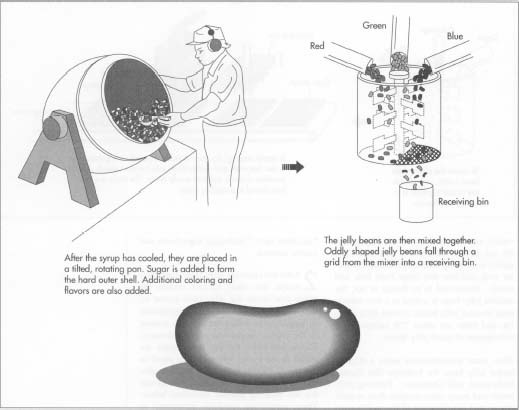
The murky origins of the jellybean have me intrigued, but so too does the apparent skill required to produce this common sweet just so. Of all the innovations in sweet making, I keep thinking that they are likely attributable to a food technologist, or a precursor of that profession.


Have I missed my calling, I wonder? I don’t know. Although, I did find out years later that on the strength of my teenage career musings, a school friend, who moved away in my senior year, did go on to become a food technologist. Sweet.

Happy Easter!

Friday, October 20, 2006

98 Reasons For Blogging: 1-2

1. One Day The Ice Will Reveal All Its Dead arrived in the mail today.

It begins:
Let me tell you about ice. There are a few things you should know: firstly, it's not white. Usually it's blue, almost a turquoise, almost warmly Mediterranean. Sometimes it's not even blue, but yellow or maybe orange. That's when the sun is setting. Sometimes it seems that the sun is always on the point of setting up here. It's not, of course. It's just that often it is so low that all the light is scattered, and for a small while, just a few seconds, it is so beautiful you could forget to breathe. Stupid to forget to breathe, I know, but it happens. You forget to breathe and then you have to take a great mouthful of air and gasp at the coldness of it.

2. Veronica Mars is not on television this evening.

Thursday, September 14, 2006

Tonight

Tonight, I've come home and decided to sit at the computer and blog about something, anything. Why? Well, it's time to end my self-imposed ban from blogging that I declared on Monday. I'm just going to sit and write here for fiteen, maybe twenty minutes, and whatever ends up written down I will post. This is the kind of exercise I did when I took a writing class at the youth theatre I once attended. We'd be given the task of writing whatever for a really short period of time, not as long as five minutes, if I recall correctly, and the object of the exercise was not to censor yourself. It's quite a difficult thing to do. Even now, every now and again, I'll do a quick series of backspaces to delete a half thought word that I've decided won't do. There, I've just paused and read back what I've written so far. I'm sure that wasn't allowed when I did the exercise before.

I suppose the trouble is that I've been censoring myself all week. This is part of the reason why I had the blog moratorium. Not just for my own blog, but others as well. Until this afternoon I hadn't checked my bloglines subscriptions for days. Is this making any sense? I don't think it does, but I'm trying not to read back what I've written at this point. It's so difficult. My eyes keep straying. I decided not to read any other blogs or post on my own because I can't help getting caught up in the whole social activity of blogging, and this week I had to work on my thesis prospectus--a kind of rehearsal for the confirmation--that I delivered today. It went well. People seem interested. My supervisor said nice things to me. My project is 'meaty'. Heh.

So, everything is all calm again. In fact I'm feeling quite wide awake and I shouldn't. I've spent all week stressing about trying to give a perfect presentation. Lot's of 'Oh my Gods!' and 'I don't have a thesis statement!' and 'What the hell is this about again?'. Days have flown by and all I've been doing is censoring myself. Crap. Crap. Crap. Crap. Crap. Apparently the effect of all that stress rendered my presentation as something that had been very thoroughly worked on. Now all I have to do is mark eighty assignments. They're short ones, but still the deadline for that is close. What am I doing sitting here blogging?

Well, the Brisbane Writers' Festival started yesterday and I really didn't think I'd get the chance to go to anything, but then I read my emails and there were some free tickets on offer to the one session that I really wanted to see. So that's where I've just been, at the Brisbane Powerhouse seeing John Tulloch talk about his experience of being on the London Underground when it was bombed on the 7th of July last year. He was turned into a bit of a poster boy of the victims of 7/7 in the UK media, and now he's written a book about it, the bombing and the media use of his image afterwards. I will probably write more about this at some stage. But I've less than five minutes left to write before I promised I would stop, and now tiredness is setting in. I ran into my associate supervisor when I sat down with a friend who I had run into earlier on the ferry and discovered he was also going to the event. Running into A/Supe was fortuitous since I would never have talked to John Tulloch afterwards if she hadn't drawn A and I into a discussion with him. He is appalled at The Australian's review of his book, he believes it misinterprets and misrepresents his work. I am not surprised.

Oh, my eyes are straying back, over what I have written. All those long sentences. Very Virginia. I wanted to relate the story of the ferry travel. We got off at Sydney Street instead of New Farm. We had to run past the joggers who were out for exercise, in order to make the session in time. We were 10 minutes late, and the session didn't start for another 15, leaving plenty of time to order a nice tall flute of sparkling wine.

Friday, September 01, 2006

Tardy Book Meme

I have not been keeping on top of my blog reading and as a consequence I missed a meme tag that was issued to me earlier this month by Lucy from Always Listen to Your Pig-Puppet. But now on this rainy day, when I should be doing my thesis, I thought I would catch up on some blog reading and take up the meme challenge. With profuse apologies to Lucy for my tardiness.

One Book That Changed Your Life
The dictionary, or rather becoming aware of how to use the dictionary effectively. It's more than a spelling aid, it opens up worlds of meaning when you encounter unfamiliar words in your reading. I remember my favourite English teacher talking about the word 'cicatrice' from My Brother Jack, and how she had looked it up in the dictionary to discover it was the most perfect word in the context it was used. I wanted to have experiences like that.

One Book You Have Read More Than Once
I tend not to read books more than once. Here I have to resort to books I've written a thesis chapter on: Loaded by Christos Tsiolkas, Praise by Andrew McGahan. I've recently re-read The Great Gatsby on a voluntary basis, but I don't think I really read it properly the first time.

One Book You Would Want On A Desert Island
When ThirdCat did this meme, I was very impressed by her answer, which was some kind of manual on desert island survival. I think if I could have only one book, that would be my preference too, but if the matter of surviving was taken care of then Don Quixote because in it there are stories within stories. And if I were that isolated, I would probably finish it.

One Book That Made You Laugh
The Blindman's Hat by Bernard Cohen. Oh, that fluffy little white dog, Muffy!

One Book That Made You Cry
Lucy said that Markus Zusak's The Book Thief made her cry, and it had the same effect on me too. Another book that elicited strong emotion from me was Siri Hustvedt's What I Loved. I have wanted to write about this book in more detail, but I truly don't think it's possible without ruining the experience for someone else. I've just had a look at my bookshelves and was reminded that it took me two days to recover from reading Candy by Luke Davies.

One Book You Wish You Had Written
I don't know that I really think this way. Perhaps I can offer that during the time I fancied myself as a potential writer of novels, there were a couple of authors who used to make me think I had something to say: Milan Kundera, especially The Joke and The Book of Laughter and Forgetting; and Paul Auster, particularly The Invention of Solitude. I could also probably add Roddy Doyle for Paddy Clark Ha Ha Ha and The Barrytown Trilogy (The Snapper and The Van, more than The Commitments).

One Book You Wish Had Never Been Written
That Eye the Skyby Tim Winton. It put me off Tim Winton forever. I hated the way the women were punished thoughout the narrative after expressing the vaguest of feminist sentiments: the grandmother went mad in a rocking chair in the back room, while the daughter harmed herself with self-inflicted cigarette burns before going off to meet a dubious fate in the bush that hinted at sexual assault. Meanwhile, the father who had been injured arose Christ-like from near-death out of a baptismal-like bath, reborn to take his place at the head of his family; and the son kept seeing prophetic visions in the cookie jars, because his naive view of the world, unsullied by any l institutional mediation, was apparently clear and true. All that self-appointed prophet, I-don't-believe-in-organised-religion-but-I-am-the-leader-of- my-own-spirituality made me want to drink Kool-Aid. I have a particular objection to Tim Winton's linking of white, male spirituality to the land in a kind of psuedo-envirnomentalist way. It just looks like another vile mutation of colonialism to me.

One Book You Are Currently Reading
The White Earth by Andrew McGahan

One Book You Have Been Meaning To Read
Next on my list, after The Vivisector, is Tuvalu by Andrew O'Connor. If I could get hold of Wegener's Jigsaw by Clare Dudman, or Siri Hustvedt's other novels, The Blindfold and The Enchantment of Lily Dahl I would like to read them too. This is the problem when you don't have a credit card, you can't just order things online, you have to rely on bookshops. The bookshops in Brisbane haven't been very good on these books, they tell me that Wegener's Jigsaw is out of stock, but I learned from the author's blog that it's about to be remaindered!

Dear readers of Galaxy, if you find any of these books on your travels, please think of me. I will gratefully reimburse you.

Now Tag Five People
Everyone seems to have done this already, but if you haven't and want to, consider yourself tagged. Let me know if you take up the tag after reading this post.


***
I noticed that Lucy has since posted another book-related meme, so I thought I'd do that one too:

• Grab the nearest book.
• Open the book to page 123.
• Find the fifth sentence.
• Post the text of the next four sentences.
• Don't cheat by looking for a book with more literary/intellectual credibility.

The book on the desk in front of me was A Plea For Eros by Siri Hustvedt; clearly I'd half imagined a blog post on it, celebrating the fact that she's done a PhD on Dickens and is crazily smart in the way that I like. I think she might qualify for nerdy nerd status. I was also going to reflect on the topic of self-revelation, wondering about what seem to me to be the similarities between published books and blogs.

Anyhoo, the fifth sentence on page 123, and the following four:
An acerbic, often cynical film reviewer for The New Yorker ended his column with a heartfelt statement about love. He seemed to mean it. My brother-in-law, a sculptor, reported a conversation that he had with fellow artists who said they were rethinking their work. For a brief time, photographs of firefighters and policemen replaced pictures of celebrities in the tabloids and on magazine covers. The news channels dropped commercials from their coverage, as if they knew that alternating film footage from the site, where rescue workers were digging for pieces of the dead, with ads for dish washing liquid or an allergy drug would be unacceptable.
I want to reveal the next sentence as well:
But by now, this talk of a cultural sea change is mostly gone.

Friday, June 02, 2006

Tout Va Bien

My reading is such a mess at the moment, it’s impossible to organise it into any coherent order the way I usually do via the list on the sidebar.

The difficulty began after I finished The Philosopher’s Doll by Amanda Lohrey. Instead of buying a new book, I decided to have another go at Atomised by Michel Houellebecq. Although an abandoned bookmark suggested I had read at least two thirds of the novel on my first attempt, I truly couldn’t remember anything about it, except perhaps a vague confusion about what was going on.

I decided to try Atomised again because I was reminded of it while trying to locate a link for The Philosopher’s Doll. During the search, I discovered that the Tasmanian State Library had nominated Lohrey’s work for this year’s IMPAC Dublin Literary Prize (I note it didn’t make the short list). I browsed the rest of the site and found that Atomised had won the Prize in 2002. I suppose I bought it because it won that award. In retrospect, I should have read the signs that warned me against any potential enjoyment of my rediscovery.

First of all, I didn’t like The Philosopher’s Doll. It’s divided into four parts with the first and second parts combining to make up at least three quarters of the book. Each of these parts are divided into chapters and are variously told from the perspectives of Kirsten, who wants to have a baby, and her husband, Lindsay, who doesn’t want to have a baby right now, and sets about purchasing a dog to offer his wife, with a view to stalling the demands of her biological clock. There’s nothing too wrong with the first two parts of the novel, they present both perspectives of a lived conundrum, and offer no easy answer. It’s when I began reading the third part that I wondered what the author was trying to achieve. All of a sudden, the perspective changes to that of a character who was barely been mentioned in the earlier parts of the novel. Sonia is a graduate student of Lindsay’s, and the impression conveyed by Lindsay’s voice, until the third part, is that she has been stalking him for a period, but she suddenly stops, leaving him a written apology before disappearing. When Sonia begins to speak, we learn that their relationship was more reciprocal than we had been led to believe. (Or maybe not?) So, the impression is that Lindsay was lying, which was not so much of a shock, considering his proposed solution to his wife’s desire for a child. But even if it was a revelation that had any kind of potential to demonstrate some deep insight into the human condition, the uneven structure of the novel completely undermined my sympathies for it as a story. As soon as I entered the third part, the book lost me. Emotionally, I was cast adrift.

The second clue that should have alerted me to avoid reading Atomised was the place of the aforementioned bookmark. Who abandons books after making so much of an investment in them? Most sensible people would cut their losses earlier. Well, at least I can say I’ve begun to learn that lesson, because this time I only made it halfway through Atomised before I threw in the towel. My decision was most likely hastened by the fact that I caught a cold/flu (there were aching bones involved) and so my attention span for such a desolate view of humanity was much diminished. I can understand on an intellectual level that Houellebecq is theorising contemporary social relations or lack thereof, as his title suggests. And he is very clever in conveying the sense of alienation felt by his characters through his writing style. The trouble is that he is also successful in alienating the reader. I simply could not care for someone who sought relationships with very young women, while speaking about women his own age in the most derogatory way. I appreciate that such characterisation is part of Houellebecq’s thesis, but, well, I just wasn’t up for it. Even as I lay in bed recovering from illness, I couldn’t conceive of such a bleak vision. I longed for something life affirming.


I remembered a collection of short non-fiction pieces written by Edmund White and illustrated by Hubert Sorin, that I had picked up in a bargain bin at Target. Sketches from Memory: People and Places in the Heart of our Paris was conceived and accomplished while Sorin was dying from AIDS in the apartment he shared with White in the Châtelet district in Paris. Perhaps it was the drawings I wanted to revisit, something my poor diminished attention span could cope with. But that can’t be entirely true, for I found myself studying them in great depth. They are brilliant and comic and the figures seem to move. There are wonderful portraits of well-known figures of Sorin and White’s acquaintance, such as a young Naomi Campbell and the courtier Azzedine Alaïa.White writes:

I remember one night when the Galatea was a ravishing, pouting, smiling teenager, Naomi Campbell, who would later become the world’s most famous model but who then was just a sumptuously beautiful, shy English adolescent. She kept turning and turning as Azzedine ordered her to do, though when he stuck a pin in her she shouted lustily and tapped the tiny maestro on the head.

More important than the voyeuristic, though thoroughly charming, insights into the rich and famous, however, are Sorin and White’s portraits of the people who inhabit their neighbourhood, with whom they have affectionate, neighbourly relationships.

There are fishmongers, butchers, green grocers, buskers and building contractors; there are priests, prostitutes, eccentric homeless people and local dogs, all of whom are the friends of Sorin and White’s basset hound, Fred (after their friend Frédéric; they were unaware of the comic strip).

Madame Denise, the concierge of their apartment building, appears frequently. She is on the front line of demonstrators, protesting about several building projects in the neighbourhood; she is a despairing mother, trying to convince her son to marry; she likes to drink too much in the afternoon; and she is an incurious supporter of her gay charges, especially on the subject of Sorin’s illness. Most humorously, she is a willing model for the local hairdresser’s creative experimentation:

One day our concierge will look like a Roman matron, the next like a Neapolitan tart, then a week later she’ll become a Tonkinese princess or a cabaret singer of the 1940s, startlingly resembling the imposing, throaty lesbian chanteuse Suzy Solidor. Of course constant variety is the very source of the Parisienne’s power to bewitch us, but it’s somewhat disconcerting to see your motherly (and normally brunette) concierge coiffed with a bright red punk’s coxcomb at eight in the morning (or to be more honest—at ten).

While all of these portraits are tinged with the sadness that arises from knowing that Hubert Sorin is soon—within the time frame of the essays—to pass away, that Edmund White will be left alone after his lover’s death, the sketches are anything but bleak. This little book, remaindered no doubt to make way for ‘some vulgar, current best seller’, is finely wrought, and it made me laugh and cry. Reading it, I felt fully engaged with all the foibles of humanity.

"In this drawing of our local gay and lesbian book shop, Les mots a la bouche, Hubert is daring to suggest that my books and other 'literary works' [the titles on the sale table include O. Wilde, V. Woolf, Proust, M. Foucault, A. Gide] of queer fiction are usually remaindered, whereas customers throng to the shelves selling pornography.

Update: Wendy at Sarsaparilla posted a great quote by Nabakov that addresses the conundrum I have recently faced in my reading. Look at this post by David as well. Glad I'm not alone in having a surfeit of half-read books littering my bedside.

Monday, March 27, 2006

Spanish Inquisition: Part Three

I am reading Don Quixote by Miguel de Cervantes Saavedra. In order to keep myself on task and so finish this 940 page tome, I have enlisted the support that your presence will provide to urge me to continue reading. I will post a record of my progress here at irregular intervals, as well as any comments and questions that are provoked by the text along the way.


III A Series of Improbable Coincidences and a Point of Irreconcilable Difference

You may have thought I’d abandoned Don Quixote and it’s true my progress has been slow, but I have been making my way through it amidst distractions from other novels, my PhD, and a newly discovered obsession with Sudoku. In the month since I last posted on this topic, I’ve inched through another twenty chapters which has brought me almost to the end of ‘The First Part’. In the story, the priest and the barber, with the help of Sancho and some other characters encountered in the mountains, have been successful in drawing Don Quixote back towards his home in La Mancha, by way of the inn where DQ and Sancho stayed earlier. Sancho is reluctant to enter the inn because on his last visit to the establishment he was unceremoniously tossed in a blanket by the innkeeper, his family and various guests, so he is justifiably wary of his reception. But the whole party is greeted warmly, after they promise to pay handsomely, and so settle in for the evening. The inn functions within DQ as a place of fortuitous meetings and happy reconciliations which we learn about through the discovery and recounting of various stories by a whole range of people that DQ meets. That it has taken twenty chapters for the main story to progress so little is evidence that it is a device through which to tell a plethora of other stories. If DQ wasn’t inhabiting a parallel reality, if he was perfectly sane, if he had just stayed at home amongst his trashy novels, there would be no Don Quixote.

In and of themselves, the tales related within the larger novel are of varying interest. Invariably they are about star-crossed lovers and the teller of each story is one half of the doomed couple which is central to their tale. In each story there are overbearing parental figures and duplicitous friends and siblings; in one instance, it is one of the lovers himself who is a philandering cad that causes his wife no end of unhappiness, nevertheless, she still loves him and wants his love in return. Again, I’ll admit to being somewhat impatient with these stories, they seemed to be of no more value than those that Cervantes was apparently criticising, those tales of chivalry where everything is miraculously resolved due to some kind of sorcery or inexplicably fortuitous turn of events. While DQ points to the workings of enchantment and demons to explain anything that thwarts his knight errantry, magic is no explanation for the implausible reconciliations that occur at the inn as all the pining lovers and long lost relatives unwittingly converge upon it and fall into one another’s arms.

I wonder if these unmotivated reconciliations are an example of the irony that I have thus far failed to recognise? And surely this passage must be tongue in cheek?:

He lead by the hand a young lady of about sixteen in travelling dress, so gay, striking, and beautiful that the sight of her impressed them all; and so vividly that, if they had not already seen Dorothea, Lucinda, and Zoraida at that inn, they would have doubted whether she had her match for beauty.
In these lines the reader is introduced to another star-crossed lover, Clara. It may be already clear from the list of the other women who have gathered at the inn, that this is the fourth outlandish description of rarely matched beauty that Cervantes writes. In view of all the literary opinion interspersed throughout this section of the book, I can only conclude that such hyperbole serves a purpose in Cervantes’s telling.

The contributors to 400 Windmills reflect on an earlier section of ‘The First Part’, the library scene, where the Priest assesses Don Quixote’s library of chivalrous tales. While the Priest is deciding which books to burn, it becomes apparent from his commentary on each book that he has in fact read all of those he encounters in the library. It’s a revelation that exposes the Priest as a hypocrite; he is condemning books which he has obviously read, if not necessarily enjoyed—although there is certainly some suggestion that he did take pleasure in some of the works.

In the scenes at the inn, there are two events that are worth discussing to tease out the questions of literature and literary criticism that are first raised at the book burning and which preoccupy ‘The First Part’. The first of these events is the discovery, at the inn, of a written story. A manuscript of The Tale of the Foolish Curiosity is chanced upon by the Priest who is attracted by the title and the fact that it is ‘written in such a good hand’. The Priest’s fellow travellers urge him to read it aloud in order to pass the time and he agrees to read it ‘if only out of curiosity’, allowing that ‘[p]erhaps there will be something pleasant in it’. Is there some meaning to be drawn about the relationship between the priest’s curiosity and that of The Tale? I’m not sure. The story is not one of knight errantry; it’s about Anselmo who decides to test the loyalty of his wife, Camilla, by urging his best friend, Lothario, to seduce her. Lothario points out to Anselmo what a ridiculous idea it is, but Anselmo insists, so Lothario acquiesces. I’m not sure if continuing to explain the story constitutes a spoiler if you haven’t read DQ; perhaps it is safe to say that it doesn’t end so neatly as all the reconciliations that are occurring at the inn. When the telling of The Tale is finished, the Priest declares that he likes it, insofar as the ‘manner of its telling’, but he thinks ‘there is something unconvincing [and impossible] about it’.

I wonder how seriously the Priest’s literary judgements should be taken? He doesn’t seem to admit to reading anything, except out of a kind of insincere curiosity, or to gather fodder for dismissive critiques. Are his opinions nothing more than posturing? Are they offered only as an opportunity to pontificate so that he can perform his status and thus assure himself of it? He has shown he is an avid reader of the tales of chivalry, which in the world of Don Quixote are beneath contempt. Does this undermining of the priest’s critical judgement through the narration suggest that The Tale of the Foolish Curiosity is proffered by Cervantes as an example of writing he condoned? Is the human folly, which is the topic of The Tale, a more worthy subject for exploration, according to Cervantes, than that of fantastic story-telling that characterised the tales of chivalry?

The second event in the most recent chapters I have read is the occasion of another diatribe against the books of chivalry, this time by a Canon in conversation with the Priest. The Canon also admits to reading the books of chivalry, or at least the beginnings of them. Further, he claims to have written a few, but then apparently abandoned the endeavour as unworthy of his station. Are we to suspect the views of the Canon as well as those of the Priest? Again, I’m not sure. The Canon goes on to criticise drama, using the same argument he applies to the books of chivalry. He condemns the producers of plays that serve merely to entertain audiences instead of providing instruction. Thus the Canon at once confirms the Priest’s arguments and so the reader’s suspicions of the Canon's views. But isn’t the Canon and the Priest’s opinion about books of chivalry in accordance with the construction of Don Quixote as a pathetic figure harmed by the absurdist tales? The question of whether the Canon and Priest are indeed as ridiculous as Don Quixote in some way seems to be negated when the Canon nominates a play by Cervantes himself, Numancia, as an example of one which is not absurd. Would Cervantes mock his own work? Now, what am I to conclude about the function of the exasperating coincidences of beautiful women and timely meetings at the inn in Cervantes’s work?

In many respects I think much of my difficulty with Don Quixote thus far is attributable to a lack of agreement with its central thesis. In effect, high culture is privileged over low culture. Chivalric texts are discussed in terms of the irresponsible authors who produce them and the ill-effects on susceptible readers. The Canon concludes his speech by proposing a kind of censorship:

all these evils, and many more of which I will not speak, would cease, if there were some intelligent and judicious person at court to examine all plays before they are performed... anywhere in Spain. Then no magistrate in any town would allow any play to be performed without this man’s approbation, under his hand and seal... Now if the same person or some other were entrusted with the task of examining newly written books of chivalry, no doubt some would be produced of the perfection your worship requires, thus enriching our tongue with the charming and precious treasure of eloquence, and causing the old books to be eclipsed in the bright presence of the new.
I am troubled by the extent to which the prejudices against popular culture and those who enjoy it still exist in the discourse of literary reviews, largely unaltered since the seventeenth century. Perhaps I will never fully appreciate this book as long as I have been ‘corrupted’ by the interrogations of Cultural Studies and its re-evaluation of culture.

Related Posts
Spanish Inquisition: Part Two
Spanish Inquistion: Part One
Tilting At Windmills