Showing posts with label Academic. Show all posts

Sunday, April 04, 2010

(30) Rock On

So, after the first day of being sick, where I wasn't really able to focus my eyes on anything much beyond the inside of my eyelids, I decided to watch discs 2 and 3 of 30 Rock Season One that I had on loan from BigPond.

Between erratic television scheduling and cracked discs, I've had a bit of difficulty watching 30 Rock in any kind of sustained way over its four seasons, and if that hasn't been enough for me to just give in and buy it, then it's finally been due to the program itself, or at least from what I've managed to watch of it this weekend, that henceforth I will be on the look out to buy 30 Rock, preferably on sale.

I haven't mentioned it here before, but this semester I'm convening a subject in a television degree, and there are so many moments in 30 Rock that just speak to the massive changes that television as a medium has undergone in the past decade or so that I think it would be remiss of me, as a television scholar, not to own it.

Just off the top of my head:

Jack Donaghy is the Head of West Coast Television and Microwave Programming for GE .

Liz Lemon explains to a colleague of TGS with Tracy Jordan that 'This is not HBO, it's TV'.

In one episode a webisode is featured. It consists of a character's entrance to a room and two spoken lines before the credits--longer than the webisode--roll.

There, in three brief instances, you have commentary on the industrial context of contemporary television, as well as aesthetic and technological developments. Brilliant.


Finally, I can't overlook the irony of my desire to buy 30 Rock on DVD.

The DVD has contributed to changes in television that have brought about this current crop of extraordinary television narratives; it's encouraged the production of texts that can bear repeat viewing.

So, that's why I'll buy the DVDs of this TV show, because I don't want to miss a single self-referential moment of this television sit-com about the production of a live television variety show. And then I'll want to watch every moment again.

Monday, December 14, 2009

An Observation

Often, when people are discussing the poverty of postgraduate students, special mention is always made of how particularly difficult it is for those with families to support.

I don't want to deny this. Yes, it would be difficult, impossible, to support a family of even one child, with only a scholarship for income.

But what maddens me about this often-repeated assertion is that it imposes a hierarchy of need, where single people are apparently less in need of financial support, any other special consideration or, indeed, compassion, than those who have children and partners.

I'm entering difficult territory here. It's not my intention to contribute to the op-ed-fuelled battle between parents and single women (for it is always single women who are problematic). I am not against children or the desire to have children or those who choose to have children. One of my favourite persons is, in fact, a child, for whom I would do almost anything. ☺

What upsets me, however, is the assumption that it's easier for single people to get by in conditions of poverty or with a low income. Actually, it's difficult for me to know whether it is easier or not for single people, since I've never been a parent. Let me attempt then, to step outside of what seems to be a particularly unhelpful binary opposition between those who are coupled (with children) and those who are not, and tell you about my experience of postgraduate poverty.

The first thing is that poverty is not simply about money, it's as much about isolation and a lack of social support. In fact, this might be the only item I go into right now, for I am consumed with it.

I have a family into which I was born, but it's a difficult one. Sometimes I've had the opportunity to witness the various kindness that friends' families do for them and I'm astonished at such generous, unreserved giving. It's not simply material gifts I'm thinking of here but a generosity of spirit which reassures my friends that if they were in any trouble they could call on their family and be guaranteed support in all its forms.

I don't have this grounding and so it should scarcely be surprising that I haven't been able to create such a family for myself.

There are many people who strive for the myth of self-reliance and although I am clearly not self-reliant in terms of growing food in order to feed myself, I am self-reliant to the extent that anyone in a liberal democratic society can be. Again, this is more than financial self-reliance, although that is great, it is also emotional self-reliance. It is self-reliance from which there is never any respite. It is self-reliance that must be the basis for achieving the same things that those who don't have to worry about shelter and food on a daily basis are achieving with the love and support of others who are in this life with them.


This is my observation: it's hard to do a postgraduate degree when you don't have anyone to share the burdens, financial and emotional, of everyday life.

Monday, July 06, 2009

Feedback

I'm just waiting for my mushroom soup to simmer for 15 mins before I put half of it in the blender at which point I'll be minutes away from tonight's dinner. Since I have to wait, I thought I'd take the opportunity to reflect a bit on the teaching results I got today. I don't want to spend too long on this, otherwise I will obsess until my head explodes, because that's how I am.

I taught in two subjects at different campuses of the same university, which is not the one where I'm doing my PhD. The comments I got on one subject really arise from the fact that I had minimal face to face contact with the students. I marked their weekly blog posts and I posted questions for the Twitter workshops, only occasionally interjecting beyond that. It wasn't an ideal situation, but it was a solution that the course convener came up with when he was handed the subject a week and half before the semester started and discovered the room bookings were completely unworkable for the usual tutorial structure. There's not much I could have done when the students say they would have liked to have seen more of me.

The second subject I tutored in was a bit of a disaster as far as the support from the course convener went. It wouldn't have been so bad if I'd been left to plan my own tutorials, but along with the total lack of support was the demand to follow a tutorial plan that I only ever got at the last minute. About half way through the semester things came to a head and I told the students of the situation, and I made a request to be exempt from the survey that the students do.

You've probably gleaned that my request from exemption was refused, so today I got to read the comments that the students from that subject made. I find these things confusing. I think overall they were positive, but when you get extremes it isn't clear which to take on board. I certainly don't like to hear that someone stayed away from the tutorials because they didn't like my teaching style, but I don't want to delude myself either that I should only listen to the student who said that I really helped their understanding by persisting with discussing the readings in the face of a class full of people who generally hadn't done them. I'd like to think that it was only one student who thought I shouldn't have been chosen to tutor the course and a whole lot more who would echo the sentiments of the student who said s/he would actively sign up for one of my tutorials again.

I suppose if anything came through more than once then it was a question of my teaching style. I'm not sure what to make of this. Someone said it took them a while to get used to my style. Is it really that unusual? Each week, I tried to take them through the practical tasks that I was directed to so they could complete their assessment. Initially, I tried group work, getting them to talk amongst one another, take notes, and present their ideas, refined through interaction, to the rest of the class. They really seemed to hate group work and writing things down, so then I switched modes and resorted to asking a bunch of questions arising from the readings in an effort to stimulate discussion. A lot of the time many students hadn't done the readings, and worse, hadn't even brought them to class, so that we might go through them together. In the end, I did just persist. I got some good feedback on that strategy, so I stuck with that.

I don't know. What's your teaching style? Or what was the style of teaching that you found most effective for your learning at university?

Saturday, February 07, 2009

To Whom It May Concern

There are many reasons why a postgraduate student or an early career researcher might feel utterly crushed by her experience in academe, but recently I was asked to write a letter of support to be included in an application for promotion for someone I have worked for over the past couple of years, both as a tutor and a research assistant. It gave me the opportunity to reflect, in a concentrated way, on what I hope won't be a rare collegial experience, or prove the exception to the rule. Here's the letter I wrote:

To Whom It May Concern:

I have had the privilege of working with _____________ in the _______ discipline within the ____________________ Faculty at ___ over the past two years. During this time I have been employed by ____ first as a marker and then as a tutor. With ____’s support I have also had the opportunity to deliver a lecture. In 2008 I worked as his teaching assistant which involved a range of administrative activities, including communicating with students on his behalf.

Throughout my association with ____ he has provided a great deal of professional support and encouragement. On a day to day level, he has always provided a range of materials, such as clear marking criteria and suggestions for tutorial activities, that have equipped me to do the task at hand. He has also made proper arrangements for marking moderation meetings and any other additional activities that have been required.

There are many aspects of working with ____ that I have appreciated over the past two years. In addition to his talent for organisation, he has always demonstrated good humour and conveyed respect for my contribution to his courses. Further, he has provided compassionate and useful advice for my development as a teacher, as well as offering specific opportunities to increase my skills.

I have learned a lot from ____, simply by observing him work. To this extent, as a PhD student looking to pursue an academic career, I consider that he has provided me with invaluable mentoring for my chosen vocation.

Yours sincerely,

Kirsty ________ (M. Phil)

Sunday, November 30, 2008

Melbourne Sojourn: Conference Day One

This is the second post in a short series about my trip to Melbourne last week to attend a conference, Television and the National, hosted by La Trobe University at the Australian Centre for the Moving Image (ACMI).

Conference on Television and the National


Melbourne 19th - 21st November, 2008


What an excellent conference! I'm not sure if I'm channeling novelty factor with this statement, since it's been a long time between conference drinks for me... But, no! I will be assertive: this conference rocked. Sam puts it down to the fact that the Ladeez organised the conference and points particularly to Sue Turnbull who sat in each session generously chortling away (amidst the pain of being mid-ginormous-tattoo application) and offering interesting questions and comments. There is much merit to this argument, there was a spirit of generosity in the air and not more than a little bit of fizzy excitement about being TV nerds together.

If one was inclined to make comparisons, one might say it was a small conference, but from my perspective it made the whole experience far more manageable than the onslaught of people and sessions of much larger conferences I've attended. I think that you could have spoken to everyone in attendance at Television and the National if you put your mind to it and weren't too shy in the face of the rather star heavy composition of the delegates (I wonder what it would be like to be au fait with people quoting you while you sat in the audience?).

The other factor worth mentioning is that the conference had a variety of textures. It wasn't simply one paper after another. It began with a day on comedy, which feeds into the ARC funded work being undertaken by Sue Turnbull and Felicity Collins into the history and role of Australian screen comedy. There were key note speeches, a special guest presentation, a book launch, and plenary sessions that brought all of the delegates together, as well as a number of parallel sessions to round out the three day event.

On the first day I was particularly taken with Sue Turnbull's paper: 'It's like they threw a panther in the air and caught it in embroidery': Australian Television Comedy in Translation. The quote in the title is from Kath & Kim and so Turnbull gave an insightful analysis of the failure of the US version of Kath & Kim. She noted that it wasn't inevitable that the adaptation failed in view of the successful adaptation of The Office by the same creative team. Much of the problem with the US Kath & Kim derives from the bodies of the various performers: Selma Blair just can't push her flat stomach out enough to come anywhere near Gina Riley's embodiment of Kim. As well, much of the joke in the Australian Kath & Kim is down to the fact that this mother and daughter duo are played by women who are around the same age. Someone noted in question time that Australian television comedy draws much more from a theatrical/vaudeville tradition than US television comedy. When thinking about Kath & Kim that argument made sense to me. I also have a theory about the success of the US version of The Office, which wasn't successful straight away. I think, perhaps, that the US version built in popularity because Steve Carrell also appeared in a number of successful film comedies that almost certainly sparked more interest in him: Anchorman: The Legend of Ron Burgundy and, especially, The 40 year Old Virgin.

Brett Mills presented the first key note of the conference: Comedy/Nation: Which Came First? It focussed on British self-understandings of themselves as funny and sought to interrogate that in view of the quite exclusive set of programs that are deemed British both in the UK and abroad. We were all in fits of laughter as Mills showed excerpts from Welsh comedies that weren't incorporated into the 'British'. Alas the programmes aren't even on YouTube, because you know I would have embedded a bit of Boyd Clack if I could.

The last session on the first day was a bit exciting for me as Robyn Butler of The Librarians gave a presentation and took questions. It wasn't so much her work with The Librarians that interested me so much as the excerpt she showed us from Very Small Business which she also co-wrote and starred in. It was a scene where Don Angel was in a therapy session with a psychologist. I got to ask about the creative reasoning for including the therapy sessions. She really gave me the best answer I could have hoped for: so detailed and thoughtful.

Tuesday, November 25, 2008

Melbourne Sojourn: Brisbane

This is the first post in a short series about my trip to Melbourne last week to attend a conference, Television and the National, hosted by La Trobe University at the Australian Centre for the Moving Image (ACMI).

Before getting into the conference proper, I feel the need to talk a bit about what was going on in Brisbane last week too. Then I'll finish off with some things I did in Melbourne, which are not about the conference.

I left for Melbourne last Tuesday morning the 18th of November. Leaving on Tuesday meant that I could go and see Laura's paper which she delivered on Monday evening: 'Warming the imagination with scenes of the past': Time Travel romances about Jane Austen.

It's always a thrill to see someone you know from outside of academe talking about the research they do within academe. You get to see them in full, passionate scholar mode talking about something they really know and care about. I am not especially knowledgeable about the works of Jane Austen, I could only marvel at Laura's command of a whole range of literature, to which she casually referred throughout her presentation. Where I could get some purchase, if you will, was in her discussion of all the time travel fan-fiction that has proliferated around Austen and her works. I enjoyed Laura's identification of this sub-genre of Austen-derived fiction and I appreciated that while some of the novels she discussed are obviously fairly untenable, she takes seriously the phenomenon--and those who participate in it--as an expression of a broader cultural moment.

While I went off to Melbourne, I hoped that Laura would enjoy her first visit to Brisbane. At the beginning of her paper she had mentioned being attacked by a goose at the St Lucia campus of UQ (perhaps it was this one), but who was to know that would be the least of her worries as storms hit Brisbane causing widespread flooding and destruction? On the Sunday before I left for Melbourne a storm had ripped through the suburbs uncomfortably close to me:


On the Friday morning I was away, I was listening to news that reported the suburb I lived in was under water. I got a bit worried, especially when I heard about Ithaca Creek spilling its banks and cars floating down the streets:


I made a call to the property manager and left a message asking for reassurance that I still had a home, but then I had to take a deep breath, accept I could do nothing, and go and give my paper.

Thankfully, miraculously, the only evidence of the storm I could see around my home when I returned was a tree branch on the ground and some mud where the water had flowed through underneath the house. Everything inside was warm and dry.

The view from the bridge I walk across on a daily basis to catch the bus and go shopping tells a more dramatic story:


My street is just on the other side of the right bank there, so you can see why I was worried from afar given the water seems to have come up over the ravine.

Thursday, September 11, 2008

What?

I have just written this sentence:
In these analyses Brunsdon emphasises the character trait of ‘responsibility’, maintaining that in view of the extensive agenda of social reform enacted by the Conservative government, the questions, ‘Who can police?’ and ‘Who is accountable?’ assumed considerable importance in greater British society and, subsequently, in its stories, including crime-based television drama.
And it occurs to me, in the context of the larger piece I am writing, that I don't know how it fits.

My brain feels like it's chewing air.

I need a break.

Sunday, August 31, 2008

A PhD in Horribleness


I came across news of Joss Whedon's Dr. Horrible's Sing-Along Blog at Gwen's blog.

In composing this post I've come to realise that it's not officially available outside of the USA or Canada yet, which means I'm incriminating myself if I talk about how hilarious Nathan Fillion and Neil Patrick Harris are in this three act online musical. And if I give fulsome praise to this tale of a love-lorn evil mastermind then I'm toast.

It's the kind of thing I'll want to own on DVD to watch in High Definition (if that's possible), so hopefully it won't be long before the rest of the world gets proper access.

What is interesting about Dr. Horrible's Sing-Along Blog from a Television Studies perspective is that once again Whedon has proved himself to be an innovator in the medium. Out of the mess of the writers' strike Whedon has found a way to deliver content that people want to watch (5 weeks at #1 on i-Tunes television downloads), by-passing the usual first-time distribution channels for this kind of work.

I predict a slew of PhD theses about Dr. Horrible, if not its very own journal.

Friday, August 15, 2008

Absolute Zero

Here's another week of my writing journal. I think there's something of the masochist about me for posting this document of abject failure, but for some reason, right now, I'm finding it so absurd, I can only laugh. I suppose the point is that achievement can't always be measured by counting words.

Monday, 11 August, 2008
time: 0 mins
length: 0 words
comment: Exhausted from non-stop weekend including final days of film festival, meeting of book club, full day of tutor’s conference on Saturday, and tutorial preparation on Sunday. Dragged myself into uni for tutorial at 1pm. Received feedback from supervisor on most recent writing: ‘onward!’

Tuesday, 12 August, 2008
time: 0 mins
length: 0 words
comment: How easily I seem to have lost the writing habit after the first couple of very good weeks. I lazed around all morning then dragged myself out for a haircut appointment. I need to get back on track!

Wednesday, 13 August 2008
time: 0 mins
length: 0 words
comment: Nothing done again today. The psychological effects of the Ekka holiday cannot be discounted, but still I did intend to work on my thesis. I’m a bit disappointed in myself. Did lots of washing and cleaned the bathroom, as well as about two hours transcribing interviews for one of my RA contracts. This particular interviewee speaks so quickly.

Tomorrow I will try to write first thing, which I realise was the initial recommendation, but I’m not a morning person by any stretch, so I’ve always settled into the day before attempting to write. Perhaps the change of habit will shake me up. Something has to.

Just had a thought about what might be stopping me from writing, so to speak. I really have to get into the reporting of my findings now, and I’ve still got lots of categorising to do, plus the usual worry that I should go and do the database searches again in case I’ve missed something. Even if I don’t strictly write tomorrow, I at least need to report some progress on the content analysis.

Update: After writing the above entry I wrote 660 words in my teaching journal, reflecting on the tutor day last weekend and the tutorial on Monday.


Thursday, 14 August 2008
time: 0 mins
length: 0 words
comment: I succumbed to the urge to re-do some database searches. Part of the difficulty is that I’m worried I didn’t really approach the searching in a systematic way from the beginning because two of the three the databases I’m using are so bloody unwieldy, seemingly designed for use by those who know specifically what programmes they’re looking for rather than any theme or content-based search. I have been so annoyed about this glaringly obvious oversight in the design of these databases that I managed to get an abstract together on it for the television history conference later this year. So, some good has come out of all this frustration, but sheesh what a pain in the arse it’s all been.

Anyway, so, no official words but major problem solving going on—or is that major grunt work going on? My supervisor assures me that once I have the figures writing this stuff up is a doddle. Quite looking forward to that.

Friday, 15 August 2008
time: 0 mins
length: 0 words
comment: Anticipating the day ahead here. I’ve chosen to accept an RA mission for today (cue Mission: Impossible theme music), which involves finding a book and searching through it. I figure the Mission: Impossible allusion made by D in his request was a heads up that it won’t simply be a matter of looking on his bookshelves. Still have more transcribing to do for A. Promised I’d be done with this interview by the end of the week, which I’ve decided is Sunday.

On my own work, I’ll continue with the hyper-vigilant database searching. I did find it reassuring yesterday.


To end, this is from You, the Living one of my favourite films at the film festival. Neither it, nor my other favourite, My Winnipeg made it into the Showtime Top 10 as voted by the festival's patrons. Absurd.

Tuesday, August 05, 2008

Teaching

5 August 2008

Went into classroom yesterday and tried to create a presence. It wasn’t immediately successful because I still seemed to struggle to contain the errant chatting. I did draw their attention to it however, suggesting that it made the goal of everyone participating in discussion a bit more difficult.

On a related issue I found out that I have a range of levels in the class, everything from first year to third year. I suggested that when we do group work that people stick to people in their year levels, so that the first years have the chance to discuss their ideas without feeling intimidated by the advanced level of the third years, and similarly so the third years don’t get bored. Most were amenable to this reasoning, although one of the third year boys still tried to get in a group with some first year girls because they were closer to where he was sitting. He asked if it was a ‘rule’ that he couldn’t be in a group with first years. (Well, no. But think about someone other than yourself. Moving an extra three feet won’t kill you, especially if those girls’ confidence in expressing their ideas is affected by your somewhat bolshy presence. I only thought this).

Part of asserting my presence was done by outlining the plan for the tutorial, which was to address the questions for the first two weeks, to make sure they were answering them so they could get the marks they want. While I mentioned the various levels of learning again, I don’t think I was especially clear that they’ll need to provide more than information to get more than a pass. I asked them if they had managed to include quotes from the book to support their answers. They hadn’t, but hopefully the brighter ones will pick up on that and include them in their future answers.

I ran out of time again. We managed to answer the Tarzan questions, mostly, but didn’t get to go over the first week’s questions in any substantial way. I’ll make it a goal to have discussions about ‘popular’ and ‘culture’ next week when we discuss the topic of popular fiction more generally. I gave them a couple of news articles, where Howard had criticised the curriculum for teaching popular texts and a Web Diary blogger had dissected his assumptions, so that should feed into the discussion as well.

I made sure I fulfilled my request from last week to get them to write about an effective learning experience they’d had—even if most of them didn’t remember that I was going to ask. A couple of students didn’t write anything, which is their prerogative, but made me realise that some students just aren’t interested in this kind of meta-reflection. I can understand their impatience; they might see it as taking time away from their engagement with the content of the course, simply to help me with my teaching, when they might be thinking that’s my business to figure that out for myself. I don’t know. I’m following the advice in a couple of books on teaching in higher education that I’m reading, which cite the benefits of making the process of teaching a transparent process.

Anyway, I read through the comments of those students who did respond. They mentioned things like having an approachable teacher. Some were happy with the benefits they got from having class discussions. While some liked to have a clear exercise in class where they were able to consolidate their knowledge and understanding of a topic, by having a writing exercise or something similar.

On the one hand I figure I’m fairly approachable, especially if that’s the opposite of being authoritative in a punitive sense. It’s the open discussion vs structured activities that confuse me. In the past I’ve had evidence that students have interpreted open discussions as a sign that I haven’t planned anything, even when it’s been quite clear in my mind that there is a structure, and that I’ve worked hard on asking pertinent questions to keep the discussion moving in a relevant direction. On the matter of having set exercises, well, I guess I’ve been intimidated in the past by students who seem quite resistant to writing things down. They’re convinced it’s a waste of time and they’re not shy about saying that. Even when I know that writing things down forces everyone to think really hard and articulate something clearly that they mightn’t have arrived at simply through discussion.

I wish I wasn’t so easily intimidated, and I guess that’s why my major teaching goal this semester is about asserting a credible presence in the class room. I’ll keep on with my reading about teaching in higher ed and incorporate some of the strategies that the students themselves nominated as effective for their learning.

Friday, August 01, 2008

Anxious

I've mentioned before on this blog how much I struggle with writing. I have always found it incredibly difficult.

I have memories of being utterly paralysed when writing essays in high school. How I ever made it to university the first time around is still a mystery to me, because I completely froze in the statewide tests we took which decided the final tertiary entrance scores.

Suffice to say my fears did me no good in that first attempt at an Arts degree. I think I spent most of my late teens and early twenties in a state of fear, not just about writing, but pretty much everything. It wasn't a happy time at all.

I ended up dropping out of university and working a series of casual and temporary unskilled jobs, before I decided to have another go at tertiary education. How I ever got through my second attempt at an Arts degree is somewhat less of a mystery, but effectively I credit one incredibly supportive lecturer who was prepared to offer me extension after extension throughout the course, and still say things as encouraging as that I had assisted her understanding of the works of Julia Kristeva.

It wasn't until this particular lecturer asked if I was going to go onto Honours that it even occurred to me that it was a possibility for the likes of me. I did go on, first to achieve a first class Honours, then a Master's for which I made the Dean's List for Outstanding Research Higher Degrees, and now I'm in receipt of a second scholarship and completing a Research PhD.

At this point, you think even I'd believe that I could write, but still, this annoying and crippling anxiety about writing persists. My anxieties held up the progress of my Master's and the whole process seems to be repeating itself with my PhD.

One of the things I'm most fearful of is that I won't be finished before my current scholarship runs out. Actually, I've pretty much accepted that will occur, but if I'm feeling anxious now, I know how much more anxious I'll feel when I don't have that $380 a week (OMG, my rent is $270/week and only likely to go up).

In an effort to minimise the time that I'll have to be writing my PhD while trying to look for alternative sources of income, I responded to an email inviting people to join a 15 minute writing group. The idea is that you spend at least 15 minutes per day writing and keep a diary noting the time spent writing, the word count, a brief description of the writing, and any comments about the process. Because it's a group rather than an individual activity, the idea is that the individual diaries are circulated amongst the group members.

I've found reading other people's diaries, learning about the things that they struggle with when getting words on paper/screen, incredibly helpful. I've been more productive, in a substantial way, on my thesis in the past two weeks than I have for a long time. Ultimately, the grand total of my words thus far has been 2000. This does not seem much when I compare myself to what I imagine other, more effective, people write, but when I compare this progress with that I made in the previous two weeks, then I have improved by 100%.

It's this last figure that has me feeling far happier, with a greater sense of achievement, than I have experienced for a long time. Now I don't beat myself up verbally when I haven't written 1000 words a day, but I note how I managed to untangle a particularly convoluted thought process in just one hour.

Here's this past week's diary for your perusal. Aside from my anxiety, you'll probably learn more about my thesis than I think I've ever mentioned on this blog*.

Sunday, July 27, 2008
time: 30 mins
length: 500 words
description: Teaching journal
comment: Anticipating first tutorial tomorrow.

Monday, July 28, 2008
time: 30 mins
length: 550 words
description: Teaching journal
comment: Reflected on first tutorial and meeting with A about my LEX feedback. Turns out my problem isn’t communication, it’s authority and conviction.

Tuesday, July 29, 2008
time: 1 hr
length: 220 words
description: Thesis. Explanation of the evolution of another content analysis variable: Occupation
comment: As I was writing I had a thought about another category that needed to be included. While I’ve come across plenty of examples in my coding of patient characters who are either criminals or hospitalised, I’d forgotten about other employment external to the usual understanding of labour markets such as students and people looking after families. Immediately I could think of characters for whom I’ll need this category: Claire Fisher, Carmella and Meadow Soprano, Bree Van De Kamp…

Wednesday, July 30, 2008
time: Not so good at the time keeping today, maybe 2 hrs in total, accrued in 10-20 min stretches.
length: 280 words
description: Thesis. More explanation of content analysis variables, this time in relation to mental health professionals.
comment: If only I could sit still for more that 10 minutes before feeling the need to jump up and hang out the washing or some other domestic chore. I do use that time as thinking/refining time, but I’m convinced more effective writers can sit and concentrate for long stretches at a time. There I go again comparing myself to others. Note to self: ‘Stop it! Just try and think about how you’re on track for another 1000 “excellent and polished”** words’ (fingers crossed).

Have somehow managed to make useful remarks about the various hypotheses the content analysis will be testing. Quite fascinating that even in compiling the variables and trying to come up with categories that are exhaustive I’m getting a sense of the discrepancies between representations in television drama and mental health research as it is manifest in things like the US Surgeon General’s Report on Mental Health and the DSM-IV. Also getting a sense of developments in representations over the history of English-speaking television simply by have to explain and revise the categories.

Thursday, 31 July, 2008
time: Stuffed up the time keeping again. About an hour or so?
length: 230 words
description: Continuing with thesis.
comment: So much for the multi-tasking aspirations I started with. It’s all I can do to think about my thesis at the moment. It should be my priority anyway, the other two things are months away. Turns out I don’t have a meeting with my supervisor until next Friday, so I’ll have even more evidence of working, which can only be a good thing. Note: I’m on track for another 1000 words on my thesis this week. Also note: the Film Festival is starting and I couldn’t resist the incredibly discounted film student passes I was offered. Will be interested to see how I balance this extra-curricular activity with my writing goals.

Friday, 1 August 2008
time: 1 hr
length: 260 words
description: Thesis. Up to talking about ‘Site of Intervention/Treatment’
comment: Saw two films at BIFF today, but managed to get myself up to around the 1000 word mark for the working week before I went out. Progress is steady and in the right direction.

Aware that this diary is perhaps a little, nay, a lot, more wordy that everyone else’s. Trying to strike a balance between being overly confessional, yet making it meaningful for me as a tool of reflection.

* Don't pinch my ideas. Please. Although I don't suppose I can stop you.
** Direct quote from supervisor in feedback on previous 4000 words submitted

Wednesday, July 16, 2008

Teevee: 3

As I continue to research my thesis on ‘quality’ television drama, I’ve become aware, as I’m reading, that particular programs are mentioned repeatedly in academic literature to the extent that they form a television canon. This is a somewhat different process of canonisation to that presented by Entertainment Weekly (USA) and discussed by David Knox over at TV Tonight. It’s closer to the canon making exercise undertaken by Glen Creeber in 50 Key Television Programs, which I discussed over at Sarsaparilla some time ago.

Perhaps what really defines the canon that I’m noticing emerging through my academic reading is that the programs are repeatedly discussed in the context of the trinity of interests in cultural studies informed research on television: text, audience, industry.

Here, programs might be nominated because they are exemplary of a given genre or they herald an important development in that same genre. In the police genre, for example, Hill Street Blues was a commercial failure in the US, but it marked a significant development in North American television, not only for its social realism, which was more reminiscent of British police drama, but, as well, it was a pioneering example of the ensemble cast, populated by a range of characters from various backgrounds, including representations of non-white and female police officers.


In academe, The Sopranos emerges as a canonical text because it was conceived and produced in an industrial environment where a niche audience was valued above a mass audience; where writers and producers were not constrained by a least objectionable programming (LOP) strategy dictated by the concerns of advertisers; but could push the boundaries of the televisual form and address an adult audience with advanced cinema and tele-literacies, to say nothing of advanced incomes. The textual features for which The Sopranos is so lauded are inseparable from the business of HBO. The serial narratives for which HBO is known arise more from the necessity to maintain their subscription audiences across several seasons than any particular affinity with the serialised novel form of Charles Dickens, for example.


Alternatively a programme might be repeatedly discussed in a number of academic sources because it sustains an active fan community. A fairly substantial body of literature exists, for example, around Science Fiction programs and their fan communities, including Star Trek and Doctor Who fandom.


Just reading back over what I've written above, I'm aware that I've seemed to imply there's a fundamental difference in the kinds of values that academic and popular sources apply when judging television texts. The argument against drawing that conclusion too readily is to note the similarities between Creeber's list and the popular press nominations of Entertainment Weekly; both lists include, for example, The Sopranos, Buffy the Vampire Slayer, and The Simpsons, which suggests there is some agreement about the cultural impact of these shows, whether in terms of their subject matter or their reworking of familiar forms. Perhaps the key difference in approaches is simply one of transparency, or the amount of explanation and justification for the choices that each decides upon.

Another difference between the two approaches is the extent of their influence upon me. In the context of writing a dissertation on television drama, it is the academic nominated canon with which I feel compelled to be familiar. When a significant portion of my thesis will be considering The Sopranos, I take seriously Glen Creeber's Introduction to his study on The Singing Detective where he writes that '[e]verything from The Sopranos (HBO, 1999-), Six Feet Under (HBO, 2001-), Oz (HBO, 1997-2003) and Stephen King's own Kingdom Hospital (ABC, 2004) owe a debt to it'.

It is this concern, for me to be familiar with the genealogy, if you will, of television programmes, that is informing my DVD viewing at the moment. I watched The Singing Detective (BBC/ABC 1986) and saw what features pioneered by Dennis Potter (Writer), John Amiel (Director), and Kenith Trodd (Producer) have made their way into contemporary 'high-end' television. In particular it is the ontological shifts undertaken by the lead character of The Singing Detective, Philip Marlow, that are most apparent in the HBO productions cited by Creeber; those moments where we believe that Nate is being hit by a bus or screaming at Lisa, only to discover that he is simply standing by the side of the road or calmly eating dinner were, in part, prempted by Marlow's 'witnessing' of his wife's affair and his experience of hospitalisation.


We have, as well I think, The Singing Detective, to thank for all those musical episodes of television programmes, including Buffy's 'Once more with feeling' and the 'My Musical' episode of Scrubs.


To say nothing of all those Ally McBeal moments:


I don't want to overstate the influence of any particular programme on any other. These histories are alway easily written in retrospect and, of course, the influences upon any one text are multiple. In the North American tradition especially, it would be foolish to ignore the place of the film musical in that culture, although perhaps we might still want to credit the British with bringing it to television.

A book that has been quite influential for me recently, in terms of informing my DVD watching, is Robin Nelson's State of Play: Contemporary High End TV Drama. Nelson also cites The Singing Detective, but his book has been instrumental in helping me seek out various other programmes to watch for my personally assigned television history project.

One programme that Nelson discusses as exemplary of high-end television, which has emerged in the TV 3 era*, is Shooting the Past. I watched it overlapping with the first season of the BBC/HBO co-production, Rome. Apart from the coincidence that Lindsay Duncan was in both programmes, I was able to consider Nelson's discussion of Stephen Poliakoff's desire to create 'slow' television, to challenge the myth that we all have increasingly short attention spans and will switch channels the moment we encounter a lull in the action.


I think the excerpt from The Sopranos, above, illustrates the narrative richness of slow television.

I've just started watching Boys from the Blackstuff having first watched the tele-play from which it was developed, The Blackstuff. It's pretty bleak social realism looking at the plight of unemployed working class men in Liverpool during the Thatcher years.

More on this another time.


* Post-1995, arises 'from a conflation of influences (cultural, technological, industrial, social, aesthetic) with particular implications for TV drama forms and their production, distribution and reception under new circumstances' (Nelson 2007, 8).

Monday, June 16, 2008

Procrastination 101

I'm in the middle of doing some marking.  It's been made a bit easier because, well, quite frankly, more than a few students didn't really seem to take the assignment topic seriously.  

They were supposed to do a critical reflective essay on team work drawing on case studies arising out of their own experience of team work throughout the semester.  They were supposed to keep a learning journal to reference as a primary source and make broader connections with the wealth of  literature on team work. 

I've read a couple of outstanding ones so far (go you girly swats!), but the worst of them have just submitted their learning journal with no critical essay attached.  I guess they missed the instructions distributed in lectures,  tutorials,  emails, to say nothing of the assignment sheet itself, that stipulated the learning journal didn't need to be submitted, but it should be quoted and referenced, along with secondary sources, according to the usual referencing conventions.  Oh well, as they say on teh internets these days:  FAIL! 

Meanwhile, I am in need of some desk bound amusement where I can convince myself that I'm still working:  OH RLY! 

I've decided to do a meme that I found over at Keeper of the Snails wherein I am to reach for the nearest book, turn to page 123 and avail you all of the fifth sentence. 

Reaching.

Flip, flip, flip.

One, two, three, four...

Five!

'His first authorized biography appeared in 1879, written by the editor of an official government newsletter, and several more were to follow before he was dismissed as chancellor in 1890'.

The sentence is from this book:

It's from the section on Germany, 'Mass Circulation Newspapers Shaped by an Authoritarian Setting' by Ulf Jonas Bjork.  The biographies referred to are those of Otto von Bismarck, who was apparently quite the one for using the press to self-promote.

The only reason I have this book next to me is because I was looking at it as part of one of my Research Assistant positions. I have no special interest in the topic myself, aside from the curiosity I have about most things,  but the meme didn't specify it had to be a book of any particular priority.  If that was the case, I might have dug to the bottom of the pile and picked this one:


The End.


Sunday, April 06, 2008

The One Where Kirsty Talks About What She Watches On TV

I've just finished watching the first season of Medium on DVD. I've watched it before--when it was broadcast on free-to-air here in Australia--but I've had to watch it again because I'm writing an assignment on it for an Advanced Study Option I have to do as part of my PhD.

This so-called Option arises out of the Charlotte Brunsdon Master Class I attended at the Centre for Critical and Cultural Studies. You could just attend the Master Class and be done with it, as much as one can be done with a rewarding and valuable learning experience, but since it is a requirement of my degree that I complete two Advanced Study Options, then creating one on the coat-tails of a visiting international scholar in my field is certainly a better offer, as far as these Options go, than having to do one in an obliquely related field such as film or literature (not that there's anything wrong with film or literature, it's just that people studying those seem to have more Options from which to choose).

Oh, I sound so cynical, but really I'm not. I'm looking forward to writing a contained piece amidst the amorphous experience of the PhD dissertation.

I've quite enjoyed the repeat performance of the first season of Medium, viewing it through the discussion that came up in the Master Class, especially in relation to television crime shows: the discourse of equity that has permeated programs since Juliet Bravo and Hill Street Blues and the question identified by Brunsdon as central to the anxieties worked out in this sub-genre of drama, 'Who can police'?

I have much more to say about this project--I do find all of these questions enormously interesting--but this post is supposed to be, as the Friends rip-off title suggests, about what I've been watching on television, as a way of easing you into the forthcoming 'episodes' of this television six-pack that I promised to write over a month ago now. Yes, you may have thought I'd forgotten about that, but really I was just doing what I do best, which is procrastinating.

So, I did start writing this post before and I didn't get much further than a rather dreary explanation of how the programs that are listed in the side-bar over there on the right are only a partial documentation of what I watch on television. I went on about the omission of the odd news and current affairs programs, as well as the difficulty of indicating any one-off documentaries I might watch.

To continue in a similarly dreary vein: there are the shows that are listed there that I have every intention of watching, but somehow end up missing. Spicks and Specks is in that category at the moment, as is The Cook and the Chef. I've been meeting an old friend for dinner and conversation on Wednesday nights instead.

And I can't neglect to mention my brief flirtation with bit torrent that I got over very quickly, mostly due to my technical incompetence and impatience with download times of more than four hours. Still I did find a site that streams Dexter, but I've only managed to watch three episodes of that, which is not to say I didn't like it, but I like watching my TV on the TV. There'll be no multi-platform-delivery-convergence-thing-a-mammy for me, no siree! But maybe Dexter should be in the side bar because I imagine I will watch it eventually, if sporadically, if someone doesn't close the site in question down, because I'm sure a legal reason is being searched for as I write.

Then there's the repository of the DVR hard-drive. Is there any point anyone knowing that I've still got two episodes of Jekyll to watch? That I haven't watched films that I recorded from over a year ago? Do you want to know when I watch them? Is it necessary for you know every time I point the remote at the television to turn it on. Why do I even want to relate every televisual experience I have? Am I wrong to think it's harder to have a list 'What I'm watching on Television' than 'What I'm reading' or 'What's in my library'?

Viewers, I'm boring myself, which is quite a feat for someone who is genuinely entertained by Facebook and its incessant applications.

The solution to the above dilemma, is the solution to many an academic problem, which is to point out the impossibility of comprehensiveness, to make instead the lesser claim for representativeness, or perhaps in this instance, the even lesser claim for 'whenever the hell I can be bothered to update the bloody list'! (Yes we really do say 'bloody' and 'hell' a lot here in Australia).

But, really, I first wanted to do the post to comment on the new TV programs I'd watched, to let you know which I was persisting with and which I was not, on the basis that there wasn't enough in them for me to commit to on a weekly basis.

Women's Murder Club
was in the latter list (this is what taking the discourse of equity to extreme banality looks like). Dirty Sexy Money was in the former. What a delight it is. Still enjoying Brothers & Sisters and Bondi Rescue. Hated Life--what an irritating character, what irritating pseudo Buddhism. Found Psych similarly irritating and unfunny, which is a shame for Dule Hill. Am lately getting into ABC2 much more. I like the time shifting and the British comedy repeats. Cannot believe the total mishandling of the commercial digital channels--do they want anyone to watch them? They make it so difficult, scheduling shows that attract similar viewers, ie me, up against one another. I'm not wasting another breath on them since the programmers are impervious to the constructive feedback about their scheduling practices that I read all over the internets and even in TV Week.

Finito.

Thursday, January 17, 2008

Small News

On some days, you make small connections. They can be between various thoughts and concepts of which you were already aware, but it seems as though that unassuming link has finally bridged an abyss of incoherence and despair.

Thursday, January 10, 2008

Happy (Sniffle) New Year

I'm at home today, feeling sick and miserable. I was at home yesterday too, but then I only felt sick with a sore throat. I managed to get some work done yesterday, watching a couple of telemovies on DVD it's true, but I made copious notes afterwards and entered the characters' details into the spread sheet I've created for the purposes of content analysis and comparison.

I'm a bit pleased because I've managed to hire these DVDs for free. I've signed up to have DVDs delivered to my home and the introductory offer gives the first 10 free, which is a good start on the series of telemovies that is Halifax f.p. It's not exactly ground breaking television or anything, but it's 'quality' in that British sense with top notch Australian actors starring throughout. Yesterday I saw an episode, 'Lies of the Mind' that had Jacqueline McKenzie and Richard Roxburgh in it. Angela Punch McGregor was no slouch in it either.

My point of interest in Halifax f.p. is that it started in the mid-90s around the time that Cracker did in the UK. It's psychiatrist as detective, a type of character that emerged as a way to reinvigorate the police/detective genre. It's not so much whodunnit but whydunnit.

Hey, did I tell you that I got accepted into a masterclass being held by Charlotte Brunsdon? She's one of the early Birmingham School people. I've engaged with her work quite a bit over the course of my thesis. She wrote some papers urging academics to engage with the concept of 'quality' in television rather than leaving the term to be hijacked by more conservative forces. She was writing in the context of a debate around new broadcasting policy in the UK. She noted that the term 'quality' was being used in the legislation, but it was rarely defined. She challenged cultural studies academics who had spent about two decades interrogating the ideological bases for value judgements to counter the common sense understanding of the term (generally historical and educational) with definitions of their own, suggesting that 'quality' television could be innovative television that pushed the boundaries of the medium. In the context of cultural studies it was quite a radical suggestion.

In other television related news, I got an email yesterday from someone for whom I'm supposed to be reviewing a book about television criticism. It's true I've had the book a long time, longer than is acceptable, but I'm not so sure about being called 'uncool' because of my lateness. Perhaps I'm reacting badly because I suspect it is really uncool. I took the book on in the context of the public lynching I got over at Sarsaparilla by various middling members of the writing staff at the national daily newspaper for daring to suggest that one of their colleagues was patronising towards the television audience, especially the viewers of confessional talk shows and lifestyle television.

Looking back, I rather suspect that I stumbled into some kind of pre-existing intra-office feud because their response was entirely out of proportion to what I had actually written. Another clue was the suggestion by one of writers that I should have revealed that I was acquainted with the member of the writing staff who was on leave at the time. The suggestion was a bizarre misreading of a follow up comment I had made about that writer contacting me privately in response to my original post.

I probably shouldn't have agreed to review any book in such a context. I hate that I'm still talking about it, but I have to say that the whole experience was a real punch to the guts. If I use the lynch mob metaphor then it's because it felt like I was being pursued by a torch-wielding mob who delivered blow after blow on the basis of some kind of unfounded prejudice. Their response wasn't logical, it was highly emotional and uninformed by anything I had actually written, and one writer in particular clearly sought blood, stalking me to my university email address when she could easily have emailed me through the address I've provided on this blog.

Even though logically I know that their behaviour was appalling and their fabricated accusations bore absolutely no relation to my work, I think I can pinpoint that moment as a turning point in the year, where I began a slow downward slide into paralysing insecurity about my work. I hate admitting it lest it give them some kind of creepy satisfaction. But of course they're not reading this blog, in the same way that I haven't read their paper since.

I still really like my thesis project however. I think it's worthwhile and I've had conversations with various people whose opinions count in the broader world of television studies that confirm this independently. It's the writing. It takes very little for me to be insecure about my writing, even in the face of praise about it. I procrastinate beyond deadlines. It's very frustrating.

And 'uncool'.

Tuesday, November 13, 2007

Segue: Life Is One Big Segue

As I said to Oanh, when she suggested that I might do the book meme she tagged me with as part of this segue series, 'My life feels like a constant segue at the moment'. By which I mean I never seem to be doing the very thing that should be my life's purpose aka the thesis.

I had a meeting with my supervisor yesterday, and he thinks I can finish the confirmation document before I leave for Melbourne on the weekend for a two week catch up with friends, colleagues, people I've never met, and family.

Was it wrong of me not to mention the 90 0r so assignments I was yet to mark at that point? I did rapid calculations in my head and thought, 'hmmm, an hour or two a day, tidying up and rewording, adding a bit of information that I'm all over... I can do it!' Well now I have to.

But what do I do? I start to blog. In my defence, this comes after 5 solid hours of marking and adding up. I'm trying to be efficient in my resting; best not to move too far away from the desk and computer.

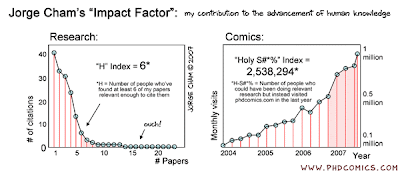
Anyway, as is requisite in computer procrastination circles these days, I checked Facebook and saw the latest PhD Comics by Jorge Cham. I subscribe to PhD Comics, and every time I read one, I'm struck anew by just how perfectly Cham captures the lot of the post-graduate student, covering every anxiety from advisory meetings, future employment, teaching and more.

For instance this was me at one point:
I get a whole lot less vengeful now.

I dedicate this one to dogpossum:

DP is so not like Mike, the eternal grad student. She completed her PhD thesis and was passed with no corrections!! But still she finds herself in a Mike-like plight. Somebody give her an ongoing academic job. You won't regret it.

I don't want this post to go on for too long, because, like, I'm supposed to be doing more marking, but I wanted to put the comics up for two reasons. The first is just me taking the opportunity to boast that I saw Cham talk when he visited Brisbane. He spoke about the power of procrastination, and of course that resonated with a lecture theatre jam-packed full of post-graduates. He asked the most pertinent question posed in all of physics. The true question is not really about the inspiration that struck Isaac Newton re: gravity when the apple fell on his head, but, 'What was Newton doing sitting, daydreaming under the apple tree in the first place?' Hmmm? Procrastinating, that's what, procrastinating. Don't let me hear a word against it henceforth.

The second reason was inspired by Cham's comic about the impact of his research vs his brilliant comics:


It reminded me--there are at least six stages of thought process between first sighting 'Impact Factor' and the point I want to share--that I really wanted to plug a new blog call Comic Artist Rehab, where some independent comics artists that I encountered while doing my thesis on zines, have organised to support one another to get back to creating comics as they once did, before life and such took them in other directions.

The strips are wonderful and I especially like reading the comments they make on each other's work, because then I look at the comics again and appreciate them even more. Enjoy!

Saturday, September 29, 2007

Tears of Rage Against the Machine

I'm at work today. Not the main work place, but the other one, where I've managed to pick up more work than I should ever have agreed to.

Actually, I didn't think I'd be marking these assignments at all. This is what has gotten me into the sense of trouble I'm feeling. I agreed to do the marking at the end of last semester, but then I didn't hear from the convener for ages, so I assumed he'd found someone else and I accepted other work. I didn't think that the convener would wait until the assignments were due to organise the paperwork for the appointment. Then I didn't feel as though I could say I've got too much on, because, technically, I had agreed to do the work. Well.

So between trying to marking these 80 or so assignments, I'm taking a series of short breaks by doing some blogging. I should warn you that I'm feeling a bit melancholy, which is my way of trying not to take responsibility for what you'll read in this rambling post, but, I suppose, the truth is, I've been thinking about various things along these lines for some time, things that have confused and upset me, whether it's needless emotion, I don't know--here, I think of Kate's byline from Moment to Moment: 'over thinking everything since 2005'--but I think I have to somehow get these thoughts out of my head, and I wouldn't mind some feedback from the more regular readers and commenters of this blog, because I value your insight.

To some extent, I've been prompted to write this by a couple of Oanh's posts, specifically those where she has discussed relationships between women, that is, her relationships with colleagues and school friends and her sense that she hasn't quite fitted in with them. On both occasions, on Oanh's blog, I made some obscure comments that I had felt the same way and that I would eventually work up the courage to write about it on my own blog.

Around the time I was responding to Oanh's posts, I had not long discovered that someone whom I had tried very hard to be friends with 'in real life' removed me from her blog roll. Being as honest as I can be, I have to say I took this personally; I was upset at what I interpreted as quite a public rejection. It isn't that I think anyone else necessarily noticed the deletion but more that I began to wonder what I had done to prompt the excision. Attempting to think rationally, I know that I likely didn't do anything, but I still can't convince myself that it wasn't a comment on something about me that was lacking. Or refining the nuances of my thought process even more (you see how my mind works?), I concluded that the person in question's action was a quite deliberate exclusion of my person from her network, and I became angry.

Let me explain. There's a bit of a history.

I had read this person's blog for a while. I had a link to it on my blog roll from the moment I became brave enough to link to people I knew irl, who didn't know I had a blog. Sometimes I found her blog tough going, in the sense that I suppose I do still make a distinction between academic sites and social sites, and the blog in question isn't necessarily the kind you read for social banter or laughs. It is an extension of the blogger's professional life.

Perhaps this is where much of my confusion lies. See, when I read on this person's blog that they were feeling lonely and isolated, I responded, not really as a colleague, but more as a potential friend (not that the two relationships are necessarily incompatible), saying we should do something social together irl. Well, that never really eventuated, and any common attendance at social occasions only came about through group decisions to go for drinks after work related events.

It was after several of these thwarted attempts to initiate friendship that I eventually came to the conclusion that anything I had read on this person's blog--from the feelings of loneliness and alienation through to the dissatisfaction with Brisbane's cultural life--was in fact a case of purely professional theoretical musings. I still don't know what else to conclude in light of my experience with this blogger: the words were an Affective articulation of the working conditions of a young, newly located, researcher. She is a very good writer. But it seems that there was nothing more. Nothing that could be responded to outside of the blog, an academic reading group, a conference or seminar presentation. Nothing that couldn't be turned into a research project.

What makes this situation worse, to my mind, is that even after discovering that I'd been re-evaluated as not-blog-roll-worthy, I still attempted to engage with the blogger on line. (Although it's not my efforts that make it worse, but rather the topic on which I attempted to engage with the blogger). I commented on her criticisms about a conference she had attended, where she suggested that the majority of the conference attendees had been self-indulgent, talking far too long in question times, and just generally apolitical and nostalgic. I responded to what I interpreted as a fairly sweeping dismissal of a large number of colleagues with a question. I hadn't attended the conference under discussion, but my question wasn't about the conference exactly, so much as my confusion about an apparent lack of generosity in the comments.

I asked the question, as well, because I knew a couple of the initial commenters who had concurred with the blogger's perspective (although I did not know the commenter who took me task for asking my question with a lecture about the alienating nature of academic discourse!), and when I read their assessment of the conference too, something just got stuck in my craw and a whole well of bile just wanted to spew forth.

It didn't. I tried to be calm and direct my question towards the pessimism expressed about the older generation of scholars who attended the conference (there's almost something Oedipal there), but it's true to say that there was something else in my question. And it wasn't just the freshly minted feeling of rejection I was experiencing about the blog-roll snub; no, I admit my question was informed by something a bit more putrid and festering than that.

I have been in reading groups and master classes with these young researchers, and quite frankly, I have never felt more alienated or more dismissed in my entire life, while collectively they have monopolised the attention of the visiting expert scholar, engaging them in conversations inaudible to the rest of the class's participants, while remaining entirely oblivious to their slight, and completely unreceptive to any attempt to get them to reflect upon their actions. I have had conversations where I've felt like I've been assaulted by Judith Lucy wielding a base ball bat as sarcasm after ironism has been smacked to the outfield, leaving no room for response. I have had the repeated experience of having to practically reintroduce myself every time I encounter them since there is absolutely no flicker of recognition on their faces to suggest that they've ever seen me before. To say nothing of outright moments of snobbery.

Let's talk about lack of affect, shall we?


***

Are you still reading?

I needed a moment.

I'm not sure where to go now.

I want to say something about hypocrisy, but I don't think the situation is as simple as that: academics of all generations are quivering masses of doubts wrapped up in poor social skills that present as snubs and slights.

Another thing that prompted this post was an invitation I received to a birthday party this weekend. It was offered with the codicil that it would be good if I could make it because unlike many of the birthday person's friends (who are perfectly lovely people) I was able to talk about something other than shop, and right now, for this occasion, that would be very welcome. At the time I laughed and said that I could be invited anywhere and relied upon to talk crap, however, I was also pleased by the observation, because I don't want to spend every waking moment consumed by work.

That said, I have little problem talking about things other than work. I wonder if that isn't some of the source of my reaction to the anxieties that I've been discussing in this post. I find it really difficult to sustain for long periods of time the level of thinking required to do academic work, so I am nonplussed when I encounter people who seem to be able to operate on that level much of the time. I'd be less worried if it wasn't true that every aspiring academic compares themselves and is compared to these people who are pathological, in the most benign sense, ie 'not normal'.

I guess I have two things to say here. The first is that by removing the link to my blog from her blog-roll the blogger in question has demonstrated that she does not consider me to be one of her colleagues. I thought I was, so that's been quite a hurtful thing to realise.

Following on from that, and more vaguely, I am drawn to wonder about a forthcoming work event where the topic for discussion is about social networking sites and blogs as forms of collegial networking for contemporary researchers, who often work in isolation. I'm curious about the ways these networks are being extended, or not, to those who research fields other than the internet, but who experience similar working conditions.

If some deliberately exclude others from these collegial networks online, refusing reciprocal exchanges and deleting links, what are the consequences for collegial relationships between individuals within and across institutions in the same physical location? What happens when you encounter flesh and blood colleagues researchers, who are in the same general field, in the corridors and cloisters, or by the lift well of the physical world institution you inhabit?

Can you always dip your head and take the stairs?

Monday, September 10, 2007

Strangers To Ourselves

Every now and then you get the opportunity to see your city through another person’s eyes. In the case of friends who might be visiting, it’s not unexpected that they will comment on things they’ve never seen as they take in the sights that distinguish your town from any other. It is surprising (or at least I found it so), however, when people who are in town as part of their working lives point things out, things that comprise your everyday life, as strange.

The first time I was aware of the potential strangeness of my everyday life was on an occasion when one of my Sarsaparilla colleagues, David, was visiting
Brisbane for a conference. We met up, and he commented on the ibis, or was it the indigenous scrub turkeys, that populate the university campus where the conference was held, and which I attend. I’m not sure if it was the ibis or the scrub turkeys that David commented upon, because around the same time, I had lunch with a visiting scholar—his work was relevant to my thesis—who also made a comment on either the ibis or the scrub turkeys.


In the case of the comment on the ibis, my response was to say that they were a problem in Brisbane. Due, no doubt, to the loss of their natural habitat in water ways, perhaps because of the ongoing drought, ibis have increasingly sought food in public parks and in eateries that border on green areas. The university is an ideal site for scavenging ibis, as are the parks across the CBD. To counter the problem, in addition to ‘Do Not Feed the Ibis’ signs, the council employed the services of an eagle to swoop the ibis, and so deter them from menacing people in public areas.

The surprise expressed about the presence of scrub turkeys was that they roosted in the trees. It’s my experience that the scrub turkeys scavenge far less than the ibis. (I’ve seen an ibis use it’s curved beak to extract the filling from a sandwich). The scrub turkeys occasionally jump on tables at one eatery on campus, but everywhere else they seem content to dig holes in the gardens and nestle in for their dust baths, or rearrange the mulch into piles for their nests amongst the bamboo near the lakes, and roost in the trees too, I guess.

This past week, I’ve been introduced to some further apparently strange things about the life I take forgranted. I organised an academic symposium where many of the participants were from other parts of Australia. As part of those arrangements I chose the caterer and approved the food that was served. It was a fairly easy process. I thought the caterer offered fairly standard fare: gourmet sandwiches and wraps on the first day, a choice of lamb and couscous salad or chicken Caesar on the second (with vegetarian options), and the usual tea, coffee, and juices for drinks, while the morning and afternoon teas were various combinations of muffins, scones, Danishes and fruit platters.

Perhaps it wasn’t so strange that the symposium participants commented on the differences in the food from that which they were used to eating on such occasions, given that one of the concerns of the symposium was about regional cultural differences across Australia.

From the beginning, the people from Darwin pounced on the strawberries that are currently in season in Queensland. I was told that they just didn’t get decent tasting strawberries in Darwin, and while I had a vague recollection of never really having strawberries as part of my Far North Queensland upbringing, I suppose I had forgotten about the rarity of certain produce in remote areas. Even the presence of the fruit platters was commented upon; it was an enormous treat when one was used to being served biscuits at conferences. I am sure that fruit platters bursting with strawberries, grapes, watermelon, rock melon (cantaloupe), honey dew melon, oranges etc, have always been part of the Brisbane conference landscape.

The other unfamiliar moment that struck me about the response to the catering was when one of the people from Melbourne commented that we had pineapple juice in the selection of juices that were available. I said, ‘yes, don’t you?’ I learned that it wasn’t considered standard fare. And, again, when I thought about it, I realised that of course it wasn’t. Looking at the bottle I saw that the juice was from somewhere on Queensland’s Sunshine Coast, just north of Brisbane, where fields of pineapples abound.

I suppose, the thing is, that many of us are used to thinking of Australia as a fairly homogenous society, in spite of (or perhaps because of?) the rhetoric of Multi-Culturalism. And suddenly, in the most banal of circumstances, over a table of food, shared between, it must be said, a fairly homogenous group of academic and industry researchers, there were differences that I hadn’t contemplated. My world was made unexpectedly strange.

And that was before I saw the woman from Melbourne pouring pineapple juice into her coffee.

Tuesday, July 10, 2007

More PhuD

This is the YouTube version of PhuD.

I was reading JustTV, Jason Mittell's blog (he's a media scholar, so, you know, it was work) and was alerted to the phenomenon of the Five Second Movie. Mittell recommends Fargo in 5 Seconds, which, I agree is quite excellent:


But as someone who will be living in purgatory while teaching the book version of The Lord of the Rings this coming semester, I will recommend Return of the King in 5 Seconds. There's no need to even watch the preceding two LotR in 5 Seconds films, because they have all been usefully condensed into the third film: