Showing posts with label Films. Show all posts

Tuesday, November 24, 2009

Waiting

A week or so ago in the mail I received a guide to the 6th Asia Pacific Triennial of Contemporary Art which begins at the Gallery of Modern Art in Brisbane on the 5th of December. I received the guide as part of my Queensland Art Gallery membership, the benefits of which I don't use nearly as much as I would like.

The guide was a 'Preview/Cinefile special edition' and while perusing its pages I came across a still from a Sri Lankan film, The Forsaken Land (Jayasundar 2005), a film that I saw at the Brisbane International Film Festival.

Click to view full image

The production still in the guide is not cropped to the extent this picture from the APT6 site is. The trunks of the trees in the surrounding bush and the bleached sky beyond them extend out of this frame to convey a sense of isolation and claustrophobia all at once.

The recent news of Australian-bound asylum seekers from Sri Lanka had already made me think of The Forsaken Land and, in particular, I recalled two things. The first was the mood or tone of the film. It is masterful film-making, conveying life as it goes on while waiting for random, unannounced explosions of military violence. It was very affective; utterly devastating.

The second recollection is about the question and answer session with the director, Vimukthi Jayasundara, after the screening. It was an odd Q & A session to the extent that it was so forcefully chaired by the representative from the film festival. The chair was determined that the audience not read the film as political. Or, if that isn't quite correct then we were, according to his instructions, to acknowledge that it was political, but then recognise that it was 'so much more'.

In this he appeared to be fulfilling the wishes of Jayasundara, who seemed to be well and truly tired of discussing the political situation in Sri Lanka instead of the merits of his film. Part of me has some sympathy for the director's schedule here, but I wonder at the assertion of the existence of a clear distinction between content and form that such a forceful request is premised upon. For me, it was precisely the various aesthetic components of the film that so effectively conveyed the weight of living under such conditions.

I think this is an important film, one that Australians must see, and especially now. I urge you to view it as political.

Saturday, August 08, 2009

Dear John Hughes

I'm still unable to update Twitter from the main web page. Apparently there's a problem for some Firefox users, so I guess I'm one of them. I could use the Safari browser I suppose, but I've decided I quite like the idea of being prompted by the tweets of people I follow on Twitter to reflect in more depth (or perhaps just at greater length) about life, the universe, and everything.

The tweet that prompted my line of thought today:


Well, I have to admit that it made me tear up rather a lot and it got me thinking about my own experience of John Hughes. I didn't have any direct correspondence with him the way Alison did, but at least three of his films were very important to me in my senior years of high school. In 1985 I began Grade 11 and that was the year The Breakfast Club was released. I remember going to the cinema with my friends and we all identified with those characters, their insecurities and their dreams, their desire to be different.


The next year we went to see Pretty in Pink and Ferris Bueller's Day Off.

Watching Ferris Bueller, I suppose I just wished I'd had his chutzpah, his ingenuity, not only to wrangle a day off school, but to go all out and celebrate that day, dragging his girlfriend and his genuinely sick friend along for the adventure, and infuriating his sister along the way.


It was joyful celebration of youth, and just writing about it now, I've got a such a grin on my face that it's crinkling my eyes. The lengths Ferris goes to, to fool his teachers, prefigure Hughes's later Home Alone series, but I think the best moment is when Ferris suddenly appears atop a float in a street parade, writhing and lip-syncing to Twist and Shout. Ha! LOL!

Now I probably identify more with the teacher at the school: 'Anyone. Anyone'.


I wasn't as enamoured with Pretty in Pink as a film as I was with its soundtrack. I still think it's one of the best film soundtracks ever.


Not that I've had an ongoing knowledge of film soundtracks, but what's a blog for if not to indulge in a bit of hyperbole?

Anyway, I wanted to include a clip of Echo and the Bunnymen's Bring on the Dancing Horses, which was amongst my favourite songs on the soundtrack but I could only find a live version from years later where the lead singer was smoking while singing, which no doubt accounts for his completely shot voice.

There is a clip of the original video but in their continued fear of and confusion about YouTube, WMG has ordered the sound to be muted. (Is there any point in railing against this short-sighted practice? Is there any point in suggesting that no-one would make any money off the clip if the audio was available, and nor would it prevent WMG making money from the song? Who knows, perhaps by not infuriating people with corporate standover tactics and being generous enough to allow people to indulge in their nostalgia for the song, well, people might come over all warm and fuzzy and even go out and buy it again? Bah!)

Here's the closest I could get to it: a mashup of Bring on the Dancing Horses and Snow Patrol's Chocolate.


RIP John Hughes.

Thursday, July 31, 2008

BIFF Tweet


The marathon starts tomorrow for me. I've bought 2 film student passes that will let me see 10 films, plus I'm planning to go to see a free screening of the silent film Siren of the Tropics which stars Josephine Baker and will be accompanied by some live jazz piano.

I've decided to Tweet my responses from the festival. If you're interested, you can follow the Twitter feed in the margins of this blog, or sign up to follow me through Twitter proper. I promise to Tweet about things more interesting than freezing cold journeys at night on the bus back from the Palace Centro at New Farm.

Friday, August 10, 2007

Takva

While looking through next week’s TV Week I noticed that SBS will be screening a film I’ve just seen at the Brisbane International Film Festival (BIFF). My first thought on seeing the listing for Takva: A Man’s Fear of God was, ‘Oh, I could have used my ticket to see another film.’ And just now I’ve had a brief recollection of how I had to pay an extra $6 to see Takva because there was a mix up in one of the universities’ timetables and I had to exchange my ticket for the first screening, instead of the second, so I could meet my teaching responsibilities.

In that light, the prompt appearance of Takva on SBS is a bit annoying, but in another, if the three people in Australia who read this blog are interested in the film, and have decent SBS reception, the opportunity to see it for themselves won’t be too delayed.

At BIFF Takva was one of several films that formed a focus on Rumi, the 13th century ‘mystic and poet’, whose work ‘is one of the most important sources of inspiration for theology, poetry and philosophy in the Islamic world’ (Official Programme 2007, 8) . I was attracted to this film, in particular, because it was about the Dervish order. Here I anticipated seeing the mesmerising dance of the Whirling Dervishes. Further, the brief synopsis in the BIFF Programme described the central character, Muharrem, a man who led an ascetic life, and there’s something that I find intriguing about that kind of existence.

While the order of Dervishes portrayed was not of the Whirling variety (or at least I didn't see the iconic dance), the centrality of poetry, music and movement to this order of Dervishes’ worship was evident. Extended sequences depicted the order immersed in prayer. They were seated, but they oscillated in their meditation, synchronised with one another and the sounds of their chanting.

Muharrem is invited to join the Dervish order as a lay member. He is recruited from his job working for a sack retailer by a local religious leader. His role is explained to him as one where he will concern himself with the worldly affairs of the order. In effect he is to collect the rent on the various residential and commercial properties that the Dervishes own, and oversee the maintenance and accounting associated with those business interests.

Before moving into the order’s premises, Muharrem has lead a simple life. He submits himself to the orders of his somewhat self-satisfied boss, without complaint. He lives in a small, worn apartment, and heats his plain dinner for one on a gas burner. He wears clean but shabby clothes and a knitted hat. He is devout. The invitation to serve the Dervish order is an honour for Muharreme. He is frightened that he won’t fulfil the faith the order has placed in him, but to decline would be akin to an insult.

From the moment Muharrem accepts the position his life is altered. His boss begins to defer to him, if somewhat insincerely. The order gifts him with a range of luxury items, including a brand new car and wardrobe, accoutrements, they explain, that are necessary for his work, which enables the order to continue its operations, such as the education of the poor.

It is perhaps not surprising that a man as devout as Muharrem begins to struggle with his new found power and wealth. Ironically, perhaps, it is the religious members of the order who prove to be far more prosaic about ‘worldy affairs’, while Muharrem is shocked by tenants who drink alcohol and wants to extend charity to the poor families from whom he collects.

In this age, where many representations of the Islamic faith, in Australia and other Western countries, are routinely imbued with the fear of terrorist acts, it is an important role that film festivals (and SBS) play in bringing to our attention the lives of ordinary Muslims as they go about their every day lives. Takva: A Man’s Fear of God is a film that effectively portrays one man’s efforts to live a life according to the principles of his faith; that the institution of his faith presents the greatest test of those principles is the paradox that makes Muharrem’s story so compelling.

See Sarsaparilla for a look at another BIFF screening.

Tuesday, July 10, 2007

More PhuD

This is the YouTube version of PhuD.

I was reading JustTV, Jason Mittell's blog (he's a media scholar, so, you know, it was work) and was alerted to the phenomenon of the Five Second Movie. Mittell recommends Fargo in 5 Seconds, which, I agree is quite excellent:


But as someone who will be living in purgatory while teaching the book version of The Lord of the Rings this coming semester, I will recommend Return of the King in 5 Seconds. There's no need to even watch the preceding two LotR in 5 Seconds films, because they have all been usefully condensed into the third film:

Saturday, June 09, 2007

Home Movies

I tried to go to the cinema last weekend. I hadn’t been for a while, so I looked online to see what was showing at my preferred cinema. I navigated my way to view the proffered screenings at other venues, but nothing was particularly appealing or showing at a suitable time. Perhaps I didn’t really want to go out. I do want to see Noise.

At the forefront of my mind, I suppose, was the hours of films I have recorded on my DVR, hours that I haven’t watched. The weekend before I had sat down and watched one of these films: Igby Goes Down. I recorded it at the time it was broadcast because I know it’s one of the films a colleague is writing about in her doctoral thesis on American ‘Smart’ Cinema (See Jeffrey Sconce, “Irony, nihilism and the new American ‘smart’ film”, Screen, vol. 43, no. 4, Winter, 2002, pp. 349-369.)

Since, as I have mentioned in a previous post, the DVR hard disk is almost constantly at full capacity these days, I thought my lack of enthusiasm for a more social movie-going experience could be turned into an opportunity to clear some space on said hard disk.

That sounds as though I might as well be going to the supermarket—such an absence of affect in my expression; as if watching films is an uninspiring experience.

I ended up watching three films: Focus, The Chant of Jimmy Blacksmith, and Song For Martin. Spoiler warnings apply.

The first was an American film, Focus. It starred William H. Macy and Laura Dern, each of whom is enough reason alone to see a film. Focus is set during the Second World War, after America has entered the war. Macy’s character is a human resources man, whose new glasses apparently make him look Jewish. His appearance is enough reason for his boss to demote him to a back office, a move which prompts Macy’s character to resign. He finds it difficult to get work anywhere, until he seeks employment with firms whose principals have Jewish-sounding names. It’s at one of these firms that he re-encounters a woman (Dern) whom—under pressure from his boss—he refused employment in his old position, because she had a Jewish-sounding name. Macy’s character’s Jewish-ness attracts negative attention from his neighbour, who is a member of a Christian, white supremacist group, ostensibly a labour group, and after he marries Dern’s character, the harassment escalates.


What was intriguing for me about Focus was the way Macy’s character wasn’t politicised by the injustice of his treatment at the hands of the religious bigots. He developed no allegiance with the local Jewish newsagent who was similarly persecuted. Indeed, it was the Jewish man who rescued Macy’s character when he and Dern’s character were approached on a dark night by a gang of the white supremacists. He was basically a weak man trying to survive the situation. Describing him as weak is perhaps a bit harsh, because I wonder if he isn’t like most of us, just trying to avoid trouble.

The second film was an Australian classic, The Chant of Jimmie Blacksmith. I hadn’t seen this film before, and it’s one that I wish I could have seen on the big screen, since it was cinematic in its sweep of the Australian landscape, as well as in the more detailed depiction of flora and fauna.

Whenever you watch an Australian film from the 70s, it’s always a case of spotting the current day soap star. Who ever imagined that Alf from Home and Away was once so fresh-faced? It’s probably quite telling that you can’t do the same thing with the Aboriginal actors who are the stars of this film.


It’s appropriate that I watched The Chant of Jimmie Blacksmith during Reconciliation Week. It’s the story of Jimmie Blacksmith (Tommy Lewis) a ‘half-caste’ aboriginal boy who is taken in by the local religious minister and his wife and provided with an English education. The minister has high hopes for Jimmie—he is apparently redeemable because of his partial whiteness. Jimmie is bright and he excels in his education, and this is part of his downfall, since he’s more literate than many he encounters. When he leaves the minister’s home to find work, his aboriginality is a problem for white employers, who either won’t hire him or if they do, it’s for back-breaking physical work, such as fence-building on vast properties. For a brief time he is employed as a trooper, until he’s asked to dole out ‘justice’ to his aboriginal community. Jimmie is constantly being cheated by dishonest white men who refuse to pay him for completed work, even when they know he has no food; they constantly change the employment agreement offering only the most baseless reasons, if any; and they manipulate his white wife and the child he loves as his own to leave him for their own good. Naturally all of this mistreatment and injustice eventually gets to Jimmie and he metes out his own horrific form of justice, killing the families of many of his former employers.


The third film was Danish. Song for Martin is about an affair between a concert composer and the woman who is his first violin, Barbara. They bond over a suggestion she makes for one of his compositions during a rehearsal. They both leave their marriages for one another and embark on a life together. As the days unfold, it becomes increasingly apparent that there is something wrong with the composer, Martin. It turns out that Barbara's identification of the anomaly in Martin’s composition was the first evidence of his eventual diagnosis with Alzheimer’s Disease. We witness Martin’s deterioration and Barbara’s struggle as she witnesses the man she loves forget their relationship and become unable to control his behaviour.

So, that’s three down; only twenty-two to go. I might not have to go out for a while.

Saturday, December 23, 2006

Re: Volver


I just saw Volver this evening, and I've since been marvelling over the depths of the female characters, and thinking that Penelope Cruz has never been so wonderful as she is in this Almodovar film, and that a film in which I laughed all the way through deserves the highest recommendation.

Friday, October 06, 2006

More Parallel Universe

I’m not feeling terribly well today. Yesterday’s malaise has revealed itself as a precursor to the sniffles. And here I thought it was because I was woken up at around 4am yesterday by a bizarre yet insistent bird call—sort of like a series of extended whistles, interspersed with the trills of other birds. I eventually fell asleep again but didn’t wake again until 11 o’clock, when I remembered I didn’t have any coffee left. I assumed the sharp pain in my eye that I carried around with me for the rest of the day was due to not imbibing caffeine within the crucial hour after waking, but it appears the eye was connected to the nasal and throat passages, which woke me up at 4am when I couldn’t breath adequately, and the ear passages which helped keep me awake because they were hurting me.

Anyway, ‘Boo Hoo! Yawn!’ I hear you say, ‘Take some vitamin C, drink some juice. Baby.’ Alright, I didn’t start this post to bore you with my trivial maladies, perhaps I just needed to justify not going into the University today to myself.

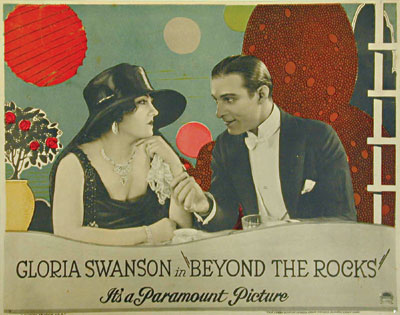
I started this post because I’ve been walking past the film festival tickets and programme I’ve kept for over a month now to remind myself that I had promised to post something here about the films I saw at the BIFF. The ticket on top at the moment is from the silent film I saw Beyond the Rocks.

Every year the BIFF presents a silent film which is screened to the accompaniment of organ music. Whatever film is playing it’s a bit of a special occasion because we just don’t have these kind of cinematic experiences any more; any extra-filmic music is usually courtesy of those miscreants who still haven’t figured out that it’s just plain rude to leave your mobile phone on in the cinema (or haven’t the poor dears figured out the silent mode of their phones, yet?). I always feel like I’m getting two for the price of one, a concert and a film experience (when I see the silent films that is, not when I’m distracted by the ignorant mobile phone owners).

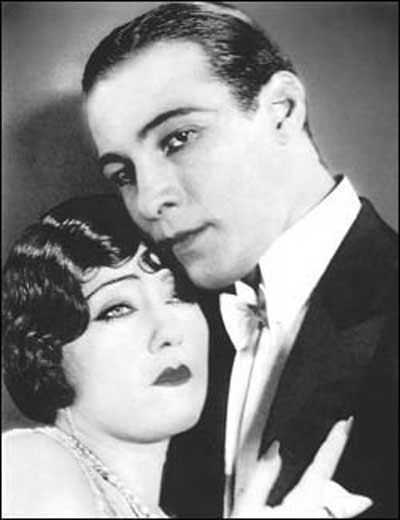
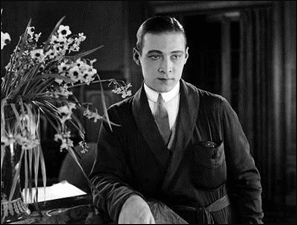
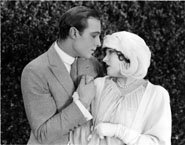
This year the film was one that, until very recently it was thought, had been lost to the annals of decay. Then someone was scavenging through an un-catalogued archive in the Netherlands somewhere and found a near complete copy. It was promptly restored and now you can get it on DVD. People who know about these things were very excited about the discovery of Beyond the Rocks, not only because it’s an old film, but because it was an unusual film for its time since it featured two stars of Hollywood in the one film, Gloria Swanson and Rudolph Valentino. While this kind of double act is fairly common practice now, apparently, at the time, it was not. Gloria Swanson read the move as a slap on the wrist for daring to ask for more money for the films in which she starred; she maintained that putting her in a film with Valentino was a way of reminding her that she was not the star she thought she was. One wonders what kind of atmosphere this knowledge made for while shooting, but any fears that there would be fisticuffs at dawn between Rudy and Gloria as they vied for superior star status were, we learnt, put aside because they really were very good friends. Oh, I love a happy ending.


The film itself was an adaptation of a torrid romance novel, about an ill-timed flirtation between a young woman and an aristocrat, while she’s on her honeymoon with her overweight and, it must be said, not terribly robust, older husband. The poor neglected husband seems to make matters much worse for himself by getting sick in the mountain air and on almost every other occasion. I ended up feeling quite sad and sorry for him.

Still, when the competition is Rudolph Valentino, not too many would stand a chance. I swear, I had to catch my breath and fan my face; I was all aflutter after watching Valentino on screen. The appeal of him as an actor and sex symbol is more than obvious. Dr H. credits Valentino with giving her a crisp white shirt and cuff links fetish, and while the man himself was beautiful in his own right, the fashion of the 1920s and the costumes in the film did him no harm whatsoever.


The costumes served Ms Swanson rather well too, it must be said. Seeing all those twenties outfits made me wish I could see them in full colour. I’m sure the seamstresses amongst you can appreciate the work that has gone in to them more than I ever will, but they were quite glorious.

This is a strange poster; the fashion is completely wrong.

While there were no mobile phones going off in this film, there was a distraction that neither I nor anyone sitting around me could understand. It was only ten minutes into the film when it became obvious that someone had fallen asleep and was snoring! I did my very best to tune the offender out, and I was successful thanks to the appeal of Valentino. Alas others were not so successful, and after I had declared to all and sundry that Valentino was ‘hot’ and managed to regulate my breathing again, the conversation turned to the snoring man. I could elaborate, but really, all I can think about is Rudolph Valentino; the way he holds his hands, the way he leans against a tent pole, the way he fixes Gloria with his gaze... Phew!

Monday, August 14, 2006

Another Parallel Universe

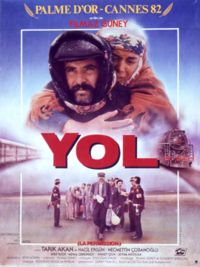
The second film I saw at the Brisbane International Film Festival, Yol, was one that screened as part of Unveiling Islam, a major focus on films from Turkey and Iran. As the emphasis on the veil in the programme’s title suggests, the films that ran as part of the focus were concerned with women in the cinemas of the two Islamic countries. The BIFF catalogue offers, ‘In both countries, cinema began as entertainment for men by men. At the turn of the century in Turkey, armed fundamentalists were occupying theatres and threatening to knife any woman who dared to enter. In Iran, ordinary men experienced cinema in 1908, but ordinary women had to wait another twenty-one years, until a movie-theatre was opened for women.’ In addition to limits placed on even being able to go to the cinema, Muslim women did not appear in the films of Turkey and Iran until 1923 and 1933, respectively. In Turkey, Muslim women needed their husband’s permission to appear in films and therefore it was no surprise to learn that the representations were less than empowering: ‘In both countries, women were generally depicted as gullible weak creatures, a threat to the nation’.

If you’re interested in learning more about the programme and the history of cinema in Turkey and Iran, you can go and read the full text (pdf) that appeared in the free BIFF Catalogue. It seems superfluous to continue replicating it here, plus it diverts from my professed intention of offering a personal response to the films I’ve seen at the Festival. In total, I saw three feature length films and one short in this focus, and I watched them half aghast and half in admiration when I thought about the odds that the film-makers had to overcome, not only to get these stories to the screen, but also to ensure that prints of their films even continue to exist.

In an aside, I also went to a seminar this week about the documentation of the second wave feminist movement in Australia. As part of her presentation, Margaret Henderson recounted the dismal tone of Gisela Kaplan’s A Meagre Harvest, which laments the failure of the feminist movement in Australia as one that only yielded rewards for middle-class women and ‘a few film-makers and artists’. After seeing these films from Turkey and Iran, I couldn’t help but think that while human rights for all classes of women should continue to be a priority, we could probably afford to be a lot more optimistic about the ground made by those women who fought for all of our rights to represent ourselves.

Yol

After I saw Yol (1982), by Turkish film-makers Yilmaz Güney and Serif Gören, I was a bit fragile. I ran into someone I knew, who asked me how I’d enjoyed it, and I had to blink rapidly, because as I began to talk about it I started to tear up.

Güney wrote Yol while he was in prison and Gören directed the film on his behalf. It tells the story of five men who are granted leave from their prison sentences for a week so they can visit their families. The film follows the prisoners on their journeys home to various parts of Turkey, and it is in this way that a mosaic of Turkish society emerges.

The men travel by bus and train and are all stopped at some point by the military demanding to see identification. One of the men has lost his ID, so he spends his leave detained, while the guards seek confirmation from the prison of his legitimacy. Others have their travelling delayed due to a curfew imposed by the military. Again, these men are detained, but at least only until the next morning.

The film shows a society where the military subject the Kurdish people to ongoing assault, and the Kurdish do not publicly admit to the identities of their dead for fear of further retribution; where a man is duty bound to marry his brother’s widow, and a widow has no choice but to accept her dead husband’s brother; where men freely visit prostitutes, and women are condemned to death for making a living in their husband’s absence.

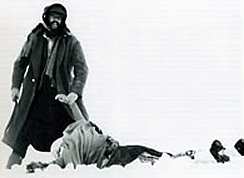
The most disturbing scenes of the film for me were those where one of the men travelled on a horse through the snow to retrieve his wife who had been locked up by her family for eight months, fed only bread and water, and denied any bathing facilities. The man’s brothers-in-law had been waiting for him to return home so he could have the first opportunity to restore their family’s honour, which had apparently been damaged by their sister when she prostituted herself. While the prisoner is angry at his wife’s infidelity, he is reluctant to kill her because he loves her. He has no choice but to make the journey through the snow—again, it is a matter of honour, his brothers-in-law will kill their sister anyway, but will condemn her husband if he doesn’t assert his authority.

There is no happy ending. The horse doesn’t make it, and on the journey back, its carcass has been scavenged by birds of prey and wolves. The wife begs that her fate not be the same as she too struggles against the snow, trailing after her husband and son, ill-dressed for the weather. Belatedly, the man tries the same method to restore his wife against the freezing conditions that he used on the horse, flogging her, to no avail.

Saturday, August 12, 2006

A Parallel Universe

Introduction

My recent cinema viewing cannot be done justice through my usual practice of listing the last five films I’ve watched on the side-bar. To begin with, I’ve been attending the 15th Brisbane International Film Festival, and I bought two ‘Take Five’ passes, so the films I saw just last week would have already dropped off the list if I’d been listing them as per usual. As it is, I think I’m going to go back and just list the BIFF as one entry, that is if I can retrieve, either from my memory or an old index page, the films I watched before the Festival started.

The purpose of this post is to give due respect to the films I’ve seen at BIFF, and maybe create a record to serve my own memory. I don’t really want to review them in any concerted way, just comment on what I got out of them. On another level, it intrigues me that any number of people can attend an event like BIFF and have entirely distinct, or parallel, experiences of the Festival. This is my BIFF universe.

Klimt

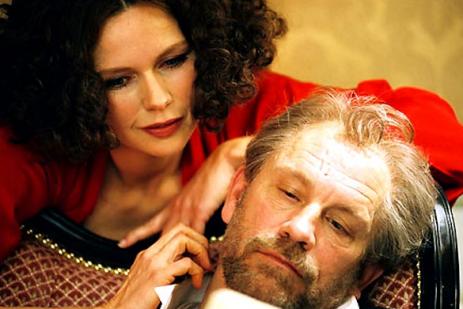
The first film I saw was Klimt, a kind of surrealist bio-pic of the eponymous artist, by Chilean director, Raul Ruìz. If Klimt’s work has become a hollow currency through mass-produced popular culture in the form of prints that grace the walls of aspiring intellectuals, then Ruìz’s film portrays an artist whose vision was at odds with the political elite of his day. It becomes clear that Gustav Klimt depended upon the acceptance and patronage of the Viennese government to continue inhabiting and working in Vienna. Despite this state of affairs, Klimt is not inclined to flatter those upon whose good will he depends. He is only saved, it seems, from being banished, because he wins an award or two.

There is no coherent narrative in Klimt, a decision that is motivated by the perspective of Klimt as he is being treated for syphilis. While the mercury treatment is cause enough to addle anyone’s brains, the point-of-view is also an attempt to convey Klimt’s artistic vision. The BIFF catalogue describes this as ‘kaleidoscopic, mysterious and passionate’. ‘Mysterious’ could simply be the charitable interpretation of what might otherwise be deemed obscure, but, apparently, as far as Ruìz’s films go, this one is accessible. ‘Kaleidoscopic’ is probably a more accurate description than ‘impressionistic’, which is the term I initially wanted to use to describe the disjointed narrative. But I suppose there isn’t an entirely coherent picture of either the film or the artist that emerges in the end, and I guess it’s best to avoid confusing your artistic movements.


Visually, the film is impressive. Distorted and mirrored images convey a sense of the complexity of Klimt as an individual. For me, John Malkovich in the lead role was a bit of a distraction. I had high hopes, since I had just seen him play Charles II in The Libertine, and for once he hadn’t used that voice he does: slightly effete with lots of disdainful pauses. Unfortunately, that voice was back in Klimt. In spite of this irritation, the portrait of Klimt could be deemed successful. The film avoided the usual pitfalls of bio-pics where the artiste is a misunderstood genius. Klimt sketches a man who is difficult and sexually promiscuous (and prolific, if the reports of the numbers of children he fathered are accurate) ; he wasn’t terribly likeable if you weren’t in his favour.
Most importantly, I think, the film pays attention to Klimt’s art. Its beauty is suitably fêted in the representation of the artist models, the golden glow that suffuses every frame, and in one glorious moment where gold leaf flies into the air and continues to rain down long after it would have stopped in a realist picture.


'A Parallel Universe' will be continued...

Friday, July 21, 2006

This Life on Earth

Who’d be a penguin? And even if you believed in re-incarnation, could you choose to be a penguin over, say, the privilege of being a human being or the curse of being a bug relegated to the undergrowth? Hmmm. Just what is the hierarchy of sentient beings according to Buddhist teachings?

I’ve been vaguely wondering who’d be a penguin, ever since I saw March of the Penguins at the cinema. They lead such harsh lives, especially during their breeding season. How do they survive as a species, I wonder? Between the arduous trek to the heart of the Antarctic, the standing around in the snow and wind, the perilous and often fatal transfer of the egg from the female to the male, the standing around in the snow and wind, the near starvation, the threat of predators, the standing around in the snow and wind… life doesn’t look all that good for a penguin. Maybe it’s better to be a bug; at least if you get eaten by a predator, the end is bloodless—unlike the unenviable fate of sea lions when they’re tossed into the air and mauled to death by killer whales

Recently I’ve been reminded of my concern for penguins while watching the first episode of the BBC documentary Planet Earth. Again, I learnt about the male penguins nursing their eggs on their feet. In this instance, they didn’t mention that the females, after the exertion of having just laid the eggs, had to return to the sea to get some food, either that or turn into popsicles through lack of nourishment. Always the male penguins get the praise for looking after the embryos. Still, after watching the second episode now, I’m enjoying the David Attenborough narrated documentary. While I might wonder about the future of penguins, it’s no surprise that pandas are a dying breed. Can’t they find something else to eat, other than the nutritionally poor bamboo?


adopt your own virtual pet!


Anyway, with the magic of the Internets I’ve taken a penguin under my arm. Her name is Gwyneth—Gwen for short, and alliterative reasons. Unfortunately I couldn’t find any pandas to adopt.

Saturday, July 15, 2006

Entertain-Mints

So, right now I’m thinking that when Robbie Williams comes to town in December, I will be able to sell tickets for a seat at my dining room table, because so far this afternoon I’ve been treated to some very clear choral renditions of Advance Australia Fair and Waltzing Matilda from Suncorp Stadium, as it prepares for an international Rugby Union match later tonight. The mp3 player on my newly acquired mobile phone would be proud to achieve that kind of sound quality.

Before Robbie arrives to entertain us though, I’m looking forward to the Brisbane International Film Festival (BIFF) next month. I’ve just been perusing the schedule and there are many decisions, or rather eliminations, to be made. I never feel compelled to go along to the opening or closing night films—admission to those requires parting with larger sums of money than for the usual screenings and I’m frightened by the thought of socialising with film industry types and their entourages in the after-parties that always follow. Besides, you can always be certain that the films shown on those occasions will have no trouble finding distributors, indeed they probably have deals already.

I didn’t go to the festival last year, so I’m not sure if the ‘Showcase’ event was introduced then, but it seems to be another kind of cinema event involving a party afterwards. It’s less expensive than the Opening Night, but more expensive that the Closing Night. Again, while I would be very interested to see Thank You for Smoking, 48 Shades and Like Minds, all of them will be released more broadly, even the Australian films. It would be good to see the film-makers talk about their work, which they seem to be doing as a part of these Showcases, but the whole party-afterwards puts me off. I prefer the straight forward question and answer sessions with film-makers that you get at the regular sessions where the director or an actor, sometimes a producer, are there as a guest of the festival.

After the films that are followed by parties are crossed off my list, I tend to draw a line through anything from the USA, the UK or France. Again, my reasoning here is that even if they won’t be at Hoyts or South Bank, they will show at the Palace or Dendy cinemas. To my mind, the only reason to see films from these countries at a film festival is if you must be amongst the first to see things. (If you haven’t guessed already, I tend to be amongst the stragglers in the uptake of any ‘new’ cultural phenomenon—that mp3 player on my phone is my first foray into the technology). Another reason, of course, is if you’re a fan of either the film-maker or the topic of the film. I remember, a couple of years ago at the festival, many of the Metallica fans who were turned away at the ticket counter to Some Kind of Monster seemed very disappointed. I was sympathetic to their plight, but for myself—not an aficionado of metal—I figured I could wait a couple of weeks until it began screening at the Dendy, at which time I thoroughly enjoyed watching those crazy rock stars scream at one another in group therapy.

Another measure I have for narrowing down the range of choices at the BIFF is to see whether the film is funded by SBS or ABC, in which case you can be sure it will appear on those broadcast television networks in the next few months. While ordinarily I prefer to watch a film on a cinema screen, when a television station is a production partner, generally the film has been made for the smaller screen and so little is lost in a visual and aural sense by waiting to watch it at home.

Even after all of these carefully considered eliminations, there is still much more to see than any one person can easily absorb over two short weeks. This year, there’s a major focus on women film-makers and women in film from the Islamic countries of Iran and Turkey. I’ve really enjoyed the Iranian films I’ve seen in recent years. I’m interested in seeing a recently recovered silent film with Rudolph Valentino and Gloria Swanson in it, Beyond the Rocks. It must surely be compulsory to see the first heart throb of cinema in action on a big screen. Since there’s little opportunity to see experimental film, I’m intrigued by the description of Figner, the End of a Silent Century: ‘A homage to the man who has provided the sound of footsteps, door-slams, and fist fights for films in St Petersburg for decades. When Figner (playing himself) takes a train journey, reality, memory and fiction blur as his fellow travellers take the form of characters from films on which he has worked.’ I have very fond memories of The Five Obstructions, a documentary film where Lars Von Trier collaborated with Jorgen Leth, setting limits--an edit every 24 frames, anyone?--to recreate segments of Leth’s 1967 film The Perfect Man. I’m not sure I’ll be able to resist seeing Executive Koala from Japan. It’s the story of an office worker—a giant koala (his boss is a similarly proportioned rabbit)—who becomes a suspect in his girlfriend’s murder. Apparently there are song and dance routines in that one. I also want to see Klimt by Raul Ruiz. And the puppet animation of Kihachiro Kawamoto in The Book of the Dead.

I haven’t even touched on the films in the World and Asia Pacific Cinema pages.

Oh. Decisions, decisions.

Saturday, January 28, 2006

Rhythm 'n' News


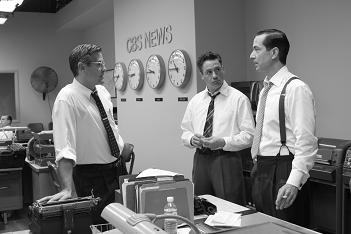
Before yet another film I’ve recently enjoyed gets superseded from the ‘Now Screening’ list with nary any other mention, I should take a moment to reflect upon Good Night, and Good Luck (George Clooney 2005). It tells the story of the makers of See it Now, a television news program which aired in the USA in the early fifties. In particular the film catalogues the program’s response to the methods used by Senator Joseph McCarthy as he sought to expunge his country of communists and their sympathisers through his inquiry into allegedly un-American activities. Anyone who has ever studied Arthur Miller’s The Crucible will be more than familiar with the kind of criticism that has been directed at McCarthy’s hysterical accusations. And just as Miller turned to an historical event to comment upon contemporary affairs, so Clooney, both writer and director of Good Night, and Good Luck, opines on present-day North America by revisiting the media’s response to the McCarthy Senate Committee. In taking this approach, Clooney implicates today’s journalists and media managers and owners in the witch hunt of our time, all the excesses and injustices that are perpetrated in the name of the inquisition into terrorist activities.

More than a criticism of the actions and policies of the current US Administration, Good Night, and Good Luck seems to take issue with the surfeit of opinion and the entertainment values that characterise present day journalism. In the case of the former, the film establishes its critique by showing how the See it Now production team builds its argument against the tactics of Senator McCarthy simply by showing footage of him addressing the senate inquiry and the North American public. Clooney also utilises this convention in his representation of the senator, by avoiding the use of an actor to play McCarthy; the film seamlessly splices the historical footage of McCarthy’s filmed appearances with the contemporary film stock. Of course, even unadulterated footage offers a perspective that precludes others, however the apparent integrity of the investigative journalism practiced by the makers of See it Now is contrasted sharply to the preoccupation with entertainment values in news which, it is stated, contributes to the eventual demise of the program. In Good Night, and Good Luck, the managers of the television business cite the demands of the audience who want more entertainment with their news, to whom they are obliged to respond in order to ensure the ongoing viability of their programming. Clearly, Clooney is sceptical of this argument, as is the presenter of See it Now, Edward R. Murrow (David Strathairn) who, pre-empting Theodor W. Adorno, calls for the deployment of television as a medium that might inform and educate.

More than the examination of the events surrounding the McCarthy Committee inquiry, what I most enjoyed about this film was its representation of television as a nascent medium. The re-creation of the live broadcasts throughout Good Night, and Good Luck illustrates the way that television developed along a model established by the conventions of radio. Television’s debt to radio is further acknowledged in the various montages throughout the film where an African-American jazz band is recording in one of the sound studios at CBS. The music contributes to establishing the film’s era, but also conveys, through the pace it sets, the sense of improvisation that must have characterised the early years of television, especially when producing such politically challenging journalism. The use of black and white film also worked well, preserving the sense of the era by smoothing the transitions between the historical and contemporary stock.


I really can’t speak highly enough of Good Night, and Good Luck. George Clooney’s work as a director puts me in mind of the excitement I felt when it became apparent that Clint Eastwood was a new directorial talent. I’m not sure that Clooney ever attracted the disdain for his acting work that Eastwood did for all those spaghetti westerns, but, if I may say so, it’s a bit of a thrill to learn that such a sexy man has a political conscience and prodigious talent.

Sunday, December 18, 2005

Smoke Gets In Your Eyes

If Annie Hall is a frantic meditation on the nature of romantic relationships in which the individual is ultimately preserved, then Smoke is a gentle rumination about small acts of kindness that draw isolated people into communion...
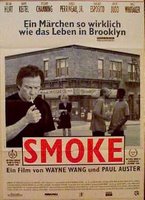
In my earlier post I mentioned that Smoke was directed by Wayne Wang, but I didn’t say anything about the writer of the screenplay, Paul Auster. Without any disrespect to Wang’s direction, for me the main pleasure of this film is Auster’s contribution. I watched it as though Auster was entirely responsible for its authorship. In part, this is because, as I have indicated previously, I am entranced by the scope of Auster’s imagination and writing, however, the opening titles of Smoke encourage the privileging of the screenwriter over the director in this instance. It is a film by Wayne Wang and Paul Auster. In the closing titles, the film is ‘Written by Paul Auster’, adding weight to his authorship of the film, beyond that with which screenwriters are usually credited. I daresay that Auster’s well-established audience was a key consideration in the promotion of the film. The cameo appearance by Auster’s son, Daniel, as the ‘Book Thief’ is a signature that irrefutably marks the film as Auster’s, in a manner similar to Alfred Hitchcock’s on-screen presence throughout his oeuvre.

Watching Smoke this time, I was reminded of Auster’s most recent novel, The Brooklyn Follies. Both stories are set in Brooklyn which holds host to a range of isolated characters who are drawn into taking care of one another. There is something inexorable about the relationships that are formed, as if being responsible to those around them is intrinsic to the characters’ constitution. This is in spite of individual characters’ initial resistance to being more than considerate of the strangers they encounter. In Smoke, the character played by William Hurt is a writer named Paul Benjamin*. He buys cigars from a local tobacconist, Auggie (Harvey Keitel), and shields himself from others with the pain of his wife’s sudden death; she was shot, caught in cross-fire, on her way to work one morning. She was five months pregnant. Paul is drawn into the conversations which are part of the service in Auggie’s shop#. One evening, just as Auggie is closing up, Paul runs up to him, breathless, and asks him if he could still buy some cigars. Auggie raises the security grill on his door and soon Paul and Auggie are sitting at a kitchen table smoking, drinking beer, and looking through Auggie’s photo albums.
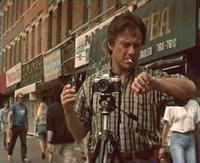
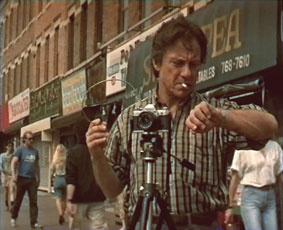
Auggie’s photo collection is a record of a ritual he has undertaken everyday for all the years he has owned the tobacco shop. Each morning at 8am, Auggie sets his camera on a tripod on the corner across from his store and takes a photo of the activity in ‘his’ corner of the world. He explains to Paul that it’s his project; his life’s work is represented in over 4000 photographs of the same corner in Brooklyn. Paul says that they’re ‘overwhelming’ and he flips through them rapidly, not really looking at them. At first, Paul doesn’t understand when Auggie tells him to slow down, after all the photos are all the same. Auggie explains how different each one is; because the earth rotates around the sun each day the light is slightly different in every one, to say nothing of the shifts in weather and thus the clothing people are wearing. Eventually Paul comes across a photo of his wife. He says, ‘Look at my sweet, sweet Ellen’.

The notion of a ‘life’s work’ is a recurring concern in Auster’s work. The nature of the obsessions that occupy the lives of Auster’s characters are often repetitive and seemingly pointless. As well as Auggie’s photographs in Smoke, there are the films made by Hector Mann in The Book of Illusions, which are produced without any desire on behalf of the film-maker that they will ever be shown, despite the interest in his work, which is exemplified by David Zimmer—also recently widowed—who devotes his time to ‘finding’ Mann. The endless walking of the streets of New York by Stillman in 'City of Glass' is incomprehensible to the character Quinn who decides to follow him on his apparently aimless meandering; and Quinn himself ends up spending his days waiting in all kinds of weather for a glimpse of Stillman after he has lost track of the older man. The point of the repetitive actions is, for me, best revealed in the opening sequence of another author’s work. In The Unbearable Lightness of Being, Milan Kundera explains his understanding of Nietzsche’s concept of the eternal return:

'...the idea of eternal return implies a perspective from which things appear other than as we know them: they appear without the mitigating circumstance of their transitory nature. This mitigating circumstance prevents us from coming to a verdict. For how can we condemn something that is ephemeral, in transit? In the sunset of dissolution everything is illuminated by the aura of nostalgia...

If every second of our lives recurs an infinite number of times, we are nailed to eternity as Jesus Christ was nailed to the cross. It is a terrifying prospect. In the world of eternal return the weight of unbearable responsibility lies heavy on every move we make. That is why Nietzsche call the ideas of eternal return the heaviest of burdens...' (4-5)
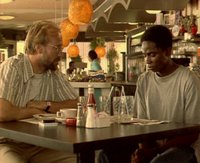
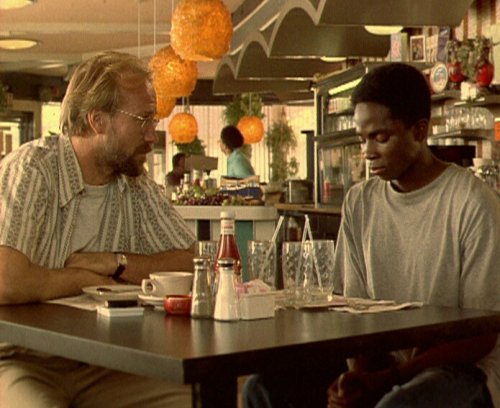
I’m not sure if my interpretation is entirely valid; I know that Auster references Cervantes’ Don Quixote a lot (especially through the characters who drop everything to follow their obsessions), but I don’t know enough about either Nietzsche or Don Quixote to know if the two are compatible. I suppose my referencing of Kundera’s work is premised on the notion that Auster’s characters are drawn to assume responsibility for one another through the repetitive obsessions in which they are engaged, or even just by taking time over the apparently tedious concerns of everyday life. It’s Auggie’s photographs that elicit a break in Paul’s numb façade, that enables him to finally grieve and thus to be comforted by Auggie. It’s the repeated appearances of the frightened young African-American boy who introduces himself variously as Rashid, Thomas and Paul (Harold Perrineau Jr.), who is on the run from some criminals he stole from, that prompts Paul to ask Auggie to give the teenager a job. Rashid uses the same method to get to know his biological father (Forrest Whittaker), sitting across the road from the garage he owns. It’s the drip, drip, drip of water from an overflowing bucket abandoned by Rashid onto Auggie’s stash of Cuban cigars that ends his dreams of making a fortune through trafficking the contraband. Rashid is able to reimburse Auggie the money he lost on the purchase of the cigars with the money he stole. Instead of reinvesting the money in cigars, Auggie now has the money he didn’t have to give to his ex-wife (Stockard Channing) who asked for his help with her daughter, and so he gives it to her without strings. It seems that through repetition the characters’ lives attain meaning, and they are unable to escape their responsibility to one another. The responsibility that the characters’ assume is not the ‘unbearable burden’ that Kundera first introduces us to—indeed he goes on to immediately question the negative attributes of weight—but it is a load that imbues the most apparently insignificant existences with ‘splendid’ life.


*Names are carefully wrought in Auster’s work. They are always borrowed—from the author’s life, from the author’s other works, and from other writers’ lives and works—and each new borrower carries the full weight of everyone who has borne those names previously.

#One of the conversations that is not central to Paul’s story is one that occurs in the background between three of the shop’s regulars, one of whom is played by the vastly underrated Giancarlo Esposito—seen recently on television in 5ive Days to Midnight with Timothy Hutton. It prefigures another deftly placed conversation in The Brooklyn Follies about yet another war in Iraq.

Wednesday, December 14, 2005

New York Stories

On the weekend Channel Seven screened Annie Hall (Woody Allen, 1977) and Smoke (Wayne Wang, 1995). They were shown at an unsociable time, between 10.40 and 3am, on the cusp of Saturday and Sunday, but still, that they were scheduled at all on free-to-air television, and together, felt like an unexpected gift. I set my DVD recorder to Extended Quality recording so it would capture the full four-and-a-half hours combined of these New York films. And now, at the time of writing (this paragraph at least)—10.00pm on Sunday evening—I’ve just finished watching Smoke. I watched Annie Hall earlier in the day, between solving Tangram shapes and a mid-afternoon sleep from which I emerged strangled by a yoke of sweat .

While both Annie Hall and Smoke are set in New York and each seems quintessentially ‘New York’ in its sensibility (or what I know about New York from films, books and television), the contrast between the films couldn’t be greater. Woody Allen’s film is filled with what became his signatures: an adult love affair which is marred by ill-timed and mismatched passions between an equally mismatched pair of individuals. Why is it that the characters played by the strange creature that is Woody Allen are partnered with the most charismatic of women such as Diane Keaton? It’s a conceit that we have to accept in all of Allen’s films. (Although the writer/director’s succession of romantic partners throughout his own life—including Keaton—would suggest the premise is less of a conceit than I am able to imagine). Many people cite Annie Hall as their favourite Woody Allen film. Even people who don’t like his films as a rule like this meditation on the progress of a relationship, from the first awkward overtures by Annie towards Alvie, through her decision to move on, to his fond reminiscence of their friendship.

Reflecting upon this canonisation of Annie Hall over Allen’s many other films, I wonder to what extent its popularity has to do with Alvie’s final summary of romantic relationships. While the film is quite prosaic in its conclusion that people don’t live happily ever after, ultimately it is quite idealistic. In Allen’s films people meet, they fall in love (?), they get to know one another, and then they fall out of love and have a mutually agreed upon separation, after which they remain friends who will enjoy each other’s company when they meet by chance on a New York street. I wonder if audiences forgive the anxious prate in Annie Hall, more than in Allen’s other films, because Annie and Alvie part without acrimony, without divorce settlements or child custody disputes, thereby presenting an ideal of the end of a relationship. It’s seductive to think that one might fondly recall only ever being gifted books on death by one’s ex-partner precisely at the moment of dividing the library accumulated during the relationship. The philosophical position that Alvie adopts at the end of his reminiscence about his relationship with Annie absolves both parties of any hurts inflicted and concludes that relationships are worth the effort despite the trouble . I’m just curious that there doesn’t seem to be any ‘trouble’ in Alvie and Annie’s relationship. What is slightly disturbing is that Alvie’s principal reason for being with Annie seems to be to educate her, to mould her into a ‘better’ woman. He takes her to see films and counts a post-relationship sighting of her taking a new lover to The Sorrow and the Pity as a ‘personal triumph’; he pushes her to take college courses with the sole aim, it seems, of ensuring she gets the references in his stand-up routines, but then asks her to give up her studies when she begins to form relationships with the interesting people he assured her she would meet; and he pays for her to see a psychoanalyst. Even when Annie’s analyst suggests that moving out of Alvie’s apartment will be good for her, Alvie says he trusts her analyst’s advice because she was recommended by his! To the film’s credit, Annie is never controlled by Alvie’s Pygmalion tendencies, and she uses what she has absorbed from college and in analysis to make decisions which are in her best interests (although moving to California to live with Paul Simon and his bad seventies haircut cannot be condoned).

***
Next Post: Smoke

If Annie Hall is a frantic meditation on the nature of romantic relationships in which the individual is ultimately preserved, then Smoke is a gentle rumination about small acts of kindness that draw isolated people into communion...

Sunday, September 11, 2005

Chocolate Fish

Johnny Depp has come a long way since his 21 Jump Street days. If I remember correctly, the programme’s premise was rather flimsy: a handful of recently enlisted police were singled out for undercover operations. The chief criteria for recruitment to the secret taskforce seemed to be youth. The recruits had to be able to pass as high school students to infiltrate pubescent drug rings. The team that was formed was a veritable United Nations of law enforcement. Aside from Johnny Depp, there was an African American woman, whose name I can’t recall, and Dustin Ngyuen. They were lead by an African American man, who later played Fox Mulder’s government contact in The X-Files. There must have been someone else; four people does not a taskforce make. They conducted their work from a secret location, the impression of which remains in my memory as a brick warehouse, with high ceilings, more akin to a nightclub than the base of exceptional detectives. The operation was always under threat of being closed down at the provocation of the renegade behaviour of Depp’s character and the political whim of whoever controlled the budget.

Of course, like everybody else, I had a crush on Johnny Depp, but I also remember watching him and having this revelation that he could also act. The particular moment in which I had this epiphany was in the episode where his character’s girlfriend was shot and killed in a convenience store hold up. In the series, Depp’s character had been contemplating breaking up with his girlfriend out of sheer indifference to her. When the girlfriend was shot, Depp’s character was at the back of the shop, getting milk from the fridge. He saw the gunman and just froze. The arc of the episode involved Depp’s character torturing himself with what he could have done in the seven seconds between his sighting of the gunman and the shot that ended his girlfriend’s life. One of the things he discovered was that it was possible to undress and dress again, including tying his shoelaces. Depp’s character practised this feat over and over again, reducing the time on each occasion. Add to this obsessive behaviour the guilt of not loving his girlfriend... well, it made for quite intense television.

Twenty years later, I still appreciate Depp on both levels. I saw Charlie and the Chocolate Factory last weekend and Depp’s portrayal of Willy Wonka as an eccentric entrepreneur with a palpable dislike of children is riveting. Now, whoever designed Wonka’s teeth deserves much kudos; they contribute so much to the character, and Depp uses them to great effect. Aside from that perfect overbite (I couldn’t help but think of Tom Cruise), there are a couple of other moments worth mentioning: when Willy Wonka answers one of the children’s offer to supply him with their names, he raises his eyebrows and counters, ‘I can’t think what difference it would make’; and the moment when Veruca Salt disappears down the bad nut disposal chute and Wonka encourages her father to rescue her, the way Depp opens the gate is replete with meaning. (I loved the squirrels, too.)

So, we know that Johnny Depp has been the most successful graduate of the 21 Jump Street alma mater, and I’ve mentioned that the agents’ boss resurfaced on The X-Files every time Mulder put a masking tape X in his window, but what of the others?

Today I saw Little Fish. I was sitting there looking at the character of Johnny Ngyuen, thinking he looked familiar. I thought he looked like the Vietnamese guy from 21 Jump Street, but dismissed the idea; what would he be doing in an Australian film? I must have seen him on some Aussie soap. On the way out of the cinema, I picked up a brochure for the film. I often like to read the publicity after I’ve seen a film to see if it matches my impression of it. I don’t like to read all that five star hyperbole before going in because you’re just set up to be disappointed. As well, I find it fascinating to see, in the publicity brochures, what films they list in brackets behind the actors’ names as instances of their noteworthy performances. In this instance the question is begged, why is Hugo Weaving’s filmography reduced to The Matrix? It’s an Australian brochure promoting an Australian film to an Australian audience; we know his work outside of offshore Hollywood projects (!); at least mention Proof. Anyway, reading through the brochure, I discovered that my memory of 21 Jump Street was not limited to Johnny Depp; the Johnny in Little Fish was played by Dustin Ngyuen of that long ago television series. I’m sure he’s been in much better things in the intervening years than the brochure cared to divulge, especially if his appearance in Little Fish is any indication.

If you haven’t seen Little Fish yet, it’s important to know that there will be no Charlie and the Chocolate Factory ending. The brochure cites reviews of the film that describe it as ‘real’, ‘excruciatingly honest’ and ‘frighteningly accurate’. I’ve always hated the use of words like ‘real’ and ‘truth’, because they do nothing to prepare anyone for the experience of watching a film that doesn’t follow a classical Hollywood narrative structure. Whatever your conception of reality is, it is better to know that the film depicts the struggle of Tracy, played by Cate Blanchett, to get a loan so she can become a partner in the business where she is a manager. The trouble is she was a drug addict and has a credit history which involves fraudulent practices. Even though she has been clean for four years she is refused the loan by various financial institutions on the basis of her former life. The limits of Tracy’s prospects are developed in the cinematography; the depth of focus is shallow throughout, trapping the protagonist in a world which is defined entirely through her current relationships with people who are from her past. Dustin Ngyuen plays Johnny, Tracy’s former boyfriend, who disappeared to Canada over five years ago without bothering to say good-bye. His reappearance is both a complication, since he shared her drug addiction, and a pleasure, because she hasn’t exorcised him from her heart.