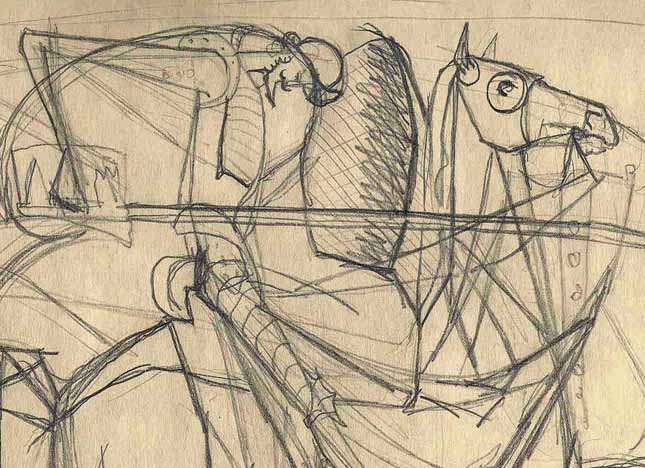
I am reading Don Quixote by Miguel de Cervantes Saavedra. In order to keep myself on task and so finish this 940 page tome, I have enlisted the support that your presence will provide to urge me to continue reading. I will post a record of my progress here at irregular intervals, as well as any comments and questions that are provoked by the text along the way.
IV. A Very Very Long Post On Literary Doubts and Questions Which Are Worthy Of Being Known And Related.
A few weeks ago in the Review supplement of The Weekend Australian, there was an article on Edith Grossman, the translator of the most recent version of Don Quixote. She was visiting Australia to attend the Ibero-American Cultural Festival in Canberra.
I was aware of Grossman’s 2003 translation of DQ through 400 Windmills—it was the version the site’s contributors had elected to read. From reading their enthusiastic comments about Grossman’s translation, I had begun to wonder whether some of my impatience with the novel might be attributed to an outmoded translation. Although I bought my copy of DQ in the late 90s, the translation by J.M. Cohen is dated 1950. Perhaps Cohen was one of those translators who subscribed to the notion of the ‘invisible translator’ described by Bernard Lane in his interview with Grossman. Cohen writes an introduction, but he is very clear that he has included as few notes as possible to avoid replicating the ‘long notes in the more ponderous editions of the book’. The trouble with Cohen’s approach is that the allusions he doesn’t bother to explain, because they were ‘topical’ at the time Cervantes was writing, renders his DQ bereft of its social and cultural context and, thus, much of its meaning. An example of the ramifications of this stripping of context for someone who is not terribly familiar with the 17th Century is upon the introduction of the village priest: ‘A learned man, a graduate of Siguenza’. One of the contributors to 400 Windmills says that Grossman’s notes explain that ‘Siguenza was basically the 17th Century equivalent of a party school’. When I read this, I realised how differently I would have perceived the priest and his literary judgements if I’d known about the dubious calibre of his qualifications in the first instance. It took me ages to figure out the priest (if indeed I have), when I could have been aware from the very beginning of the irony of his inquisition into Quixote’s library.
In the absence of knowing the 17th Century context of DQ, I have had to interpret the novel in the context of this century. Again, the contributors at 400 Windmills provide some guidance on this. One contributor approached DQ by trying ‘to imagine what kinds of changes would be made to the characters and plot that would let us as 21st Century readers relate to the novel ... as 17th Century readers did’. He concludes that the 21st Century equivalent would be hard-boiled private detective fiction. He writes:
Picture the plot of DQ reimagined for contemporary times; of this middle-aged college professor who goes nuts from reading way too much crime pulp fiction... and suddenly starts wearing a Sam-Spadesque outfit all the time (the trench coat, the fedora) roaming the streets of New York, butting into situations when he clearly shouldn’t, attempting to solve crimes, sticking up for the little guy, making up some long-legged femme fatale with whom to be in love...
Well, here’s the Paul Auster connection. Even if the contributor was unaware of Auster’s work, he has loosely described a number of his novels, especially The New York Trilogy, but also those where the characters (not necessarily employed as detectives) roam across America in pursuit of various dreams, and always the notion of one’s life’s work which informs the protagonist’s reality. The contributor goes on to make some disparaging remarks about popular crime fiction. A female commenter takes up the contributor’s line of thought by trying to think of a contemporary female equivalent to DQ. The contributor suggests Norma Desmond from Sunset Boulevard, citing her age, her loose grip on reality due to a popular form of entertainment—silent films—and her fantasy life in which her past glories are experienced in the present. Personally, I keep thinking of Nigel, from the documentary series Nigel’s Place In France, a real life Don Quixote moving country and opening a restaurant all at the behest of a beautiful woman. Nigel’s friend Nippi is the equivalent of the priest, trying to talk sense into the quixotic hero. Reza is Sancho who is quite mad himself but enables Nigel in his quest to open a restaurant and, when that fails, a bed and breakfast; there’s probably a little bit of Sancho as well in the real estate agent who procures all the property for Nigel’s whimsies. And what about poor Sally Ann? She could be Sancho’s wife, DQ’s niece, or perhaps his housekeeper: the long suffering woman who picks up the slack, while the men folk pursue fantasy lives. Sally Ann lives with Nigel in his tent and does all the hard work at the B&B while Nigel goes off on yet another quest; this time he has visions of being a hired hand on a boat and sailing the seas of the world.
Here I come to the core of my frustration with DQ. In the absence of the 17th Century context through which to read the novel, I am reading DQ with the 20th/21st Century tools I have at my disposal including a feminist critical perspective. If Harold Bloom and Les Murray are to be believed, then there is no point my going on either with reading DQ or studying it, even in this self-imposed fashion. According to The Weekend Australian, Bloom and Murray have recently announced the death of literary study in Australia, because a respected Sydney Grammar School asked its senior students to consider Shakespeare’s Othello from either a Marxist, feminist or critical race perspective.
This may seem a little tangential but, please, bear with me.
I am probably a bit sensitive at the moment to the kind of criticism put forward by Bloom and Murray, and so disingenuously reported by The Australian. I have recently read The Human Stain by Philip Roth and there’s a character in that novel, a young female scholar who advocates the kind of ‘ideological’ readings that are routinely condemned by proponents of humanist and universal approaches to literature like Bloom and Murray and academic-hating journalists everywhere. In The Human Stain, Delphine Roux is French and she arrives in the United States with her Continental philosophy and proceeds to ruin the reputation of Coleman Silk, a classics professor. I haven’t done Roth’s work any justice with that description, there is much more to it and Delphine is not really a major character. There are many places where The Human Stain is deft, but Delphine Roux elicits little sympathy and I suppose I found that quite confronting. Delphine likes the theoretical work of Julia Kristeva and looks to Milan Kundera and his fiction as a barometer of the ethics of her actions. She champions the students who maliciously accuse Coleman of racism and she is the worst kind of opportunist, exploiting the awareness of sexism to preserve her reputation with the despicable outcome of besmirching Coleman’s even further. She is desperately lonely and really desires Coleman in a sexual way and wishes he would return her interest. Yes, really. I would describe her as a frustrated ‘crocodile’ feminist, and it isn’t surprising that Coleman didn’t like her, even before she targeted him. Why would anyone like her? I certainly didn’t. What troubles me is that this insincere kind of feminist who advocates a ghastly caricature of complex, subtle theory is used so often to trivialise important political work; work that seeks to address the norm of Anglo-middleclass male perspectives by identifying the real exclusions that many women, people of lower socio-economic classes and racialised others experience on a daily basis in contemporary Western society.
I am sensitive to the dismissal of so-called ‘ideological’ criticisms because, as is probably abundantly clear to anyone who has been following my struggle with DQ, much of the source of my exasperation with the book arises from exactly those critical perspectives with which Bloom and Murray are so appalled. Through the lens of class, I have worried about Quixote’s exploitation of Sancho and his ill-treatment of the barber, including his appropriation of the basin with which the barber makes his living. From a feminist perspective, I have been concerned about Sancho’s abandoned wife and children, as well as the improbable beauty of all the noblewomen—there is no physical description of the servant women . And what of the curse, in the final pages of the first part, upon the ‘fickleness of women, their inconstancy, their double-dealing, their unkept promises, their broken faith and, last of all, the lack of judgement they show in their choice of objects for their desires and affections’? It is, however, also from this viewpoint that I cheered Marcela when she gave a passionate defence of herself at Chrysostom’s funeral in Part I Chapter XIV.
Another aspect of DQ that I had been preparing to write about here, concerns the assumptions of race that are throughout the novel. I was somewhat taken aback when the narrator of DQ tells of how he learned the story of Quixote:
Now, if any objection can be made against the truth of this history, it can only be that its narrator was an Arab—men of that nation being ready liars, though as they are so much our enemies he might be thought rather to have fallen short of the truth than to have exaggerated. So it seems to me; for when he could and should have let himself go in praise of so worth a knight he seems deliberately to have passed on in silence; an ill deed and malicious, since historians are bound by right to be exact, truthful, and absolutely unprejudiced, so that neither nterest nor fear, dislike nor affection, should make them turn from the path of truth, whose mother is history, rival of time, storehouse of great deeds, witness of the past, example and lesson to the present, warning to the future. In this history I know that you will find all the entertainment you can desire; and if any good quality is missing, I am certain that it is the fault of its dog of an author rather than any default in the subject (Part I Chapter IX).
Ahem. Then there’s the moment where Sancho begins to worry that the kingdom he expects Quixote to bestow upon him will be populated by black people:
One thought alone distressed him: that this kingdom was in Negro country, and that the people he would have for subjects would all be black. But he at
once invented a good remedy for this, saying to himself: ‘What do I care if my vassals are black? I’ve only to put them on board ship and bring them to Spain,where I shall be able to sell them, and be paid in cash. Then with the money I can buy a title or a post on which I can live at my ease for all the days of my life. I’ve got eyes in my head, and I’m fly enough to sell ten thousand subjects in the winking of an eye—or thirty thousand even. I’ll shift ‘em, the little ones with big ones, or any other way I can. Never mind how black they start, I’ll turn them into whites or yellows.’ (Part I ChapterXXIX)
Hmmm. In the chapters that concern the captive’s tale we are introduced to Zoraida who has converted to Christianity. She and the captive send letters back and forth in which they orchestrate his escape on the promise he will take her back to Spain and so free of her Moorish father. In one letter Zoraida writes: ‘Do not trust any Moor; they are all deceitful’.
Given these passages and others like them, I don’t think it’s that untoward to consider DQ from critical feminist, race or class perspectives. It’s worthwhile to get a picture of the views in Cervantes’s time (which is also Shakespeare’s) about those things that concern us now, so that we can reflect upon the state of humanity and everything that encompasses. A discussion about the narrator’s characterisation of Arabs, for example, could enable a productive critique of Western discourses about Arab nations in the 21st century.
I suspect that much of the hostility towards these ‘ideological’ analyses arises when they are thought to displace approaches to literature which focus on the appreciation of the work in and of itself, that is of the language and narrative, the craft of writing ( and performance in the case of Othello), and the contribution of the writer, if any, to the form (novel, play or poetry). If critics such as Bloom and Murray are concerned that more traditional methods of literary appreciation and criticism are being neglected, then it’s a shame that their discomfort is articulated in such defensive terms, in a way that denigrates critical feminist, race and class perspectives, when surely what they want is to encourage a love of reading, in the best way they can identify. When they attack ‘ideological’ criticisms, it seems to me they are distracted from their argument. But perhaps I am giving them too much credit? Perhaps they do mean assert a humanist view of the world and thereby marginalise any articulation of difference?
For now, in reference to reading DQ, any work that is a translation inevitably removes the idiosyncrasies and nuances of the language in the original text, so it is difficult for me to judge how well it might have been written. This is especially the case if the translation I have is not ‘good’ according to whatever standards are applied. I understand from talking to Dr H that Cervantes was writing against the contemporary literary form by producing a novel, long before anybody in English did, and the extent of his creativity and innovation is certainly to be admired. Dr H also told me that Foucault like Don Quixote, because for him it demonstrated that truth was relative, everything is discourse. I quite liked that idea, but I’m not sure that Bloom would approve of that reading. I quite like that thought too. When I asked Dr H to tell me what she loved about DQ, she said that when she first read it as a child (!I know!) she was able to picture the knight and his squire very vividly in her mind. She also said she had found it very funny. Here, it’s worth knowing that she read it in the context of being familiar, as a child, with Alfred Lord Tennyson (!I know!) and other tales of chivalry, so she could appreciate its humour much more.
I will persevere.




 When we held the seeds in our hands they came to feed and they dive bombed one another to get at them. They landed gently and their claws didn't hurt. They nuzzled our hands until the very last morsel was gone. This is Dr H. in Ranger Stacey mode. If you look carefully you can also see some female birds, who are more cleverly disguised with green heads.
 I just liked the colour of this growth on one of A.'s balconies. Apparently when the sun hits at the right angle, it glows like fluorescent light.

