dogpossum just posed a question over on Twitter. Weeks running she's been watching her neighbour spend a long time hosing his balcony, watching the water run off and go nowhere.
For anyone who's lived with Level 6 water restrictions such a blatant waste of water is shocking, especially when there are clear alternatives for cleaning one's balcony. Sweeping comes to mind. And maybe you could even use a mop and bucket if you're concerned about dust.
There are by-laws against such blatant wastage, so it's not exaggerating too much to dub such behaviour criminal. One can be fined if a council inspector happens to be passing by.
Of course, council inspectors have many things to occupy them, so those in authority rely on citizens to survey other citizens to keep us all in order. For this they offer hotlines and websites where you can provide details of any breach one might witness.
dogpossum clearly went to the effort of looking up the option to report her neighbour, perhaps at my prompting, I don't know. At any rate, she decided against reporting her neighbour for breaching Sydney's Water Wise rules, and is going to try the 'one-on-one guilt' approach.
Anecdotal evidence convinces me that people who can stand and water concrete slabs for hours aren't likely to be very receptive to such tactics, but I won't attempt to talk dogpossum out of her chosen course of action.
What does interest me, however, is her characterisation of herself as 'anal' should she fill in the anonymous report.
Immediately upon reading this I thought of all those Foucault-informed arguments about discipline and governance and the surveillance society. If we were talking about those television ads where we're all encouraged to watch our neighbours for suspicious, potentially terrorist activities, I'd be critical of the constant exhortation to report people of Middle-Eastern appearance who carry backpacks. In this particular instance, however, I wonder if there is some merit in surveillance.
Is reporting your neighbour for wasting water the thin end of the surveillance society wedge, only undertaken by the paranoid, or is it a legitimate thing to watch out for anyone who would squander a precious resource that many in the world don't have ready access to? Is it 'anal' or responsible? Or is it something you only resort to after your water wasting neighbour has told you to fuck off and mind your own business?
Your thoughts are welcome.
Showing posts with label Environment. Show all posts
Showing posts with label Environment. Show all posts
Saturday, November 21, 2009


Tuesday, December 09, 2008

Tuesday, November 25, 2008
Melbourne Sojourn: Brisbane
This is the first post in a short series about my trip to Melbourne last week to attend a conference, Television and the National, hosted by La Trobe University at the Australian Centre for the Moving Image (ACMI).
Before getting into the conference proper, I feel the need to talk a bit about what was going on in Brisbane last week too. Then I'll finish off with some things I did in Melbourne, which are not about the conference.
I left for Melbourne last Tuesday morning the 18th of November. Leaving on Tuesday meant that I could go and see Laura's paper which she delivered on Monday evening: 'Warming the imagination with scenes of the past': Time Travel romances about Jane Austen.
It's always a thrill to see someone you know from outside of academe talking about the research they do within academe. You get to see them in full, passionate scholar mode talking about something they really know and care about. I am not especially knowledgeable about the works of Jane Austen, I could only marvel at Laura's command of a whole range of literature, to which she casually referred throughout her presentation. Where I could get some purchase, if you will, was in her discussion of all the time travel fan-fiction that has proliferated around Austen and her works. I enjoyed Laura's identification of this sub-genre of Austen-derived fiction and I appreciated that while some of the novels she discussed are obviously fairly untenable, she takes seriously the phenomenon--and those who participate in it--as an expression of a broader cultural moment.
While I went off to Melbourne, I hoped that Laura would enjoy her first visit to Brisbane. At the beginning of her paper she had mentioned being attacked by a goose at the St Lucia campus of UQ (perhaps it was this one), but who was to know that would be the least of her worries as storms hit Brisbane causing widespread flooding and destruction? On the Sunday before I left for Melbourne a storm had ripped through the suburbs uncomfortably close to me:
On the Friday morning I was away, I was listening to news that reported the suburb I lived in was under water. I got a bit worried, especially when I heard about Ithaca Creek spilling its banks and cars floating down the streets:
I made a call to the property manager and left a message asking for reassurance that I still had a home, but then I had to take a deep breath, accept I could do nothing, and go and give my paper.
Thankfully, miraculously, the only evidence of the storm I could see around my home when I returned was a tree branch on the ground and some mud where the water had flowed through underneath the house. Everything inside was warm and dry.
The view from the bridge I walk across on a daily basis to catch the bus and go shopping tells a more dramatic story:


My street is just on the other side of the right bank there, so you can see why I was worried from afar given the water seems to have come up over the ravine.
Before getting into the conference proper, I feel the need to talk a bit about what was going on in Brisbane last week too. Then I'll finish off with some things I did in Melbourne, which are not about the conference.
I left for Melbourne last Tuesday morning the 18th of November. Leaving on Tuesday meant that I could go and see Laura's paper which she delivered on Monday evening: 'Warming the imagination with scenes of the past': Time Travel romances about Jane Austen.
It's always a thrill to see someone you know from outside of academe talking about the research they do within academe. You get to see them in full, passionate scholar mode talking about something they really know and care about. I am not especially knowledgeable about the works of Jane Austen, I could only marvel at Laura's command of a whole range of literature, to which she casually referred throughout her presentation. Where I could get some purchase, if you will, was in her discussion of all the time travel fan-fiction that has proliferated around Austen and her works. I enjoyed Laura's identification of this sub-genre of Austen-derived fiction and I appreciated that while some of the novels she discussed are obviously fairly untenable, she takes seriously the phenomenon--and those who participate in it--as an expression of a broader cultural moment.
While I went off to Melbourne, I hoped that Laura would enjoy her first visit to Brisbane. At the beginning of her paper she had mentioned being attacked by a goose at the St Lucia campus of UQ (perhaps it was this one), but who was to know that would be the least of her worries as storms hit Brisbane causing widespread flooding and destruction? On the Sunday before I left for Melbourne a storm had ripped through the suburbs uncomfortably close to me:
On the Friday morning I was away, I was listening to news that reported the suburb I lived in was under water. I got a bit worried, especially when I heard about Ithaca Creek spilling its banks and cars floating down the streets:
I made a call to the property manager and left a message asking for reassurance that I still had a home, but then I had to take a deep breath, accept I could do nothing, and go and give my paper.
Thankfully, miraculously, the only evidence of the storm I could see around my home when I returned was a tree branch on the ground and some mud where the water had flowed through underneath the house. Everything inside was warm and dry.
The view from the bridge I walk across on a daily basis to catch the bus and go shopping tells a more dramatic story:


My street is just on the other side of the right bank there, so you can see why I was worried from afar given the water seems to have come up over the ravine.
Saturday, August 30, 2008
Bubble n Squeak
For a moment I toyed with calling this post 'Rain and Bird shit' as a way of registering my irritation with some of the comments over at The Orwell Prize blog. In particular I'm talking about those comments which express dismay that things Political didn't occupy Orwell's thoughts all the time. On this point, that many of the comments take the liberty of referring to Orwell by his birth name, Eric Blair, rather than his pen name, strikes me as especially ironic. What after all are the expectations of the personal diaries of a man with whom they presume such familiarity? It seems to me that there's a mordant fear of banality, in the sense of something trite or trivial, evident in the comments. It's as if the commenters are convinced that if they betray any interest in someone interested in the change of seasons or the ripening of various fruits and crops or, yes, the colour of the local birds' shit, then that will somehow reflect upon them in such a way that is incommensurate with their sense of themselves as people who only think Important Thoughts.
One can only hope, on their behalf, that Orwell's perspective on the outbreak of WWII will prove to be a suitably interesting contrast to all that terrible banality. Hmmm, isn't that an old Chinese curse?: 'May you live in interesting times'.
I suppose my irritation with these comments arises from the fact that I have a less fractious relationship with banality. Meaghan Morris reminds us that banality also means 'commonplace'; it is the ordinary and everyday aspects of life that many humans have in common. When banality is understood as a 'common place', then it is a place to arrive at rather than flee from. This is much of what cultural studies is concerned with. So, on that note, I will say that it's also getting warmer here in Brisbane as Spring is officially but a couple of days away, and the shit that concerns me most right now is that of fruit bats: why do they have to splash it all over the side of house?
***
I eventually decided upon 'Bubble n Squeak' because, although you wouldn't know from that diatribe above, this was planned as a kind of bits and pieces post. I have a few things to mention that probably warrant dedicated posts, but I don't really have the stamina to write all the posts I want to, or think I should be writing, right now. As well, I can't resist a culinary pun when there is one to be had.
So, I'm sitting here, with a glass of red wine in hand--my first since my sister scared me with all her talk of fatty liver disease--and munching on vitaweats with hummus bi tahina and roast capsicum, trying to figure out how to make my thoughts concise and orderly.
Even as I say that, I have to go off on a tangent immediately to tell you that I did have a glass or two of white wine last Friday when I went over to Clare's new house-sit. There, I was commandeered as a pillow by the cat of the house. All was going very well until even this cat-deprived cat lover had to go to the bathroom and so disrupt said cat's slumber. Who needs LOLCats to interpret the language of cats? It was a very clear message: 'Pillow. Ur doin' it wrong'.
***
I wrote some notes on the way home, on the back of a template for a mask I picked up from the kids section of the 'Picasso and His Collection' exhibition, to remind myself of the things I wanted to tell you. Let me go and get it.
***
I pilfered the 'Make A Mask' template to give to my niece next time I see her. I did the same with the Kids' Activity book from the Andy Warhol exhibition that GoMA hosted earlier this year. She had a fun time with that. Now, whenever she says something is boring, I ask her 'What did Andy Warhol say?' She's never terribly impressed by that come back.
These exhibitions, along with the Meaghan Morris lecture I linked to above, are definitely events I think I should have blogged about, not here so much as over at Sarsaparilla. I haven't posted over there for a while, and I do feel some responsibility to represent Brisbane and Queensland since I'm the only contributor from these parts.
Anyway, just briefly, I enjoyed both exhibitions. I liked the way the Picasso exhibition placed the artist so firmly in the context of his influences, making the point that he was able to make something new because he was an avid collector and admirer of other artists' works. Like writers who read, he was an artist who was better because was literate in his chosen medium.
Overall, I think the Andy Warhol exhibition was better as an exhibition. Perhaps that's due in part to Warhol's own marketing savvy (certainly the gift shop offered a better range of merchandise). It felt far more dynamic than 'Picasso and his Collection'. I'll make special mention of the time-line in the Picasso exhibition, which was just so wordy and cumbersome, a blockade in the middle of the exhibition. I decided I could read about Picasso's life in the exhibition's catalogue that I would inevitably purchase.
I suppose one could argue that the equivalent of the time-line in the Warhol exhibition was the cabinets jammed with the ephemera of Warhol's shoe-boxes, but perhaps because it was ephemera and not an historical time-line, I was happy to take a far more aleatory approach to the material.
It was good to see some works by Henri Matisse that I hadn't before. What colours!
***
Looking at my notes, I seem to have been a bit crankier on the way home than I am now. I've noted that while looking at the exhibition there were a couple of times when I hung back to let a few voluble 'experts' move ahead of me. I like silence when contemplating pictures, or rather I like the head space to think things through. A ridiculous expectation to have in a public art gallery, I know.
I did have to laugh when one young boy was acting as a guide to some younger children, pointing out the various anatomical features in Picasso's more abstract works so they could make sense of the figures.
***
On the way home, I walked across the Victoria Bridge and saw the preparations for the Riverfire fireworks tonight. There were people waiting on the bridge, up to 2 hours before the fireworks began. That's committment.
On the bridge, there were tubes filled with those plastic bread bag seals, accompanied by signs that said some extraordinary number of them had been fished from the river. I've forgotten the number. The statistic that stuck in my head was the one that said if they were stacked on top of one another the line would extend 1km.
One can only hope, on their behalf, that Orwell's perspective on the outbreak of WWII will prove to be a suitably interesting contrast to all that terrible banality. Hmmm, isn't that an old Chinese curse?: 'May you live in interesting times'.
I suppose my irritation with these comments arises from the fact that I have a less fractious relationship with banality. Meaghan Morris reminds us that banality also means 'commonplace'; it is the ordinary and everyday aspects of life that many humans have in common. When banality is understood as a 'common place', then it is a place to arrive at rather than flee from. This is much of what cultural studies is concerned with. So, on that note, I will say that it's also getting warmer here in Brisbane as Spring is officially but a couple of days away, and the shit that concerns me most right now is that of fruit bats: why do they have to splash it all over the side of house?
***
I eventually decided upon 'Bubble n Squeak' because, although you wouldn't know from that diatribe above, this was planned as a kind of bits and pieces post. I have a few things to mention that probably warrant dedicated posts, but I don't really have the stamina to write all the posts I want to, or think I should be writing, right now. As well, I can't resist a culinary pun when there is one to be had.
So, I'm sitting here, with a glass of red wine in hand--my first since my sister scared me with all her talk of fatty liver disease--and munching on vitaweats with hummus bi tahina and roast capsicum, trying to figure out how to make my thoughts concise and orderly.
Even as I say that, I have to go off on a tangent immediately to tell you that I did have a glass or two of white wine last Friday when I went over to Clare's new house-sit. There, I was commandeered as a pillow by the cat of the house. All was going very well until even this cat-deprived cat lover had to go to the bathroom and so disrupt said cat's slumber. Who needs LOLCats to interpret the language of cats? It was a very clear message: 'Pillow. Ur doin' it wrong'.
***
I wrote some notes on the way home, on the back of a template for a mask I picked up from the kids section of the 'Picasso and His Collection' exhibition, to remind myself of the things I wanted to tell you. Let me go and get it.
***
I pilfered the 'Make A Mask' template to give to my niece next time I see her. I did the same with the Kids' Activity book from the Andy Warhol exhibition that GoMA hosted earlier this year. She had a fun time with that. Now, whenever she says something is boring, I ask her 'What did Andy Warhol say?' She's never terribly impressed by that come back.
These exhibitions, along with the Meaghan Morris lecture I linked to above, are definitely events I think I should have blogged about, not here so much as over at Sarsaparilla. I haven't posted over there for a while, and I do feel some responsibility to represent Brisbane and Queensland since I'm the only contributor from these parts.
Anyway, just briefly, I enjoyed both exhibitions. I liked the way the Picasso exhibition placed the artist so firmly in the context of his influences, making the point that he was able to make something new because he was an avid collector and admirer of other artists' works. Like writers who read, he was an artist who was better because was literate in his chosen medium.
Overall, I think the Andy Warhol exhibition was better as an exhibition. Perhaps that's due in part to Warhol's own marketing savvy (certainly the gift shop offered a better range of merchandise). It felt far more dynamic than 'Picasso and his Collection'. I'll make special mention of the time-line in the Picasso exhibition, which was just so wordy and cumbersome, a blockade in the middle of the exhibition. I decided I could read about Picasso's life in the exhibition's catalogue that I would inevitably purchase.
I suppose one could argue that the equivalent of the time-line in the Warhol exhibition was the cabinets jammed with the ephemera of Warhol's shoe-boxes, but perhaps because it was ephemera and not an historical time-line, I was happy to take a far more aleatory approach to the material.
It was good to see some works by Henri Matisse that I hadn't before. What colours!
***
Looking at my notes, I seem to have been a bit crankier on the way home than I am now. I've noted that while looking at the exhibition there were a couple of times when I hung back to let a few voluble 'experts' move ahead of me. I like silence when contemplating pictures, or rather I like the head space to think things through. A ridiculous expectation to have in a public art gallery, I know.
I did have to laugh when one young boy was acting as a guide to some younger children, pointing out the various anatomical features in Picasso's more abstract works so they could make sense of the figures.
***
On the way home, I walked across the Victoria Bridge and saw the preparations for the Riverfire fireworks tonight. There were people waiting on the bridge, up to 2 hours before the fireworks began. That's committment.
On the bridge, there were tubes filled with those plastic bread bag seals, accompanied by signs that said some extraordinary number of them had been fished from the river. I've forgotten the number. The statistic that stuck in my head was the one that said if they were stacked on top of one another the line would extend 1km.
Tuesday, June 17, 2008
Other Flora of the Bunya Mountains
On the second day in the Bunya Mountains we went for a really long walk--about four hours in total--along the tracks in the National Park:

Somewhere along the way I read a sign that spoke about the different kinds of forest in the Bunya Mountains. And so it did keep changing as we went along. When we started out the ground was covered in these ferns:

One of the friends I went with to the Bunyas had a keen eye for the surroundings. He pointed out this twisted trunk, describing it as reptilian:

As one might expect, there were a lot of staghorns in the forest. Some were perched up in trees, while others were not quite so firm in their grip:

I'm not sure that these mobile photographs have managed to capture the full glory of the colours of the various lichens and fungi we encountered on the trees in the forest, living and otherwise. This fungus was a series of rainbows in orange, cream, and brown:


There truly were some glorious, yet delicate shapes too:


This fungi reminded me very much of the dried wood fungus I sometimes use in Asian recipes, after it's been reconstituted. Given that they were growing on a tree, I don't think my supposition was too outlandish--still, I wasn't going to risk it:

Here are some more instances of the different kinds of forest that we came across, all within quite short distances of one another. What was extraordinary was how isolated these spots of completely different foliage were. For only a short distance, in a gully, there was a copse of these large-leaved elephant-ear plants:

Then there were these grassy patches amidst the various types of forests which were called 'balds'. Apparently these are indicative of a much colder climate once upon a time. Again signs explained that the local Aboriginal people had once managed these areas, control burning them to stop the forest encroaching. Now, of course, the forest is slowly invading these grasslands:

This photo was taken the day before, but it seemed to me that this vegetation was quite similar to that in those areas that led into the balds:

It was in this kind of forest that we came across another copse of trees the next day, this time grass trees, a sprinkling of them just in one spot:

And finally, I thought I'd show you this, because it was a pretty spectacular sight to come across. It made me think about when the tree fell; I'm glad I wasn't around for any kind of Judy moment. But the sight of that broken trunk lying there also made me think that it would soon be covered with fungi, delicate and fecund, of the kind we had seen along our walk. Soon it would disintegrate back into the forest to nourish the ground where once it had flourished.

Tuesday, June 10, 2008
Bunya Mountains: Trees
I went to the Bunya Mountains National Park over the Queen's Birthday long weekend. I forgot my camera, but that didn't stop me from using the one on my mobile phone to try and capture the grandeur and beauty of the area.

I had been invited along on the weekend by friends of a friend so I didn't do any of the travel planning (except for a couple of meals), which meant that I wasn't even really certain exactly where the Bunya Mountains were located, never mind anything specific about them.

I was surprised by the wallabies that I saw when I looked out of the window on the first morning after arriving in the dark the night before.

And then there were the Bunya pine forests for which the region is named.


I kept trying to capture the unique shape of these rare and magnificent conifers.


I ended up with too many photos for just one post.
Next time: Other Flora of the Bunya Mountains.
Sunday, March 09, 2008
How Does Your Garden Grow?
I was supposed to go sailing today. I was quite looking forward to it, but it's turned out to be too windy. Aah, the forces of nature.
Speaking of which, I thought I might use this unexpectedly free day to give you an update on my own little patch of nature, the herb-flower-maybe-a-vegetable-or-two garden that I'm trying to establish beneath the stairs outside.
(Let's consider this an ad break in the television six-pack series. The idea of the ad break is one I'd been toying with anyway. I've got a few cooking adventures to share that will fit in well amongst the television discussion if you think of them as reality lifestyle segments or, less charitably--I don't mind--as those infomercials in morning television that take you away from your interest of the main show).
Here's a snapshot of the garden in question:

It's not very impressive looking is it? Well, for someone who isn't much of a gardener, it hasn't exactly been smooth sailing (boom, boom! Hey, Basil Brush would be proud of that one.)
Let me explain. The chives in the strawberry pot pre-existed this dwelling. They've survived the noxious fumes of the Hale Street Bypass, so nothing will kill them, not even me.
I purchased the mint in the yellow planter from the Wednesday markets at work. When I bought it the man who sold them to me asked jokingly if the mint was going to a good home. At the time, I breezily said 'Yes!', thinking 'What can go wrong with mint? It's practically a weed, isn't it?' Well, who knew that all manner of creatures other than myself liked the taste of mint?
One thing I've noticed since moving to this new place is that the kinds of marauding critters here are different to those on the edge of Hale Street. There I thought I was inundated by the annual migration of hairy caterpillars and Bogan Moths, but now, on the edge of Ithaca Creek, those Hale Street critters seem remarkably benign. All sorts of bugs of the creeping, crawling, flying and hopping variety decided to drop by for breakfast, lunch, and tea in the small yellow planter I'd purchased for 50¢ at K-Mart.
I had to go back to K-Mart and get some pyrethrum spray.

I have investigated companion planting, and honestly, I thought that putting the mint near the basil would deter the critters from munching on the basil, and I guess it did, in a fashion, but only because they seemed to like the mint more, and I want to be able to eat the mint too. Where would tabouli be without it? Well, yes, at almost every kebab place--here in Brisbane anyway. (Why just the other week I ordered a kebab from a shopping centre food court and on the menu board they offered tahini as a sauce after which in brackets they had written 'yoghurt and cucumber'. I asked the person serving me to explain the confusing menu choice and he said that tahini was yoghurt and cucumber. I said that tahini was a sesame seed paste and yoghurt and cucumber was closer to tzatziki--still no mint, you'll notice--and his response was that he didn't write the menu. You can imagine what a great kebab that was).
So, the companion planting. That's what the deceptively empty pot on the right hand of the picture up there is an attempt at. There are some calendula seeds getting ready to germinate in there. When did marigolds aka 'stinkin' Rogers' become known as calendula?
I haven't had much luck with raising rocket and parsley seeds either. Here we get to the shameful extent of my lack of gardening ability. I'm trying to grow flat parsley because I like it more than curly parsley, so you can imagine that I was quite chuffed to learn that it's apparently easier to grow than the curly variety. Obviously the folk who make these kinds of pronouncements about things being fool-proof haven't encountered a fool quite like me.Of course, it's all my own fault. I started the garden during a period when we were getting rain almost every day, so I was lulled into a false sense of security about the wellbeing of the seedlings. Then there were a couple of days of excruciating hotness that zapped any life out of the delicate leaves of the parsley. The jury's out on my personal culpability for the demise of the rocket. I know I should have just put the seeds into the ground, but I'd bought these nifty little bio-degradable seedling containers that I wanted to use. I could have just buried the seedling container in the ground when it came to transplanting, but I thought it would be better to separate the plants out, so they had room to grow. Whether it was an effect of the transplanting or the fact that the patch I transplanted them to received perhaps a little too much sun for such delicate leaves, I don't know, but only one of the rocket plants has survived and not terribly well. I've enough rocket to garnish a water cracker, but that would be the end of the plant.
Anyway, I'm slightly deflated, but clearly not enough to be put off the whole enterprise. It seems the lure of fresh herbs and salad greens is too strong. I'll become a gardener by default, as a by product of being an enthusiastic home cook in search of good ingredients.
I've started again. I have new rocket shoots, this time in the ground. I'm waiting for the parsley to rear its delicate fronds. And I've gone one step further and sown some baby beetroot, already their deep pink stems have broken the surface.

I'm also working on creating good nutrient rich soil with the contents of the Bokashi All-food Composting bin. I've managed to mix up some of the liquid that drains off the bin into a fertiliser, and just yesterday, I emptied the bin for the first time since I began filling it and buried the contents which will break down into hummus--definitely not to be confused with hommus.

In closing , a few words about my Bokashi experience. First of all I was fairly concerned that since I knew I wasn't 'an average family' that I would take far longer than 3-4 weeks to fill the bin. In all, judging from the date of my post about setting up the bin, it 's been closer to 6-8 weeks that the bin has been sitting in my cupboard slowly filling. Just writing this now, I realise I could easily have buried the contents, whatever they were, at 4 weeks, but even after the extended period, the bin didn't stink in the way that plain garbage sitting for 6- 8 weeks would. Of course, there is a smell, but it's a sweet, pungent smell, a fermented smell, and it's not one that attracts flies to create their wriggly offspring. After 6-8 weeks, the bin is certainly 'sweeter' than it was at 3-4 weeks, but while it would have been ready to bury earlier, I 'm sure it's more than ready to be buried now. Plus it might turn into hummus a bit sooner. We'll see.
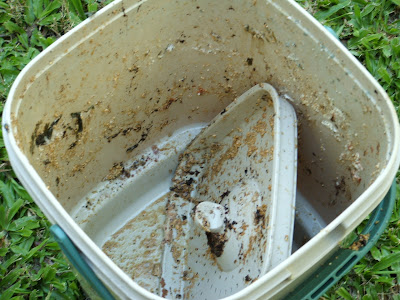
The whole burial process was fairly painless, although I suppose I should have warned you I was going to be showing you filthy pictures. Sorry if you were eating. Rest assured, I've now rinsed the bucket and set it up again. I'll see how I go with emptying it earlier next time.
Hmmm, I think that was an infomercial. They do tend to go on for longer than the main program, don't they?
Speaking of which, I thought I might use this unexpectedly free day to give you an update on my own little patch of nature, the herb-flower-maybe-a-vegetable-or-two garden that I'm trying to establish beneath the stairs outside.
(Let's consider this an ad break in the television six-pack series. The idea of the ad break is one I'd been toying with anyway. I've got a few cooking adventures to share that will fit in well amongst the television discussion if you think of them as reality lifestyle segments or, less charitably--I don't mind--as those infomercials in morning television that take you away from your interest of the main show).
Here's a snapshot of the garden in question:

It's not very impressive looking is it? Well, for someone who isn't much of a gardener, it hasn't exactly been smooth sailing (boom, boom! Hey, Basil Brush would be proud of that one.)
Let me explain. The chives in the strawberry pot pre-existed this dwelling. They've survived the noxious fumes of the Hale Street Bypass, so nothing will kill them, not even me.
I purchased the mint in the yellow planter from the Wednesday markets at work. When I bought it the man who sold them to me asked jokingly if the mint was going to a good home. At the time, I breezily said 'Yes!', thinking 'What can go wrong with mint? It's practically a weed, isn't it?' Well, who knew that all manner of creatures other than myself liked the taste of mint?
One thing I've noticed since moving to this new place is that the kinds of marauding critters here are different to those on the edge of Hale Street. There I thought I was inundated by the annual migration of hairy caterpillars and Bogan Moths, but now, on the edge of Ithaca Creek, those Hale Street critters seem remarkably benign. All sorts of bugs of the creeping, crawling, flying and hopping variety decided to drop by for breakfast, lunch, and tea in the small yellow planter I'd purchased for 50¢ at K-Mart.
I had to go back to K-Mart and get some pyrethrum spray.

I have investigated companion planting, and honestly, I thought that putting the mint near the basil would deter the critters from munching on the basil, and I guess it did, in a fashion, but only because they seemed to like the mint more, and I want to be able to eat the mint too. Where would tabouli be without it? Well, yes, at almost every kebab place--here in Brisbane anyway. (Why just the other week I ordered a kebab from a shopping centre food court and on the menu board they offered tahini as a sauce after which in brackets they had written 'yoghurt and cucumber'. I asked the person serving me to explain the confusing menu choice and he said that tahini was yoghurt and cucumber. I said that tahini was a sesame seed paste and yoghurt and cucumber was closer to tzatziki--still no mint, you'll notice--and his response was that he didn't write the menu. You can imagine what a great kebab that was).
So, the companion planting. That's what the deceptively empty pot on the right hand of the picture up there is an attempt at. There are some calendula seeds getting ready to germinate in there. When did marigolds aka 'stinkin' Rogers' become known as calendula?
I haven't had much luck with raising rocket and parsley seeds either. Here we get to the shameful extent of my lack of gardening ability. I'm trying to grow flat parsley because I like it more than curly parsley, so you can imagine that I was quite chuffed to learn that it's apparently easier to grow than the curly variety. Obviously the folk who make these kinds of pronouncements about things being fool-proof haven't encountered a fool quite like me.Of course, it's all my own fault. I started the garden during a period when we were getting rain almost every day, so I was lulled into a false sense of security about the wellbeing of the seedlings. Then there were a couple of days of excruciating hotness that zapped any life out of the delicate leaves of the parsley. The jury's out on my personal culpability for the demise of the rocket. I know I should have just put the seeds into the ground, but I'd bought these nifty little bio-degradable seedling containers that I wanted to use. I could have just buried the seedling container in the ground when it came to transplanting, but I thought it would be better to separate the plants out, so they had room to grow. Whether it was an effect of the transplanting or the fact that the patch I transplanted them to received perhaps a little too much sun for such delicate leaves, I don't know, but only one of the rocket plants has survived and not terribly well. I've enough rocket to garnish a water cracker, but that would be the end of the plant.
Anyway, I'm slightly deflated, but clearly not enough to be put off the whole enterprise. It seems the lure of fresh herbs and salad greens is too strong. I'll become a gardener by default, as a by product of being an enthusiastic home cook in search of good ingredients.
I've started again. I have new rocket shoots, this time in the ground. I'm waiting for the parsley to rear its delicate fronds. And I've gone one step further and sown some baby beetroot, already their deep pink stems have broken the surface.

I'm also working on creating good nutrient rich soil with the contents of the Bokashi All-food Composting bin. I've managed to mix up some of the liquid that drains off the bin into a fertiliser, and just yesterday, I emptied the bin for the first time since I began filling it and buried the contents which will break down into hummus--definitely not to be confused with hommus.

In closing , a few words about my Bokashi experience. First of all I was fairly concerned that since I knew I wasn't 'an average family' that I would take far longer than 3-4 weeks to fill the bin. In all, judging from the date of my post about setting up the bin, it 's been closer to 6-8 weeks that the bin has been sitting in my cupboard slowly filling. Just writing this now, I realise I could easily have buried the contents, whatever they were, at 4 weeks, but even after the extended period, the bin didn't stink in the way that plain garbage sitting for 6- 8 weeks would. Of course, there is a smell, but it's a sweet, pungent smell, a fermented smell, and it's not one that attracts flies to create their wriggly offspring. After 6-8 weeks, the bin is certainly 'sweeter' than it was at 3-4 weeks, but while it would have been ready to bury earlier, I 'm sure it's more than ready to be buried now. Plus it might turn into hummus a bit sooner. We'll see.

The whole burial process was fairly painless, although I suppose I should have warned you I was going to be showing you filthy pictures. Sorry if you were eating. Rest assured, I've now rinsed the bucket and set it up again. I'll see how I go with emptying it earlier next time.
Hmmm, I think that was an infomercial. They do tend to go on for longer than the main program, don't they?
Saturday, January 26, 2008
Friday
Here at Chez Galaxy, Friday nights could not be more exciting. On the way home from work, I decided to forgo the still novel pleasure of taking the Great Circle Line bus home--have I told you about the incredible view as you go along Stuartholme Road?--and head for my old Friday night pit stop, the Queen Street Mall.
All day, it had been just me and the microfilm machine for company in the Fryer Library, so I think I was craving a bit of human interaction, the bustle of Friday night shoppers, the conversation of retail workers.
I found myself, as I often do, salivating over various gadgets and appliances in a kitchen ware shop. They're all so pretty and shiny. This time I actually decided to purchase something, a 20cm skillet pan that I've been contemplating for at least a year. I'm not much of an impulse buyer. Now I won't have to lug the big frying pan out for small jobs. I'm especially looking forward to those moments when making Indian and Chinese food where they call for toasting various seeds or creating a flavoured oil to pour over the final dish.
Speaking of cooking, here's a blurry photo of an okra and potato dish I made last week:

After leaving the kitchen shop, I used the magics of a phone with an internet connection to look up the location of the new city branch of my favourite eco shop. They'd sent me a catalogue by email and I quite liked the look of a few things, plus since I lost my Sigg water bottle at a gelati counter on Lygon Street in Melbourne, I've been buying and refilling various plastic water bottles, which I really prefer not to do.
I looked at the water bottles, but my aesthetic snobbery got in the way of me buying a replacement. That, and I really want it to fit in the side pocket of my backpack, so I can try to minimise the chances of losing it. Well, I can live in hope. I've always been a bit prone to losing things. I remember when I heard that song that went 'Dancing in the disco, bumper to bumper. Wait a minute, where's me jumper? Where's me jumper? ... And my mother will be so, so angry...' I decided that it was my personal theme song.
Having put off the water bottle until another time, I looked at the magnet picture hangers that seemed to promise hope for renters who like pictures on their walls but aren't allowed to put up hooks or use blu-tack. Unfortunately they still involved double sided tape, but gee, what strong magnets, they could definitely keep the Andy Warhol pictures I drooled over at the GoMA shop in place, without damaging them.
I ended up buying some dish washing liquid, and then, as if to completely mock my earlier proclamation that I'm not an impulse buyer, I decide to get a Bokashi All-Food Compost Kit.
I'd never heard of them before, but just talking to my sister now, she says she's seen them on television.

Anyway, it's this bin you put your food scraps in, between layers of a Bokashi mixture, that's some kind of bacteria. Effectively what happens is that the food scraps get pickled, and after a few weeks of tamping down the bin, getting rid of air pockets, and making sure you put the right ratio Bokashi to food scraps, you can dig a hole in your garden and leave it for about three weeks, upon which time it will have turned into humus, full of nutrients for your garden.

I was a bit excited when I saw it at the eco store because straight away I could see that it was something that a renter could do, and now that I have a small patch of dirt, I also saw that it could help along my fledgling herb garden, which, by the way, was one of my new year's resolutions to establish. Even if I end up with too much pickled garbage, the pamphlet suggests I can give it to my local community garden, and since moving to this new place, I have one that I walk past most days.
I almost made it home for an exciting evening of setting up the Bokashi Kit, but I got waylaid by the bottle shop across from the bus stop and gave in to more traditional Friday night pleasures, treating myself to a Wine Adventure Pack consisting of six small bottles of Margaret River Reds.
See? The adventure never stops here at Chez Galaxy, even the wine attests to the excitementt.
All day, it had been just me and the microfilm machine for company in the Fryer Library, so I think I was craving a bit of human interaction, the bustle of Friday night shoppers, the conversation of retail workers.
I found myself, as I often do, salivating over various gadgets and appliances in a kitchen ware shop. They're all so pretty and shiny. This time I actually decided to purchase something, a 20cm skillet pan that I've been contemplating for at least a year. I'm not much of an impulse buyer. Now I won't have to lug the big frying pan out for small jobs. I'm especially looking forward to those moments when making Indian and Chinese food where they call for toasting various seeds or creating a flavoured oil to pour over the final dish.
Speaking of cooking, here's a blurry photo of an okra and potato dish I made last week:

After leaving the kitchen shop, I used the magics of a phone with an internet connection to look up the location of the new city branch of my favourite eco shop. They'd sent me a catalogue by email and I quite liked the look of a few things, plus since I lost my Sigg water bottle at a gelati counter on Lygon Street in Melbourne, I've been buying and refilling various plastic water bottles, which I really prefer not to do.
I looked at the water bottles, but my aesthetic snobbery got in the way of me buying a replacement. That, and I really want it to fit in the side pocket of my backpack, so I can try to minimise the chances of losing it. Well, I can live in hope. I've always been a bit prone to losing things. I remember when I heard that song that went 'Dancing in the disco, bumper to bumper. Wait a minute, where's me jumper? Where's me jumper? ... And my mother will be so, so angry...' I decided that it was my personal theme song.
Having put off the water bottle until another time, I looked at the magnet picture hangers that seemed to promise hope for renters who like pictures on their walls but aren't allowed to put up hooks or use blu-tack. Unfortunately they still involved double sided tape, but gee, what strong magnets, they could definitely keep the Andy Warhol pictures I drooled over at the GoMA shop in place, without damaging them.
I ended up buying some dish washing liquid, and then, as if to completely mock my earlier proclamation that I'm not an impulse buyer, I decide to get a Bokashi All-Food Compost Kit.
I'd never heard of them before, but just talking to my sister now, she says she's seen them on television.

Anyway, it's this bin you put your food scraps in, between layers of a Bokashi mixture, that's some kind of bacteria. Effectively what happens is that the food scraps get pickled, and after a few weeks of tamping down the bin, getting rid of air pockets, and making sure you put the right ratio Bokashi to food scraps, you can dig a hole in your garden and leave it for about three weeks, upon which time it will have turned into humus, full of nutrients for your garden.

I was a bit excited when I saw it at the eco store because straight away I could see that it was something that a renter could do, and now that I have a small patch of dirt, I also saw that it could help along my fledgling herb garden, which, by the way, was one of my new year's resolutions to establish. Even if I end up with too much pickled garbage, the pamphlet suggests I can give it to my local community garden, and since moving to this new place, I have one that I walk past most days.
I almost made it home for an exciting evening of setting up the Bokashi Kit, but I got waylaid by the bottle shop across from the bus stop and gave in to more traditional Friday night pleasures, treating myself to a Wine Adventure Pack consisting of six small bottles of Margaret River Reds.
See? The adventure never stops here at Chez Galaxy, even the wine attests to the excitementt.
Sunday, January 13, 2008
Flower Power
I think it was Ben, writing at Sarsaparilla recently, who made a comment about being able to recognise a landscape you were familiar with, even when it was presented to you as being another place. He used the example of films and television programmes made in Australia that were set in European countries, so, for example, a corner of Adelaide University could be represented as a building in London circa 1900. If you'd never seen the Adelaide site, you'd be none the wiser, but if you'd encountered that building everyday of your undergraduate career, then you could identify the film maker's sleight.
Reading Ben's post, I recognised my own ability to identify the places and landscapes that have been prominent in my life. This sense of recognition, combined with a slight pang in the gut, is how I could pinpoint the location on display in a slide show at a friend's place recently. On the occasion of her son's first birthday, her husband had set up a computer in the background, showing the first year of E's life. In a sequence from a visit to his maternal grandparents, I could see E before the familiar hills of a distant Great Dividing Range with low dark clouds, hovering over the haze of the blue grey hills, suffocating with their insistent humidity. The surrounding vegetation was densely green, but in the foreground evidence of farm life, partially rusted, corrugated iron sheds and stalks of sugar cane, confirmed that I was looking at somewhere in Far North Queensland, not too far from Cairns. It turned out to be Babinda, a small town about 70kms south of Cairns.
 Click on photo for credit
In October last year, I saw something else that reminded me of the vegetation of my childhood. I was visiting another friend. She was house-sitting at a property at Maleny, in the Sunshine Coast hinterland, just north of Brisbane. It wasn't the surrounding landscape that evoked the visceral reaction that catapulted me back about 25 years, but the plants throughout the house of the somewhat luxurious cottage.

They were orchids, those exquisitely crafted flowers found principally in rain forests, which is where I encountered them, on our annual holidays to Cape Tribulation and the Daintree.
 I remember the first time I saw one in its natural environment. It was growing from the side of a large tree. I identified it as a Cooktown orchid, which is Queensland's floral emblem.
 I was excited to recognise it from my school books and all at once, I felt ridiculously proud that the state floral emblem came from the part of Queensland in which I lived, yet strangely puzzled by the lack of gravitas surrounding the encounter. Stumbling over such an important flower by chance seemed to be missing in the appropriate ceremony.

When I visited C I had to learn the story of the orchids. It turned out they belonged to the gardener and he cultivated them in a greenhouse at the back of the house and when they bloomed, he placed them throughout the house so they could be enjoyed by its owners.

I was awestruck by a weird combination of admiration at such skill (the rest of the garden was pretty spectacular too) and nostalgia for wonderful holidays in such a unique environment.

I remembered walking through rain forests and being lassoed by wait-a-whiles, dropping their spurred ropes to trap unsuspecting passers-by; trying to catch yabbies in rain forest creeks, but never being quite quick enough; daring to eat an unfamiliar berry because it looked so much like a tiny strawberry (luckily, it turned out to be a wild variety); being serenaded, as we made sand castles on the beach, by a tall man known locally as 'cane knife'; walking what seemed like miles to a shop we weren't sure was open, guided only by the marker of a very tall palm tree; and wading through mangroves up to our knees in their muddy stench, ever fearful of encountering a saltwater crocodile.
Reading Ben's post, I recognised my own ability to identify the places and landscapes that have been prominent in my life. This sense of recognition, combined with a slight pang in the gut, is how I could pinpoint the location on display in a slide show at a friend's place recently. On the occasion of her son's first birthday, her husband had set up a computer in the background, showing the first year of E's life. In a sequence from a visit to his maternal grandparents, I could see E before the familiar hills of a distant Great Dividing Range with low dark clouds, hovering over the haze of the blue grey hills, suffocating with their insistent humidity. The surrounding vegetation was densely green, but in the foreground evidence of farm life, partially rusted, corrugated iron sheds and stalks of sugar cane, confirmed that I was looking at somewhere in Far North Queensland, not too far from Cairns. It turned out to be Babinda, a small town about 70kms south of Cairns.
 Click on photo for credit
They were orchids, those exquisitely crafted flowers found principally in rain forests, which is where I encountered them, on our annual holidays to Cape Tribulation and the Daintree.
 I remember the first time I saw one in its natural environment. It was growing from the side of a large tree. I identified it as a Cooktown orchid, which is Queensland's floral emblem.
 I was excited to recognise it from my school books and all at once, I felt ridiculously proud that the state floral emblem came from the part of Queensland in which I lived, yet strangely puzzled by the lack of gravitas surrounding the encounter. Stumbling over such an important flower by chance seemed to be missing in the appropriate ceremony.
When I visited C I had to learn the story of the orchids. It turned out they belonged to the gardener and he cultivated them in a greenhouse at the back of the house and when they bloomed, he placed them throughout the house so they could be enjoyed by its owners.

I was awestruck by a weird combination of admiration at such skill (the rest of the garden was pretty spectacular too) and nostalgia for wonderful holidays in such a unique environment.

I remembered walking through rain forests and being lassoed by wait-a-whiles, dropping their spurred ropes to trap unsuspecting passers-by; trying to catch yabbies in rain forest creeks, but never being quite quick enough; daring to eat an unfamiliar berry because it looked so much like a tiny strawberry (luckily, it turned out to be a wild variety); being serenaded, as we made sand castles on the beach, by a tall man known locally as 'cane knife'; walking what seemed like miles to a shop we weren't sure was open, guided only by the marker of a very tall palm tree; and wading through mangroves up to our knees in their muddy stench, ever fearful of encountering a saltwater crocodile.
Tuesday, April 24, 2007
Water
You have to imagine the title of this post being wailed in the plaintive tones of one Ms Polly Jean Harvey as she sings a song of the same name.
It isn't that the song has anything to do with Brisbane's water crisis but the level of desperation expressed is not dissimilar:

Now that's the kind of toilet humour I like. If you can read the fine print, you'll see that this is the cover of the first edition of a student journalists' magazine. With their careers ahead of them, surely the only way is up?
It isn't that the song has anything to do with Brisbane's water crisis but the level of desperation expressed is not dissimilar:

Now that's the kind of toilet humour I like. If you can read the fine print, you'll see that this is the cover of the first edition of a student journalists' magazine. With their careers ahead of them, surely the only way is up?
Thursday, April 12, 2007
The Four Minute Shower
At the beginning of this week South East Queensland began Level 5 water restrictions in an effort to mete out the ever dwindling water supply. The water needs to last either until we receive a substantial amount of rain, which isn’t looking likely any time soon, or until the water recycling works project is completed, hopefully ahead of schedule. As even the most irreligious amongst us pray for one or both of these eventualities, we are, as a population, collectively coming to terms with the novelty of these most recent water saving measures. I say ‘novelty’ because apparently they had to make the restrictions up; no government in the history of the area has ever had to cope with this combination of long term drought and population growth before.
Since I’m not a gardener, or a car or pet owner, I’ll admit to not really absorbing the details of the restrictions that apply to the water usage associated with those lifestyle accoutrements. (Something about only being allowed to water or wash with teaspoon measures of grey water). While washers of dishes, of which I am one, seem not to have received any particular directive, those who partake of regular showers, of which I am also one, have been appealed to on a nostalgic level: ‘Bring back the 4 minute shower’ is the new catch phrase. I am clearly far too young to have ever heard of ‘the four minute shower’—was it part of the home front effort for the Second World War? Viet Nam?

Nevertheless, I have found myself in a surprising state of readiness to take up this challenge from the SEQ Water Commission. Ever since I became enamoured of the star-shaped shower timers for sale at an eco shop up the road from me, I have been in training for the eventuality of ‘the [mandatory] four minute shower’. I have been flexing my four minute shower taking muscles and I’m working towards becoming a gold medal contender in the four minute shower taking stakes.
At present I am being hindered in attaining my goal due to difficulties encountered in the first stretch of the four minute shower. This is the time during the four minute shower that the water from the hot water tap takes to become hot. I have calculated that at least 20-30 valuable seconds worth of precious water is lost, for no exchange value in terms of cleaning myself, while I make the necessary adjustments to the temperature of the four minute shower.
If I was a gardener I would harness the water lost during this period of the four minute shower into a bucket for irrigating the garden. I do recall there was an invention on The New Inventors that solved the problem of this wasted water, but since I’m in rental accommodation I don’t like my chances of getting the lessor to install any water saving devices. (At this point I should probably not mention my terribly unsound shower head). I am working on solutions that might mitigate this loss of water. Perhaps if I purchase a clean bucket, especially for this purpose, I can tip it into my water filter? I’d have to be careful not to pollute the bucket with soap, lest my pasta begin to taste of suds.
Another hurdle to the timely four minute shower is the need to wash my hair. On the occasions when I have to wash my hair—every two days, since there’s masses of it—I have generally found that I have to reset the four minute shower timer, and I often take another minute or so. I am slowly getting better at this, but meanwhile, I have worked out a kind of exchange system whereby when I have a regular shower I try to be finished before the sand in the timer runs out. In this way, I can accrue shower time to use on those days when, for whatever reason, I exceed the four minute mark.
The four minute shower has been quite a challenge for me. Previously, I have liked to daydream in the shower, or just stand there for what must have been five minutes at a time with the water massaging my scalp and shoulders. But there is no time for dreaming of massages in the four minute shower. None at all. It’s all business. From the moment the water temperature is right, it’s a sprint to the end:
Shower gel. Check. Loofah. Check. Hands. Arms. Underarms. Feet. Calves. Thighs. Torso. Front. Back. Quick. Scrub away dead old skin cells and sweat. Face wash. Check. Forehead. Neck. Décolletage. Plunge my head under the stream of water. It can’t matter if it’s too hot for your face. Must get rid of the soap. Quickly. Taps off! Phew.
Aargh! Still only a silver medal performance.
Since I’m not a gardener, or a car or pet owner, I’ll admit to not really absorbing the details of the restrictions that apply to the water usage associated with those lifestyle accoutrements. (Something about only being allowed to water or wash with teaspoon measures of grey water). While washers of dishes, of which I am one, seem not to have received any particular directive, those who partake of regular showers, of which I am also one, have been appealed to on a nostalgic level: ‘Bring back the 4 minute shower’ is the new catch phrase. I am clearly far too young to have ever heard of ‘the four minute shower’—was it part of the home front effort for the Second World War? Viet Nam?

Nevertheless, I have found myself in a surprising state of readiness to take up this challenge from the SEQ Water Commission. Ever since I became enamoured of the star-shaped shower timers for sale at an eco shop up the road from me, I have been in training for the eventuality of ‘the [mandatory] four minute shower’. I have been flexing my four minute shower taking muscles and I’m working towards becoming a gold medal contender in the four minute shower taking stakes.
At present I am being hindered in attaining my goal due to difficulties encountered in the first stretch of the four minute shower. This is the time during the four minute shower that the water from the hot water tap takes to become hot. I have calculated that at least 20-30 valuable seconds worth of precious water is lost, for no exchange value in terms of cleaning myself, while I make the necessary adjustments to the temperature of the four minute shower.
If I was a gardener I would harness the water lost during this period of the four minute shower into a bucket for irrigating the garden. I do recall there was an invention on The New Inventors that solved the problem of this wasted water, but since I’m in rental accommodation I don’t like my chances of getting the lessor to install any water saving devices. (At this point I should probably not mention my terribly unsound shower head). I am working on solutions that might mitigate this loss of water. Perhaps if I purchase a clean bucket, especially for this purpose, I can tip it into my water filter? I’d have to be careful not to pollute the bucket with soap, lest my pasta begin to taste of suds.
Another hurdle to the timely four minute shower is the need to wash my hair. On the occasions when I have to wash my hair—every two days, since there’s masses of it—I have generally found that I have to reset the four minute shower timer, and I often take another minute or so. I am slowly getting better at this, but meanwhile, I have worked out a kind of exchange system whereby when I have a regular shower I try to be finished before the sand in the timer runs out. In this way, I can accrue shower time to use on those days when, for whatever reason, I exceed the four minute mark.
The four minute shower has been quite a challenge for me. Previously, I have liked to daydream in the shower, or just stand there for what must have been five minutes at a time with the water massaging my scalp and shoulders. But there is no time for dreaming of massages in the four minute shower. None at all. It’s all business. From the moment the water temperature is right, it’s a sprint to the end:
Shower gel. Check. Loofah. Check. Hands. Arms. Underarms. Feet. Calves. Thighs. Torso. Front. Back. Quick. Scrub away dead old skin cells and sweat. Face wash. Check. Forehead. Neck. Décolletage. Plunge my head under the stream of water. It can’t matter if it’s too hot for your face. Must get rid of the soap. Quickly. Taps off! Phew.
Aargh! Still only a silver medal performance.
Friday, March 30, 2007
Poisonous Loathesome Toad
I've been fascinated by the pictures of the toad found in Darwin recently. The frequent descriptions of it as the 'size of a small dog' has me imagining it being carried around in Paris Hilton's handbag, complete with a toady tiara.

More than that fetching picture that I've created for myself, however, I am reminded of growing up in far north Queensland where toads were the bane of one's daily existence.
As a child, I could never understand why a major character in The Wind in the Willows was a toad. That fact put me off enjoying the story in any substantial way, because it seemed such a strange thing to like a toad.
To any one who has been plagued by toads, they are not to be regarded as good-natured, though impulsive, anthropomorphised creatures; they are pestilence and terror.
Once, a friend of my mother's gave my sisters and I a box of clothes she was throwing out. We were very excited by the prospect of something new to wear and so, eagerly, began pulling the clothes out in order to press them against ourselves to check their fit. Before we had any opportunity to see if the clothes suited us, at least three toads leapt out of the box and scattered throughout the house.
As if the unpleasant surprise wasn't traumatic enough--our screams had my mother running to see who had died--then there was the awful task of trying to herd the toads out without actually touching one. (How those toadbusters manage to just pick them up, even with latex covered hands, I don't know. *Shudder*.)
At some point, I must have managed to capture a toad, and so touch one, because in my year 9, maybe 10, biology class we were asked to bring one in for a dissection exercise. It was explained to us that with such a ready supply of toads at hand it would be senseless for the school to source specially bred creatures for dissection. The teacher further suggested that we would be doing the environment a small favour by ridding it of the toads. (A suggestion that many of the boys took to with gusto and their cricket bats.)
So, with the native fauna preservation flag waving, I set about dissecting a toad. I saw its heart still apparently beating. We wondered why some toads were grossly overweight with fingers of fat down their sides. The teacher explained that it was on account of their diet. He predicted that if we opened the fat toad's stomach we would find dog or cat food, while the slimmer toads would have consumed fibrous insects.
That explained yet another daily battle with the toads that took place at my house. I had often shooed them away from the area where our dog fed, but assumed they were after his water. It had never occurred to me they were actually eating Buffy's food. Gross!
Since I moved to Brisbane, I have have rarely seen a toad, for which I am extremely grateful. They are of course in this part of the world, but not so much in the inner city suburbs where I have generally resided. Seeing the Darwin toad has made my skin crawl, no end. Still it's nice to be able to read these days that the kookaburras and crows of Australia have adapted to the poisonous invaders:

More than that fetching picture that I've created for myself, however, I am reminded of growing up in far north Queensland where toads were the bane of one's daily existence.
As a child, I could never understand why a major character in The Wind in the Willows was a toad. That fact put me off enjoying the story in any substantial way, because it seemed such a strange thing to like a toad.
To any one who has been plagued by toads, they are not to be regarded as good-natured, though impulsive, anthropomorphised creatures; they are pestilence and terror.
Once, a friend of my mother's gave my sisters and I a box of clothes she was throwing out. We were very excited by the prospect of something new to wear and so, eagerly, began pulling the clothes out in order to press them against ourselves to check their fit. Before we had any opportunity to see if the clothes suited us, at least three toads leapt out of the box and scattered throughout the house.
As if the unpleasant surprise wasn't traumatic enough--our screams had my mother running to see who had died--then there was the awful task of trying to herd the toads out without actually touching one. (How those toadbusters manage to just pick them up, even with latex covered hands, I don't know. *Shudder*.)
At some point, I must have managed to capture a toad, and so touch one, because in my year 9, maybe 10, biology class we were asked to bring one in for a dissection exercise. It was explained to us that with such a ready supply of toads at hand it would be senseless for the school to source specially bred creatures for dissection. The teacher further suggested that we would be doing the environment a small favour by ridding it of the toads. (A suggestion that many of the boys took to with gusto and their cricket bats.)
So, with the native fauna preservation flag waving, I set about dissecting a toad. I saw its heart still apparently beating. We wondered why some toads were grossly overweight with fingers of fat down their sides. The teacher explained that it was on account of their diet. He predicted that if we opened the fat toad's stomach we would find dog or cat food, while the slimmer toads would have consumed fibrous insects.
That explained yet another daily battle with the toads that took place at my house. I had often shooed them away from the area where our dog fed, but assumed they were after his water. It had never occurred to me they were actually eating Buffy's food. Gross!
Since I moved to Brisbane, I have have rarely seen a toad, for which I am extremely grateful. They are of course in this part of the world, but not so much in the inner city suburbs where I have generally resided. Seeing the Darwin toad has made my skin crawl, no end. Still it's nice to be able to read these days that the kookaburras and crows of Australia have adapted to the poisonous invaders:
Their natural diet consists of mainly insects and small invertebrates as well as small snakes, frogs, lizards, rodents, and the occasional small bird. They have also been known to flip cane toads over and eat the toad’s insides out while cleverly avoiding the toad’s poison sacks.

Saturday, March 03, 2007
Possum Tales
I found this graphic on a site called Brisbane Stories. It was on a page that asked 'What is Brisbane like?'

What an excellent question; I'm glad you're interested. All I can say is it's no mistake that the possum features so prominently on this Council sponsored webpage. In view of recent events I have come up with my own promotional slogan, one that I encourage everyone to use when speaking of theSmart Sunshine State's capital city:
'Welcome to Brisbane! A place where marsupials roam the streets and pop in for a visit at 4am!'
Catchy isn't it? And far more true than 'Beautiful One Day, Perfect the Next' (Oh, will we ever live that one down? At least it doesn't rain anymore, an event that used to ruin many a tourist's bizarre assumption that 'beautiful' and 'perfect' equal 'sunny').
Anyway, here's what happened. I was woken by a noise at 4am. I lay in bed for a minute or two before I thought I should probably just check what the source of the noise was, so I could go back to sleep with a clear mind. I got out of bed without turning on a light, when a dark shape caught my eye up in the right hand corner of the skylight in my ceiling.
 At first I wasn't sure if my bleary eyes were playing tricks on me. Then I had the wherewithal to turn on my bedside lamp and the shadow was revealed as one of these:

I think. It could have been one of these:
I didn't get a great look at its tail, but its face was very dark and its ears were stubby and round rather than long and pointy like the second picture.
We just looked at one another for a few minutes. I realised that the noise had been the possum's claws on the glass louvre. I consoled myself that s/he probably wouldn't come any further into the room, since the only way down would have involved dropping a fair distance onto a pile of defunct appliances. Just in case the possum was contemplating making the leap, I said to it, 'Don't you bring your children in here'. S/he continued to look at me before walking along the length of the skylight and exiting noiselessly through the louvres at the other end.
My friend, Dr. H, has befriended the possums who visit her. They get all sorts of treats, including macadamia nuts from a tree in her back yard. This possum will have to work out how to use the front door if s/he wants any treats from me.
Another friend once told me that her grandmother believed that it was good luck when animals came into your home. This is the biggest critter I've ever had visit me in this flat, and there have been quite a few visitors over the years. I think I'll believe S's grandmother; things must be about to get a whole lot better. Yay!

What an excellent question; I'm glad you're interested. All I can say is it's no mistake that the possum features so prominently on this Council sponsored webpage. In view of recent events I have come up with my own promotional slogan, one that I encourage everyone to use when speaking of the
'Welcome to Brisbane! A place where marsupials roam the streets and pop in for a visit at 4am!'
Catchy isn't it? And far more true than 'Beautiful One Day, Perfect the Next' (Oh, will we ever live that one down? At least it doesn't rain anymore, an event that used to ruin many a tourist's bizarre assumption that 'beautiful' and 'perfect' equal 'sunny').
Anyway, here's what happened. I was woken by a noise at 4am. I lay in bed for a minute or two before I thought I should probably just check what the source of the noise was, so I could go back to sleep with a clear mind. I got out of bed without turning on a light, when a dark shape caught my eye up in the right hand corner of the skylight in my ceiling.
 At first I wasn't sure if my bleary eyes were playing tricks on me. Then I had the wherewithal to turn on my bedside lamp and the shadow was revealed as one of these:
I think. It could have been one of these:

I didn't get a great look at its tail, but its face was very dark and its ears were stubby and round rather than long and pointy like the second picture.
We just looked at one another for a few minutes. I realised that the noise had been the possum's claws on the glass louvre. I consoled myself that s/he probably wouldn't come any further into the room, since the only way down would have involved dropping a fair distance onto a pile of defunct appliances. Just in case the possum was contemplating making the leap, I said to it, 'Don't you bring your children in here'. S/he continued to look at me before walking along the length of the skylight and exiting noiselessly through the louvres at the other end.
My friend, Dr. H, has befriended the possums who visit her. They get all sorts of treats, including macadamia nuts from a tree in her back yard. This possum will have to work out how to use the front door if s/he wants any treats from me.
Another friend once told me that her grandmother believed that it was good luck when animals came into your home. This is the biggest critter I've ever had visit me in this flat, and there have been quite a few visitors over the years. I think I'll believe S's grandmother; things must be about to get a whole lot better. Yay!
Sunday, June 25, 2006
Dry New World
I braved a family outing yesterday. I was lured by the charms of the adorable Hannah to get in a car with my mother and sister, V, and go up the range to Toowoomba.
Now Toowoomba may once have been known as the Garden City, with the annual Carnival of Flowers the mainstay of its tourist attractions, but the ongoing drought in South East Queensland has put an end to the possibility of, if not the ongoing colonial yearning for, the flora of Victorian England.
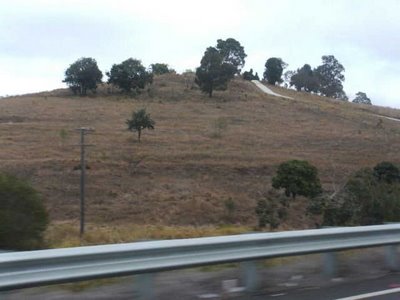 These photos were taken in the Lockyer Valley, which is at the base of the Toowoomba range.
 The landscape is usually verdant and green.
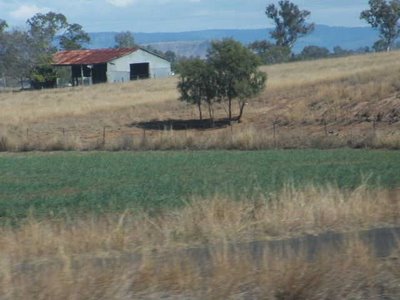 The city of Toowoomba itself looks pretty much the same. They’ve been on Level Four water restrictions for a while, so no-one has been able to water their gardens, even with buckets. They’re all preparing to enter into Level Five restrictions in August. There will be no washing of pets then, apparently. All the more reason to get a cat, a species who can look after such things for themselves. Stinky dogs will abound.
Of course, the stench of unwashed canines will be the least of their problems. The local council is eager to volunteer the town and its people as guinea pigs in the establishment of the world’s largest sewage water recycling treatment plant. A referendum will be held for the citizens to vote on whether they would like to drink the water produced from this plant. Perhaps the town’s new slogan could be: ‘Eat Shit!’ Do you think the tourists will still visit?
My sister, F, and her husband J are against the council’s proposition. They are cynical about the glossy brochures that promote the scheme, which they have been receiving in their letterbox. J is familiar with all that is involved in maintaining the proper working of industrial processing equipment and machinery, and he knows how inevitable cost-cutting is, as well the consequences of such measures for any adherence to safe operations. He added ‘And Die!’ to my slogan suggestion.
F is completely appalled that the proposed process—reverse osmosis—does not remove hormones from the sewage water and that the council would gloss over the health implications of the population ingesting them en masse. She points to the installation of dual reticulation plumbing as a much better alternative.
From what I could gather, I can’t understand why the Toowoomba council is pushing the scheme so far as to include drinking, cooking and bathing water. I would have thought that the amount of water consumed indoors was a fraction of that used in laundering and outdoors. Why virtually ensure a ‘No’ vote at the expense of a range of other, obviously valuable and safe, uses of the recycled water?
J says that regardless of whether the people vote ‘Yes’ or not the plant will go ahead and the water will be used for irrigation and other non-domestic purposes. That doesn’t seem like such a bad idea. Still, it wouldn’t hurt to have some partial uptake of the recycled water in the home. Perhaps the council should recognise the legitimate concerns for their health and well-being that citizens have and seek a compromise that uses education to communicate their aims, rather than blindly marketing an intractable position?
Just a thought.
Now Toowoomba may once have been known as the Garden City, with the annual Carnival of Flowers the mainstay of its tourist attractions, but the ongoing drought in South East Queensland has put an end to the possibility of, if not the ongoing colonial yearning for, the flora of Victorian England.
 These photos were taken in the Lockyer Valley, which is at the base of the Toowoomba range.
 The landscape is usually verdant and green.
 The city of Toowoomba itself looks pretty much the same. They’ve been on Level Four water restrictions for a while, so no-one has been able to water their gardens, even with buckets. They’re all preparing to enter into Level Five restrictions in August. There will be no washing of pets then, apparently. All the more reason to get a cat, a species who can look after such things for themselves. Stinky dogs will abound.
Of course, the stench of unwashed canines will be the least of their problems. The local council is eager to volunteer the town and its people as guinea pigs in the establishment of the world’s largest sewage water recycling treatment plant. A referendum will be held for the citizens to vote on whether they would like to drink the water produced from this plant. Perhaps the town’s new slogan could be: ‘Eat Shit!’ Do you think the tourists will still visit?
My sister, F, and her husband J are against the council’s proposition. They are cynical about the glossy brochures that promote the scheme, which they have been receiving in their letterbox. J is familiar with all that is involved in maintaining the proper working of industrial processing equipment and machinery, and he knows how inevitable cost-cutting is, as well the consequences of such measures for any adherence to safe operations. He added ‘And Die!’ to my slogan suggestion.
F is completely appalled that the proposed process—reverse osmosis—does not remove hormones from the sewage water and that the council would gloss over the health implications of the population ingesting them en masse. She points to the installation of dual reticulation plumbing as a much better alternative.
From what I could gather, I can’t understand why the Toowoomba council is pushing the scheme so far as to include drinking, cooking and bathing water. I would have thought that the amount of water consumed indoors was a fraction of that used in laundering and outdoors. Why virtually ensure a ‘No’ vote at the expense of a range of other, obviously valuable and safe, uses of the recycled water?
J says that regardless of whether the people vote ‘Yes’ or not the plant will go ahead and the water will be used for irrigation and other non-domestic purposes. That doesn’t seem like such a bad idea. Still, it wouldn’t hurt to have some partial uptake of the recycled water in the home. Perhaps the council should recognise the legitimate concerns for their health and well-being that citizens have and seek a compromise that uses education to communicate their aims, rather than blindly marketing an intractable position?
Just a thought.
Subscribe to:
Posts (Atom)